The Inventions of Oil is a CBC Edmonton series about oil and gas innovations hidden in our everyday lives.
Deep in south Edmonton, a driller carefully manoeuvres his rig while a steerhand follows the route of the drill on a computer screen as it navigates its way underground.
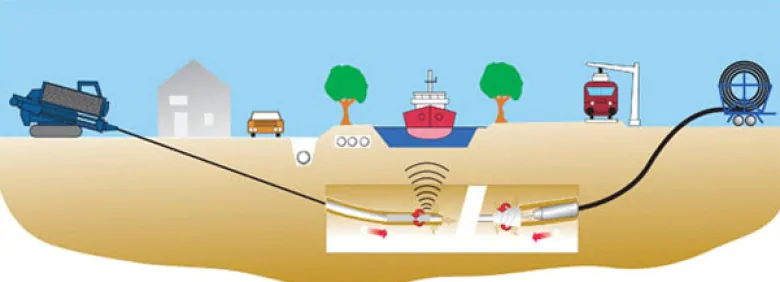
They can’t physically see which path the bore is taking. Instead, sonar technology keeps the drill bit clear of any obstructions along the way.
“If you could X-ray and look at the ground there’s more traffic underground than you would think — more gas lines, more power lines, more fibre optic,” said Blain Bourdages, owner of Ironman Directional Boring.
His company works with gas, water and telecommunication companies, installing lines around the city using horizontal directional drilling: a technique first developed in the oil and gas industry, but has become standard for underground construction in cities.
Bourdages entered the business in 2009 when directional drilling was new to the construction industry in Edmonton. Since then dozens of companies like his have joined him.
“Instead of digging stuff up we drill past it,” he said. “That’s why, it was — and it still is — the hot way to get things done.”
Rather than digging a trench, HDD technology uses a drill bit with high-pressure water to drill under a road, sidewalk or parking lot.
Evidence of a trench can be seen near Bourdages’s worksite, a seam of blacktop running the width of a street where lines were replaced a few years earlier.
That job would have taken days or weeks, Bourdages said, but directional drilling can do the same work in one day.
“I liken it a lot to open-heart surgery versus angioplasty,” said Sam Ariaratnam, an engineering professor at Arizona State University who began researching HDD in the 1990s at the University of Alberta.
“With open-heart surgery it’s like open-cut construction,” he said, “it takes some time to recover and there’s the scar.”
HDD is similar to angioplasty where an incision is made with as little disruption as possible and the patient is back up and running the next day, Ariaratnam said.
Crossing a river underground
Slant drilling dates back to the early days of the oil industry.
Remember the scene in the movie There Will Be Blood when Daniel Day Lewis yells, “I drink your milkshake”? He’s talking about slant drilling albeit in a much cruder form.
But it wasn’t until late in the 20th century that drillers found ways to guide and change the course of a drill underground with the level of accuracy needed for municipal construction.
In 1971, Martin Cherrington, the owner of a utility company in California, was contracted by a gas company to solve a problem. The company needed to install a four-inch gas line underneath a river.
Cherrington used a drill to bore under the river without digging or trenching. At the time, there was still guess-work involved, as there was no precise way to track the drill underground, but the effort spawned horizontal directional drilling.
By the 1980s, technology allowed companies to use magnetic sensors or sonar to guide the drill as it bored underground.

With the advent of fibre-optic technology, there came a booming demand for HDD, Ariaratnam said.
“I moved to Edmonton in 1996 and I got my first cell phone in 1996,” he said.
“We started putting these broadband networks all over the world [and] all of these are being done in urban centres.
“Horizontal directional drilling is a great way to do it.”
Bigger cities, more demand
Bourdages’s company is busy in the summer doing work for companies like Epcor and Telus installing and replacing utility lines and fibre optics.
Telus has spent $3 billion in Alberta since 2013 connecting communities to its fibre-optic network and has pledged to spend $16 billion more.
AltaGas and ATCO Gas plan to eventually replace the steel pipes with plastic.
“There’s so much activity that a lot of the homeowners are coming out saying, ‘Why are you digging up my yard!'” Bourdages said.
“Once you explain what’s going on, they calm right down.
“Here’s your options,” Bourdages said. “We can have a bucket hoe dig across your yard or we can make two small holes, shoot across it, and then you can keep your nice Kentucky bluegrass.”
Bourdages said HDD has transformed the industry in the last 10 years.
“It seems like everywhere you look there’s someone new with a drill,” he said, ” The technology is out there and guys are scooping it up.”