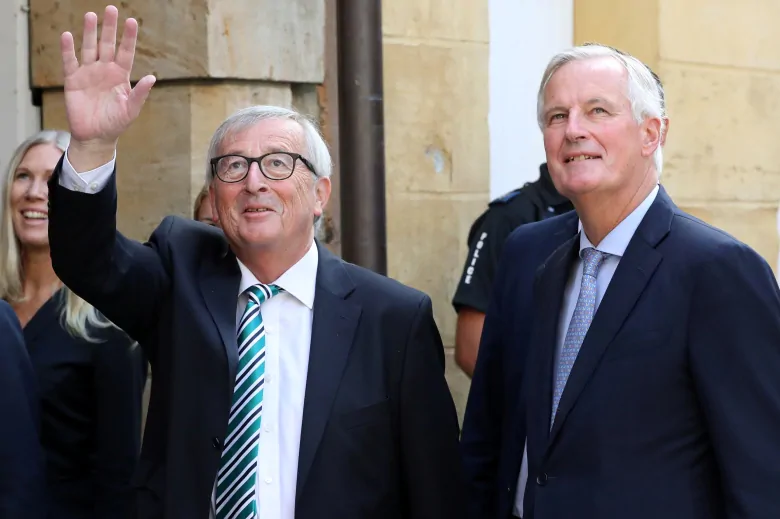
U.K. Prime Minister Boris Johnson and European Commission President Jean-Claude Juncker agreed Monday to ramp up talks on securing an elusive Brexit deal, but the two sides gave starkly different assessments of how far apart they are.
The two men held their first face-to-face talks over a two-hour lunch in Juncker’s native Luxembourg amid claims from the U.K. — though not from the EU — that an agreement is in sight.
Johnson’s Downing St. office said “the leaders agreed that the discussions needed to intensify and that meetings would soon take place on a daily basis,” with EU chief negotiator Michel Barnier and U.K. Brexit Secretary Steve Barclay getting involved in the talks.
Downing St. called Monday’s meeting “constructive.”
The European Commission, however, said Britain had yet to offer any “legally operational” solutions to the problem of keeping goods and people flowing freely across the Irish border, the main roadblock to a deal.
“President Juncker underlined the commission’s continued willingness and openness to examine whether such proposals meet the objectives of the backstop” — the Irish border provision rejected by British lawmakers.
“Such proposals have not yet been made,” the European Commission said, adding that officials “will remain available to work 24/7.”
Luxembourg Prime Minister Xavier Bettel lashed out at Johnson on Monday for failing to propose serious alternatives to unlock a Brexit deal before the Oct.31 divorce date and seeking to blame the bloc for the “nightmare.”
“Don’t make the EU the bad guy,” Bettel told journalists after talks with Johnson.
‘Friendly’ encounter
Johnson says the U.K. will leave the EU on the scheduled date of Oct. 31 with or without a Brexit divorce deal. But he insists he can strike a revised agreement with the bloc in time for an orderly departure. The agreement made by his predecessor, Theresa May, was rejected three times by Britain’s Parliament, prompting her to resign.
Johnson said in a Daily Telegraph column Monday that he believes “passionately” that a deal can be agreed and approved at a summit of EU leaders on Oct. 17-18.
While the EU says it is still waiting for firm proposals from the U.K., Johnson spokesman James Slack said Britain had “put forward workable solutions in a number of areas.”
He declined to elaborate, saying it was unhelpful to negotiate in public.
After the meeting Monday Juncker simply called the encounter “friendly.”
The key sticking point is the “backstop,” an insurance policy in May’s agreement intended to guarantee an open border between EU member Ireland and the U.K.’s Northern Ireland. That regarded as is vital both to the local economy and to Northern Ireland’s peace process.
British Brexit supporters oppose the backstop, because it keeps the U.K. bound to EU trade rules, limiting its ability to forge new free trade agreements around the world after Brexit.
Britain has suggested the backstop could be replaced by “alternative arrangements,” such as a mix of technology to replace border checks and a common area for agricultural products and animals covering the whole island of Ireland, but the EU says it has yet to hear any workable suggestions.
Brexit deadline nears
Monday’s meeting kicked off a tumultuous week for Johnson, with the Brexit deadline just 45 days away.
On Tuesday, Britain’s Supreme Court will consider whether Johnson’s decision to suspend the British Parliament for five weeks was lawful, after conflicting judgments in lower courts.
Johnson sent British lawmakers home until Oct. 14, a drastic move that gives him a respite from rebellious lawmakers determined to thwart his Brexit plan.
Last week, Scotland’s highest civil court ruled the prorogation illegal because it had the intention of stymieing Parliament. The High Court in London, however, said it was not a matter for the courts.
If the Supreme Court overturns the suspension, lawmakers could be called back to Parliament as early as next week.
Many lawmakers fear a no-deal Brexit would be economically devastating, and are determined to stop the U.K. from crashing out of the bloc on Oct. 31.
Just before the suspension, Parliament passed a law ordering the government to seek a three-month delay to Brexit if no agreement has been reached by late October.
Johnson reiterated Monday that he will not seek a delay under any circumstances, though it’s not clear how he can avoid it.
Foreign Secretary Dominic Raab said Monday the government would obey the law, but suggested it would try to find loopholes.
“I think the precise implications of the legislation need to be looked at very carefully,” he told the BBC. “We are doing that.”