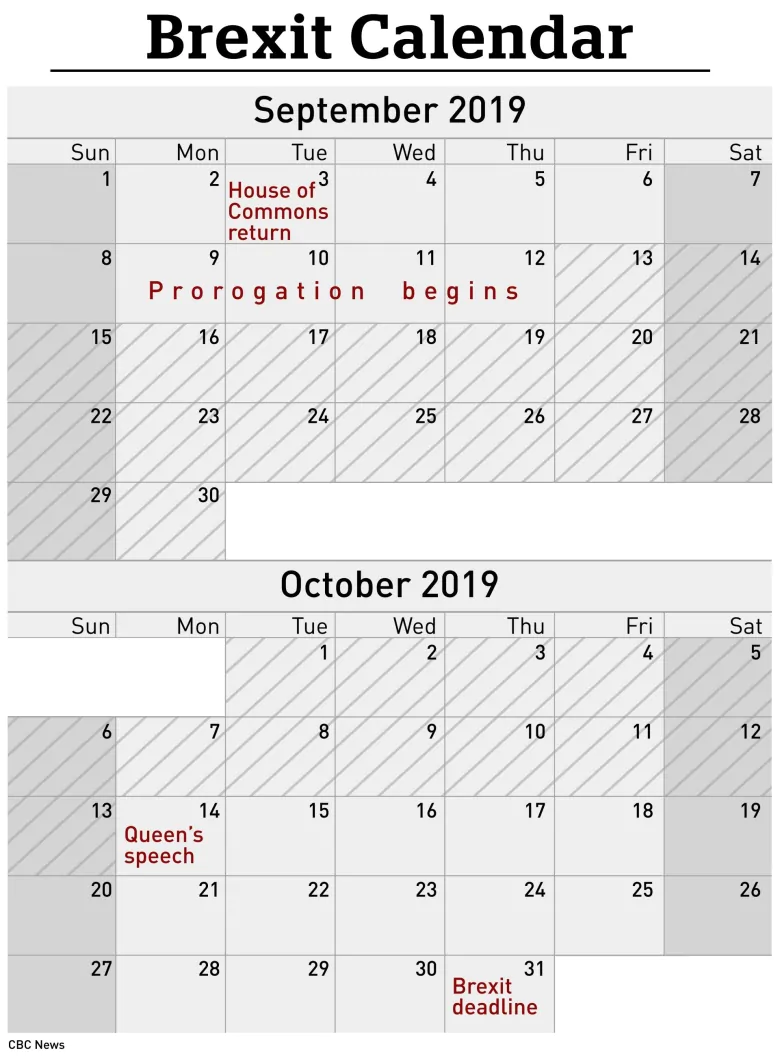
British Prime Minister Boris Johnson’s decision to suspend parliament for over a month before Brexit is being challenged by three court cases that will be heard over the next month.
Johnson announced this week he will suspend Britain’s parliament for more than a month ahead of an Oct. 31 Brexit deadline, enraging opponents and raising the stakes in the country’s most serious political crisis in decades.
Former British Prime Minister John Major has asked to join legal action to try to block Johnson’s move.
Break: Sir John Major joins legal action against Boris Johnson to try to stop him proroguing. Tory party at full blown legal war with itself. <a href=”https://t.co/TPNy9IqsyR”>pic.twitter.com/TPNy9IqsyR</a>
—@tnewtondunn
Major, prime minister from 1990 to 1997, said he would join anti-Brexit campaigner Gina Miller in pursuing a judicial review of the order to close parliament from mid-September to mid-October.
“In view of the imminence of the prorogation and to avoid duplication of effort, and taking up the Court’s time through repetition. I intend to seek the Court’s permission to intervene in the claim already initiated by Gina Miller, rather than to commence separate proceedings,” Major said.
“If granted permission to intervene, I intend to seek to assist the court from the perspective of having served in government as a minister and prime minister,” he said in a statement.
Miller’s attempt to block Johnson will be heard by a court on Sept. 5.
Court hearing re <a href=”https://twitter.com/BorisJohnson?ref_src=twsrc%5Etfw”>@BorisJohnson</a> proroguing Parliament will be heard next Thursday 5th September. I will be adjoined by Sir John Major.
—@thatginamiller
Miller successfully challenged the government in 2017 over its authority to leave the EU without a vote in parliament.
A legal bid to force Johnson to reverse his plans to suspend Parliament was also launched in Belfast on Thursday.
The case has been taken up by Raymond McCord, a rights activist who also launched a 2016 challenge to block Britain’s exit from the European Union. He said he fears a no-deal Brexit could wreck the Northern Ireland peace process.
The action is part of a wider legal action already launched by McCord against any withdrawal from the EU without a deal.
His legal team has argued in court that a no-deal Brexit would breach the 1998 Good Friday Agreement and that the use of prorogation was unconstitutional.
Scottish court rejects interim block
Meanwhile, a Scottish court on Friday rejected a request to place an interim block on Johnson’s decision said it would hear full arguments next week, a lawmaker who brought the case said.
Joanna Cherry, a British lawmaker who brought the action, said the decision was not on the merits of the case and that the court showed a willingness to hear full arguments.
The British government said it was pleased that a Scottish court had decided not to grant an interim injunction against Johnson’s decision.
“We are glad the court found against the interdict – there was no good reason to seek one, given the full hearing is due to take place next week, and the process of bringing the session to an end will not start until the week commencing 9 September,” a government spokeswoman said in a statement.
“As we have set out, the government needs to bring forward a strong domestic legislative agenda, and Members of Parliament are not prevented from scrutinizing our withdrawal from the EU.”
One month no-deal dress rehearsal

France will test run measures it has prepared for Britain’s exit from Europe for a month so that companies are fully prepared ahead of Britain leaving the bloc at the end of October, its minister in charge of customs said on Friday.
Gerald Darmanin will meet Michael Gove, the British minister in charge of coordinating no-deal Brexit planning, in Calais later on Friday to show how France is preparing for Britain’s departure.
Businesses have been warning of long lineups for lorries transporting goods between mainland Europe and Britain, and the British government has said most goods from the EU will be allowed into Britain without full customs checks for at least three months if there is a no-deal Brexit.
“For a month we will act as if there is Brexit for a large number of companies. We’re going to put in place a sort of general rehearsal so that we are ready at the end of October,” Darmanin told RTL radio.
Some 700 extra customs officers have been drafted in and authorities will also introduce online border declarations forcing companies to announce their goods prior to arriving at the border.
“There will be barcodes and numbered plates or merchandise … and without stopping at the border, your goods will go directly to Britain. There will be no queues of tens and tens of kilometres,” Darmanin said.
France is the EU’s biggest agricultural producer and exports large amounts of wine, spirits and dairy products to Britain, while relying on its neighbours’ waters to sustain its fishing industry.