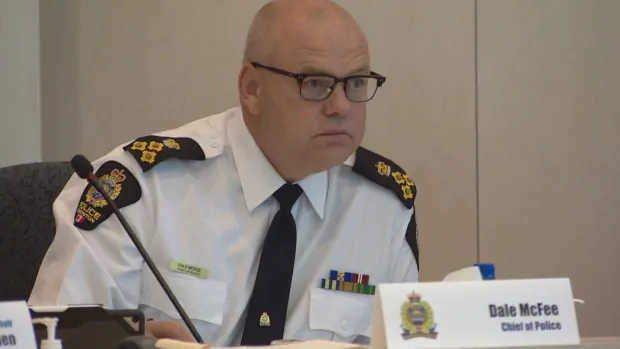
Emphasizing response times and striving to meet them does little to help officers reduce the city’s crime rate, says Edmonton’s police chief.
“What is the impact of call response times on actually reducing crime? Probably not a lot,” Chief Dale McFee said Thursday.
McFee also questioned the usefulness of using average call times as a benchmark, as every call made to police is different.
“The relevance of it — there isn’t any.”
The Edmonton Police Service presented a report outlining response times at Thursday’s police commission meeting.
The report showed call volume has risen by almost four per cent in the first six months of 2019, compared to the same period in 2018. This equates to police responding to about 3,000 more calls this year over last.
Officers are expected to respond to the highest priority calls within seven minutes, a goal that was achieved 70 per cent of the time, the report said.
Overall, police officers were able to respond to calls within their targets 63 per cent of the time, a two-per-cent drop compared to the year before.
But such targets are meaningless, McFee said, and the report doesn’t examine why officers are struggling to quickly respond to calls.
“If you have an emergency and we’re not there as quick as we can or if there’s a delay, I want to know why.”
We should look at … how it actually makes the city of Edmonton safer. I think that should be our first concern, not how quick we get there.– Chief Dale McFee
Factors such as construction projects that impede traffic flow are not taken into account, he said.
“Do you think we’re going to get there as quick? And what is the relevance of that?”
Tracking response time is important but the police service needs to look at what exactly is being measured, said McFee.
“We should look at every individual difference, not the average,” he said. “And how it actually makes the city of Edmonton safer. I think that should be our first concern, not how quick we get there.”
The EPS is currently conducting a service-wide review of its operations in order to establish a new strategic plan.
One thing to consider is whether police officers should be dispatched to low-priority calls such as public disorder, McFee said, or if a partner agency could take on that responsibility.
“The reality is, the justice response for some of the social issues that we have in the city isn’t the right response.”
Officers were only able to hit the three-hour target for low-priority calls 49 per cent of the time, the report indicated.
The new strategic plan will consider if police resources can be allocated in a different way to increase efficiency, McFee said.
“We need to add the right expertise, and the right skill set, in the right areas to actually have an impact that’s measurable, to reduce our calls for service, and ultimately reduce our crime,” he said.
“Response times doesn’t do that.”