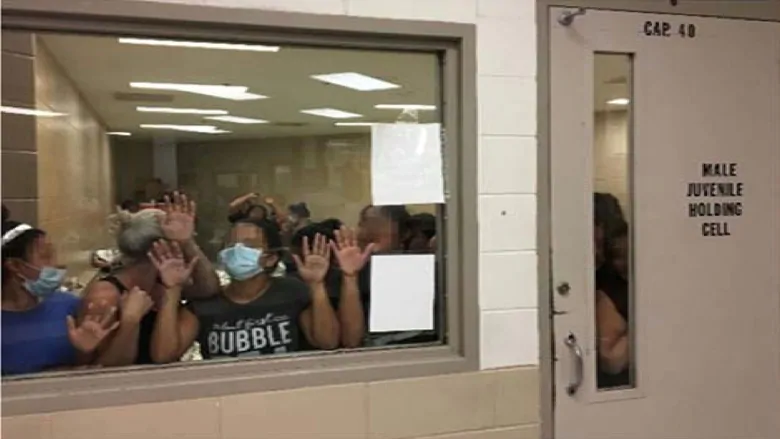
U.S. government investigators warned of dangerous overcrowding at more migrant facilities on the southwest U.S. border, publishing photos on Tuesday of packed cells in the Rio Grande Valley of south Texas where some children have no access to showers or hot meals.
A report issued by investigators for the Department of Homeland Security said supervisors raised concerns for the health and safety of detainees and agents, warning the overcrowding represented a “ticking time bomb.”
The DHS watchdog issued the report after visits to five U.S. Customs and Border Protection (CBP) agency facilities in the Rio Grande Valley area during the week of June 10. The photos provided in the report were digitally manipulated to obscure the faces of the detainees.
It came as U.S. President Donald Trump’s administration pushed back against criticism of its migrant detention centres on the U.S.-Mexico border.
Conditions at the centres have been a flashpoint since May, when the watchdog warned of similar conditions at facilities in the El Paso, Texas sector, west of the Rio Grande Valley, with migrants held for weeks instead of days and adults kept in cells with standing room only.
Security incidents among men at facilities in the Rio Grande Valley included detainees clogging toilets in order to be released from cells, migrants refusing to return to cells, and special operations teams brought in to show that Border Patrol was prepared to use force, the report on Tuesday said.

Migrants banged on cell windows and shouted when investigators visited. Most single adults had not had a shower despite several being held as long as a month. One photo showed a man in a packed cell holding a message reading. “Help 40 Day[s] Here.”
Report details potential violations of federal law
The Rio Grande Valley is the busiest area of the border for migrant arrests, which hit a 13-year monthly high in May during a surge in the arrival of Central American families. At the time of the investigators’ visits, U.S. Border Patrol was holding some 8,000 detainees in custody in the Rio Grande Valley sector, with 3,400 held longer than the 72 hours permitted.
The Democratic chair of the House of Representatives committee on oversight and reform said the panel had invited the acting heads of the Department of Homeland Security and CBP to testify on July 12 on the administration’s border policies, including the conditions of children at detention centres.
Trump has made a crackdown on illegal immigration a centrepiece of his domestic policy agenda and 2020 re-election bid. But his efforts to build a wall on the southern border have been blocked in Congress, and he was forced last year to backtrack after his “zero tolerance” border policy of separating migrant children from their parents provoked widespread outrage.

Pediatricians called again on border authorities to accept their offer to provide volunteer medical care to migrants in detention. CBP rejected the offer.
Roger Maier, a CBP spokesperson, said anyone who needs medical attention beyond what government and contract staff can provide is taken to a local hospital.
The Border Patrol made 132,887 apprehensions in May, including 84,542 adults and children travelling together. With long-term facilities for adults and children at capacity, U.S. President Donald Trump’s administration has said it has to hold people in unsuitable Border Patrol facilities for much longer than the 72 hours normally allowed by law.
Auditors from the Department of Homeland Security’s inspector general visited five facilities and two ports of entry in Rio Grande Valley. The dangers were recently illustrated in images shared around the world that showed a father and his toddler daughter, who both drowned trying to enter the U.S. by crossing the Rio Grande.
The report details several potential violations of federal law or Border Patrol standards:
- Two facilities inspected had not provided children access to hot meals until the week that auditors arrived. Some adults were only receiving bologna sandwiches, causing constipation and in some cases requiring medical attention.
- Of 2,669 children detained by the Border Patrol in the region, 826, or 31 per cent, had been held there longer than 72 hours. More than 50 children under age 7 were waiting to be moved to long-term facilities, some of them for more than two weeks. In one photo, women and children appeared to be sleeping on the ground under Mylar (thermal) blankets.
- Many adults hadn’t showered despite having been held for as long as a month. Some were being given wet wipes to clean themselves.