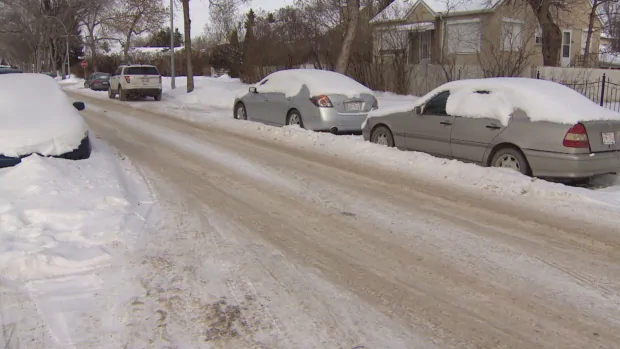
Edmontonians may see better snow and ice control on residential roads this winter, with wider driving lanes and partial parking bans.
The measures are being considered as part of a potential residential-roads pilot project, according to a report going to council’s community and public services committee on June 26.
City officials are providing news media with a technical briefing on the report Wednesday afternoon.
The document provides an update on the city’s snow and ice control pilot project.
It includes preliminary research results into costs and benefits of focusing on safety and bare-pavement conditions. It also provides summaries of feedback gathered from the public, city staff and other stakeholders including the Edmonton Police Service, Edmonton Transit and the Alberta Motor Association.
“Overall, the public expressed concern that the quality of the winter road maintenance program in residential areas has decreased in recent years,” the report says.
People surveyed by the city said they want:
- Greater focus on snow removal and maintaining full driving lanes, especially on larger roads.
- More attention on sidewalks — enforcing existing rules and having the city hold itself to the same standards it expects of citizens.
- Mandatory parking bans in residential areas, with “tag and tow” or using odd/even house numbers to designate parking.
- Providing a bigger budget to the program as the city grows.
- Better communication and education about the program.
Wider winter driving lanes
A residential pilot program would achieve wider winter driving lanes by creating “windrow free zones,” the report says. But getting down to bare pavement on residential roads by using salt and brine would not be a priority.
Administration will also consider a trial program to improve winter walking in the city, through a community equipment sharing program, a volunteer program for sidewalk clearing, and “reprioritizing select walkways.”
Edmonton has about 12,000 “lane kilometres” of roads, and in 2018 spent $66 million on winter roadway maintenance.
The report details some of the benefits and downsides of the city’s current snow and ice control measures, including anti-icing, de-icing, sand, salt and plowing.
“These tools need to be adaptive to respond to the impacts of climate change, including more freezing rain and temperature fluctuations,” the report says.
Materials used in 2018/19 included 42,000 tonnes of salt, 49,000 tonnes of sand, 617,000 litres of calcium-chloride brine and more than 8,000 plow blades.
Calcium chloride use was down significantly from the previous winter, when the city used nearly 4.7 million litres of brine on roadways. Salt use was up slightly from 2017/18, when 37,000 tonnes was used.
The focus for 2018/19 was on using “the right tool for the right conditions” to achieve bare pavement, the report says.
Preliminary environmental monitoring shows anti-icer and de-icer materials “have no apparent impact on stormwater discharged into the North Saskatchewan River,” it adds.
Seven claims were made to the city for property and vehicle damages caused by de-icing in 2017 and 2018, but none of them were validated, the report says.
Next report in August
A follow-up report is expected in August, with detailed results from lab and field research on the benefits and trade-offs of the pilot program on road safety, infrastructure and the environment.
Research outlined in the two reports “will inform any potential changes to the [snow and ice control] policy and program for next winter,” the city says.
Next week’s meeting will also see a report showing that in the period from Oct. 1, 2018 until March 31, 2019, the city’s 311 service fielded 34,547 inquiries related to snow and ice.
Nearly 6,900 calls were about bylaw enforcement, more than 10,000 were about sanding, 8,500 were about snow clearing and 5,400 were about windrows.