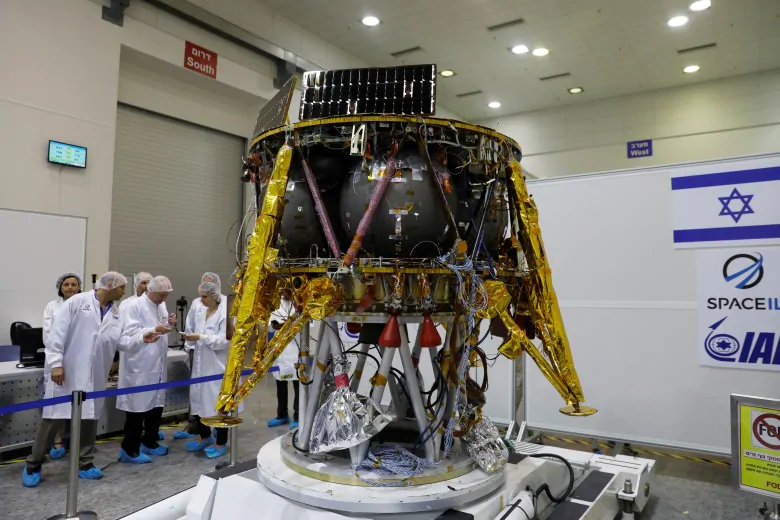
Israeli spacecraft Beresheet made its final maneuver ahead of a planned descent to the moon on Thursday, which, if successful, will propel Israel into an elite group of countries that have mastered the lunar landing.
The unmanned robotic lander dubbed Beresheet — Hebrew for the biblical phrase “in the beginning” — has travelled through space for seven weeks in a series of expanding orbits around Earth before crossing into the moon’s gravity last week.
The final manoeuvre brought the spacecraft into a tight elliptical orbit around the moon, just 15 to 17 kilometres from the surface at its closest. The landing is set to begin late on Thursday, with touchdown expected around 3:25 p.m. ET (10:25 p.m. Israeli time), the Israeli space team said.
[embedded content]
Potential member to elite lunar club
So far, only three other nations have carried out controlled “soft” landings of spacecraft on the lunar surface — the United States, the former Soviet Union and China.
The U.S. Apollo program tallied six manned missions to the moon — the only ones yet achieved — between 1969 and 1972, and the United States and Soviets conducted a total of about a dozen more robotic landings between them. China made history in January with its Chang’e 4, the first craft to touch down on the far side of the moon.
If successful, Beresheet would also make the first lunar landing by a craft not from a government program. It was built by Israeli non-profit space venture SpaceIL and state-owned defence contractor Israel Aerospace Industries, with $100 million US furnished almost entirely by private donors.
The details
Shaped like a round table with four carbon-fibre legs, Beresheet stands about 1.5 metres tall. It blasted off from Cape Canaveral in the United States on February 21 on a SpaceX Falcon 9 rocket and entered Earth’s orbit about 34 minutes after launch.
Israeli scientists stand next to unmanned spacecraft, Beresheet. The $100 million project was furnished almost entirely by private donors. (Ronen Zvulun/Reuters)
At launch it weighed 585 kilograms, most of which was fuel burned during its circuitous flight path of around 6.5 million kilometres. A direct route from the Earth to the moon covers roughly 386,000 kilometres.
Excitement was high over the lunar mission in Israel, where it has been discussed in schools and promoted on television.
[embedded content]