The Conservative government has not offered concrete changes to its Brexit plans during several days of talks aimed at finding a compromise, says British Labour Party Leader Jeremy Corbyn.
Technical talks between officials from the government and opposition Labour Party on finding a compromise on a Brexit deal resumed on Monday.
Corbyn said talks between Labour and U.K. Prime Minister Theresa May’s Conservative-led government will continue, but “we are looking for movement.”
He said “the government doesn’t seem to be moving off its original red lines.”
Earlier, Labour’s Brexit point man Keir Starmer said the two sides had not found a way forward on reaching an agreement on a divorce deal. The U.K. was scheduled to leave the EU on March 29, but was given an extension as political battles over exactly how Britain would depart continued in London.
The deal May negotiated with the EU has been voted down in Parliament three times and faces strong opposition — from outside her party and from within.
If the EU refuses to acquiesce to May’s request for another delay on Wednesday, Britain faces a sudden and chaotic departure on Friday — the Brexit extension deadline previously set by the EU.
Guarantees against ‘no-deal’ Brexit
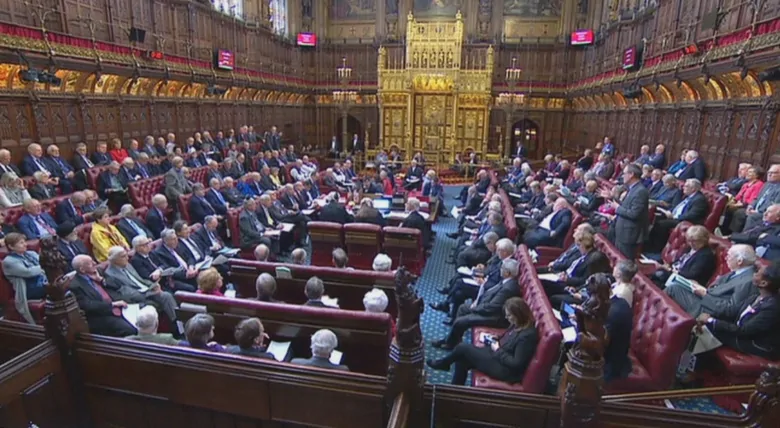
Britain’s upper house of Parliament was expected to pass a law later on Monday that will force May to seek a delay to Brexit.
Although May has already requested an extension to Britain’s EU membership until June 30, lawmakers want additional legal guarantees against a “no-deal” exit and have torn up convention by driving their own piece of legislation through Parliament against the prime minister’s will.
The bill passed through the lower chamber, the House of Commons, by a single vote last week and is now in the House of Lords, an unelected body whose role is to refine and scrutinize legislation before it is approved. It must pass both houses to become law.
The House of Lords, pictured during a previous sitting, is expected to pass a law compelling British Prime Minister Theresa May to seek a delay to Brexit. (Reuters TV)
Despite attempts by pro-Brexit peers to filibuster the bill’s progress last week, Lords resumed the debate on Monday, with the expectation that it would be approved later in the day.
It will then need to be returned to the Commons for final approval — which could bring further attempts to block it by Brexit-supporting lawmakers — before it is formally brought into force by a rubber-stamp process known as royal assent.
If these stages are all completed as expected on Monday, the bill compels a minister to set out to Parliament on Tuesday the government’s plan to request a delay and then allow Parliament to debate and, if necessary, amend the date.
French President Emmanuel Macron will host May for Brexit talks at the Élysée palace in Paris on Tuesday evening, a presidency official said on Monday. May will also travel to Berlin on Tuesday to meet German Chancellor Angela Merkel, a German government official said.
Compromise necessary, official says
Labour favours a softer Brexit than the government has proposed, including a close economic relationship with the bloc through a customs union.
Culture Secretary Jeremy Wright said Monday that both parties “must make sure we’re all prepared to compromise.”
“There’s some urgency to it, but I do think it’s important for everyone to take their responsibilities seriously, whatever party they come from, and try and get to a point where we leave the EU, as people have said they wish to do, and to do it on the best possible terms,” he told the BBC. “I think that’s achievable.”
After U.K. lawmakers three times rejected May’s agreement with the bloc that was struck late last year, the EU gave Britain until April 12 to approve a withdrawal plan, change course and seek a further delay to Brexit, or crash out of the EU with no deal to cushion the shock.
Economists and business leaders warn that a no-deal Brexit would lead to huge disruptions in trade and travel, with tariffs and customs checks causing gridlock at British ports and possible shortages of goods.
Worries about a no-deal Brexit are especially acute in Ireland, the only EU member state to share a land border with the U.K. Any customs checks or other obstacles along the currently invisible frontier would hammer the Irish economy, and could undermine Northern Ireland’s peace process.
“There will be different views, but I am confident that we will reach agreement,” Irish Prime Minister Leo Varadkar said, adding that Ireland is continuing to prepare for a no-deal Brexit while hoping it will be avoided.
EU meets Wednesday to consider delay
May has asked the EU to delay Brexit until June 30, to give Britain time to approve and implement a withdrawal agreement. The bloc’s leaders are due to meet in Brussels Wednesday to consider the request.
An extension requires unanimous approval from the 27 remaining national leaders, some of whom are fed up with Brexit uncertainty and reluctant to prolong it further.
Any compromise between May’s government and Labour is sure to inflame divisions within each party over Brexit. Labour is formally committed to enacting the voters’ decision to leave the EU, but many of its lawmakers want a new referendum that could keep Britain in the bloc. They will be angry if the party actively helps bring about the U.K.’s departure.

Former foreign secretary Boris Johnson, who quit cabinet over the government’s handling of Brexit, has been an outspoken critic of May’s plan. (Reuters)
May’s rapprochement with Labour infuriated pro-Brexit lawmakers in her Conservative Party, who say Britain must cut ties to the EU in order to forge an independent economic policy.
Former foreign secretary Boris Johnson, a leading Brexiteer, said a customs union would “enslave” the U.K.
“We should not agree to be non-voting members of the EU, under the surrender proposed by [Labour Leader] Jeremy Corbyn — it cannot, must not and will not happen,” Johnson tweeted.