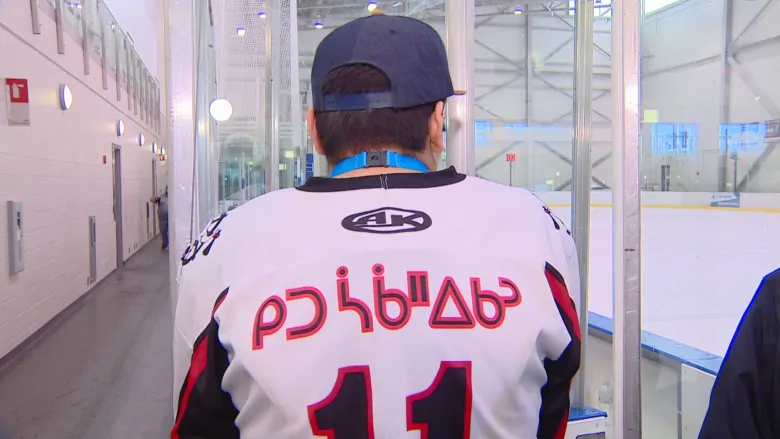
It’s a special jersey for a meaningful hockey tournament.
The players from Calling Lake in Bigstone Cree Nation wear it every year for the Native Hockey Alberta provincial championships.
The community’s name is emblazoned in Cree on the front of the jersey and written in syllabics on the back.
It’s a simple but important way of keeping the language alive, said Randy Auger, a coach for the Calling Lake Tomahawks.
“It’s part of our culture — we try to teach our young people that we have our own language and our own syllabics,” he said.
Nearly 4,000 young Indigenous hockey players gathered in Edmonton this weekend for the annual hockey tournament. Players are recruited to roughly 250 teams, many of them formed specifically for the tournament, representing dozens of First Nations from across Alberta.
“It means a lot to me because we get to see all the native people here,” said Robert Auger, a player from Bigstone Cree Nation.
Robert, Randy’s son, said it was heartening to see people from his community drive two hours south to Edmonton for Sunday’s championship game
“It makes me feel proud to wear this jersey. We don’t really use these often. So, yeah, it’s really special,” he said.
Robert Auger shows off his jersey, with the name of his community written in Cree syllabics on the back. (Scott Neufeld/CBC)
The team scored a go-ahead goal in the last minute of the third period to beat out the Maskwacis Hawks for the Bantam-level gold medal.
“I had some butterflies at the beginning of the game, and even when we scored that go ahead goal. It was just,” said Auger, letting the sentence trail off as he tried to find words to describe the moment.
Jordin Tootoo, the first Inuk to play in the NHL, and Rene Bourque are listed among the tournament’s alumni, according to the website.
The tournament opened on Thursday by acknowledging Metis and First Nations Elders, said Doug Chalifoux, Treaty 8 representative for Hockey Alberta. The tournament’s competitive spirit is built on a sense of community.
It’s a change from what some Indigenous hockey players have experienced on the ice outside the tournament.
“We faced a lot of racism this year. Not just from our local teams, but just all around,” said Jorja Desjarlais, from Frog Lake First Nation.
Desjarlais — who plays for the Frog Lake Thunderbirds — said a referee recently told her to “go back to where she came from” and called her a racial slur during a game.
She said playing alongside and competing against Indigenous players, in front of a predominantly Indigenous crowd, made her more comfortable at the tournament.
More than two dozen of the province’s elite First Nation hockey players were disqualified days ahead of the weekend’s competition. Players from the Western Provinces Hockey Association, a top-tier hockey league that’s not sanctioned by Hockey Alberta, were not allowed to participate in the tournament.
Hockey Alberta oversees the registration and insurance process for the Native Hockey Alberta tournament.