The Arctic is now locked into a destructive degree of climate change regardless of what measures are taken to halt global greenhouse gas emissions.
This conclusion comes out of a new UN environment report on the Arctic, which describes scenarios where Arctic winter temperatures increase by three to five degrees by 2050 compared to 1986-2005 levels, and by five to nine degrees by 2080. This temperature rise is expected to happen regardless of the success or failure of the Paris Agreement on climate change.
This would, according to the report, devastate the region while “unleashing sea level rises worldwide.”
Even if global emissions were to stop overnight, the report says winter temperatures in the Arctic would continue to rise by up to 5 C by 2100 compared to average temperatures in the late 20th century. The temperature rise is described by the report as “locked in” because of greenhouse gases already emitted and heat stored in the ocean.
The findings are part of a 56 page report released Thursday at the United Nations Environment Assembly in Nairobi, Kenya. The report draws on data and findings included in more than 100 journal publications and scientific papers.
Devastating impact
According to one study cited in the report, up to 70 per cent of Arctic infrastructure could be threatened because of thawing permafrost by 2050.
Permafrost will not be the only geographic casualty in the North. Under current rates of carbon dioxide emissions, the report anticipates Arctic summer sea ice could largely disappear within two decades.
“Increasing temperatures mean the Arctic will be a very different place in decades to come,” the report reads. “This will not only have regional and local implications but will affect ocean circulation, sea levels and climate and weather patterns worldwide, with profound consequences for ecosystems and human populations.”
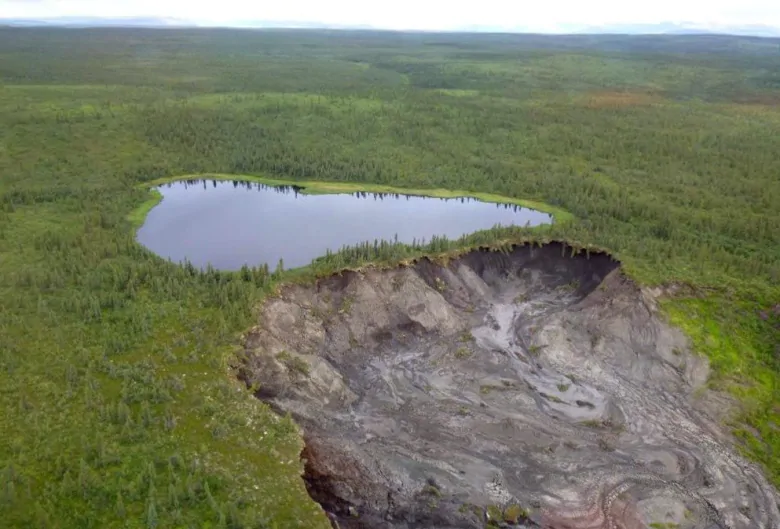
This small unnamed lake in the Northwest Territories is just one of a new wave of giant-sized permafrost slumps that are changing the territory’s landscape because of climate change. A UN report says Arctic communities should prepare for major environmental changes. (Scott Zolkos/THE CANADIAN PRESS)
Thawing permafrost, and melt water from sea ice and glaciers will have impacts worldwide. The melting of Arctic glaciers and and the Greenland ice cap will increase sea levels, while thawing permafrost is expected to contribute to increased carbon dioxide and methane emissions.
“The thawing trend appears irreversible,” the report states. “While compliance with the 2015 Paris Agreement on climate change would stabilize permafrost losses, the extent would still be 45 per cent below current values. Under a high emissions scenario, stable permafrost will likely only remain in the Canadian Arctic Archipelago [Baffin Island and surrounding Arctic islands], the Russian Arctic coast and the east Siberian uplands.”
According to the report, the world’s frozen soils hold approximately 1,672 billion metric tonnes of carbon. The resulting emissions from thawing permafrost could derail the Paris Agreement’s stated goal of limiting global temperature rise to 2 C.
“What happens in the Arctic does not stay in the Arctic,” stated Joyce Msuya, UN Environment’s acting executive director in a press release. “We have the science; now more urgent climate action is needed to steer away from tipping points that could be even worse for our planet than we first thought.”