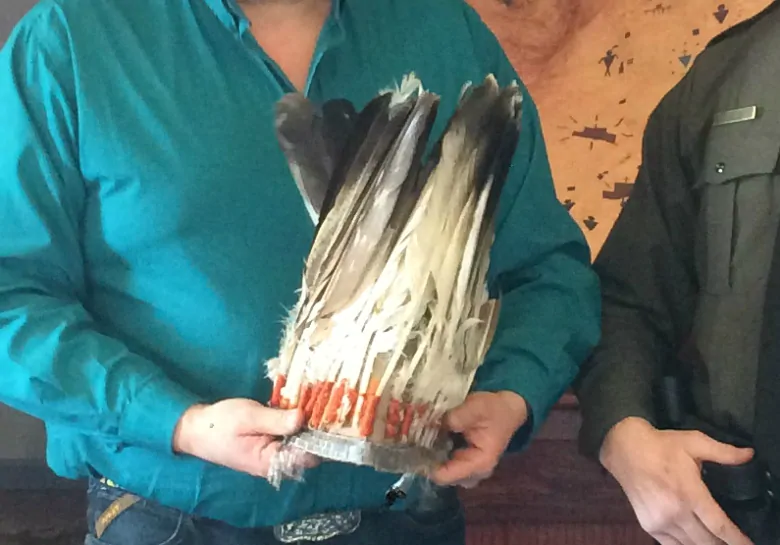
A ceremonial Blackfoot headdress, adorned with golden eagle feathers and likely once owned by a teacher in the residential school system, is now home after being found at a southern Alberta thrift store.
“It was an amazing feeling,” said Siksika Nation’s Kent Ayoungman of seeing it returned.
“This headdress dates back quite some time. It was worn by significant people. It’s made out of immature golden eagle feathers. Our people used them for ceremonial items. It was made to stand straight up. That style is distinctive to the Blackfoot people.”
Found in donation bin with a card
Ayoungman works with re-appropriated cultural items.
“Traditionally, they come to the Blackfoot people from our sacred society, the buffalo bull society. The ceremonies that take place originate from that sacred society. Our people wear these headdresses for special events. Our biggest, most important time of the year, when all our people come together, that’s where you see a lot of these headdresses being worn.”
The headdress was found in the donation bin of an Okotoks thrift store. Alberta Fish and Wildlife officer Philip Marasco got a call about it through a poaching reporting line.
“The caller was convinced it had eagle feathers and that it was an Indian headdress,” Marasco told CBC News.
“It had a lot of signs of use. You could see where some feathers had faded. There was a card with it saying it had belonged to a family. The father had been involved with the residential school system north of Red Deer in the early 1900s.”
The headdress is believed to be more than 100 years old. (Alberta Fish and Wildlife Enforcement)
Marasco reached out to the Glenbow Museum in Calgary, which put him in touch with Ayoungman.
“These items don’t come up very often. Being able to return an item that has this backstory to the appropriate people is a pretty big deal,” Marasco said.
Based on some research, Ayoungman believes it was a teacher at a residential school that had the headdress.
“We don’t know. It could have been gifted to them, they could have bought it. It could have been stolen,” Ayoungman said.
Early settlers intrigued by Blackfoot culture
The item might have been of interest to a teacher in that school system for a variety of reasons, he adds.
“The early settlers, the people who made contact with the Blackfoot, they were intrigued by them. They saw how sophisticated our social structure was, they saw how vibrant our ancestors were, the pride they took in their homes and horses. They were quite amazed with what they saw.”
The headdress will be put on display once it has been restored.