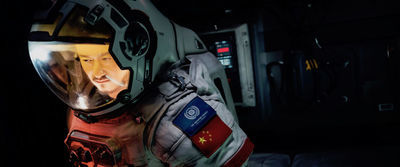
“The Wandering Earth”—an exciting Chinese science-fiction action-adventure—cured my winter depression. No, seriously: I happily joined a packed Times Square auditorium-full of moviegoers (last Friday, on opening day) in cheering on a talented ensemble cast of Mandarin-speaking stars—including action hero Wu Jing, comedy institution Man-Tat Ng, and rising stars Chuxiao Qu and Jinmai Zhao—as they worked together to save the Earth from crashing into Jupiter. I left the theater with renewed hope that “The Wandering Earth” would be one of this year’s Chinese New Year’s hits—and, sure enough, it went on to gross $300 million in China during its opening week alone. I’m very excited to see more where “The Wandering Earth” came from.
A couple of things set “The Wandering Earth” apart from the many other American sci-fi disaster movies—like “Armageddon,” “The Day After Tomorrow,” and “Sunshine”—that precede it. Neophyte director Frant Gwo and his six co-writers seemingly take the best elements from other American science-fiction movies (as well as Cixin Liu’s source novel) and synthesize them in a visually dynamic and emotionally engaging way. For starters: while the movie’s characters and basic plot may seem familiar—Chinese astronauts fight to save the Earth years after its leaders have turned our planet into a globe-sized spaceship(!) in order to save us from a fatally over-active sun(!!)—Gwo and his team never valorize a singular chest-puffing hero, nor do they scapegoat a mustache-twirling antagonist (not even MOSS, a sentient HAL-9000-style computer program).
“The Wandering Earth” also looks better than most American special-effects spectaculars because it features longer and more matte-paintings-on-steroids landscape shots of a dystopian Earth. This isn’t that surprising once you learn that Gwo and his team realized their expensive-looking vision with the help of a handful of visual effects studios, including the Weta Workshop (all the “Lord of the Rings” and the recent “Planet of the Apes” movies). Still: the makers of “The Wandering Earth” were somehow able to blend their many influences in bold, stylish ways that only Hollywood filmmakers like James Cameron and Steven Spielberg have previously been able to.
In that sense, “The Wandering Earth” succeeds where so many other American movies have failed because it’s both a great and uniquely Chinese sci-fi film. We follow two teams of Chinese astronauts to save the day: a two-man skeleton crew, comprised of the square-jawed Peiqiang Liu (Wu) and his Russian cosmonaut buddy Makarov (Arkady Sharogradsky); and a small exploratory group led by Peiqiang’s feisty twenty-something son Qi Liu (Qu) and his optimistic girlfriend Duoduo Han (Zhao). These two factions respectively spend most of their time battling an unhelpful MOSS in a remote space station, and exploring an ice-covered Earth in stolen all-terrain vehicles (some of which bring to mind “Total Recall,” specifically the tank-sized drill-cars that Arnold Schwarzenegger’s antihero commandeers towards that film’s ending).
That basic set-up may not sound particularly Chinese, but, as with all officially released Chinese movies (which must be approved by the government’s censors), this one follows characters who ostentatiously love and respect their elders. Both Peiqiang and greybeard spaceman Zi’ang Han (Ng, formerly Stephen Chow’s straight-man comedy partner) are accordingly treated with reverence because, well, they’re older and therefore have more experience and moral fiber. “The Wandering Earth” also promotes a captivating (and very Chinese) belief in teamwork and the film’s younger protagonists, whose unqualified optimism makes them as brazen as they are idealistic. “The Wandering Earth” is also a uniquely Chinese sci-fi blockbuster in that it’s an apolitical blockbuster about a post-climate-change disaster that’s also filled with narrative diversions that re-assure viewers: no single country’s leaders are smarter, more responsible, or more capable than the others—except, of course, for the Chinese.
But the real secret to the success of “The Wandering Earth” is that its creators breathe new life into otherwise hackneyed tropes. Gwo and his team take a little extra time to show off the laser beams, steering wheels, and hydraulic joints that make their various computer-generated space-cars (and exo-skeleton suits and laser weapons) seem unique. Gwo, his co-writers, and his cast also go the extra mile to show viewers the emotional stress and natural obstacles that they all overcome while solving scientifically credible dilemmas (all of which were supervised by the Chinese Academy of Sciences). This movie may not be the next “2001: A Space Odyssey,” but it’s everything “2010: The Year We Make Contact” should have been (and I like “2010,” a lot).
I’m still marveling at how good “The Wandering Earth” is, one week after seeing it. I can’t think of another recent computer-graphics-driven blockbuster that left me feeling this giddy because of its creators’ consummate attention to detail and infectious can-do spirit. The future is here, and it is gorgeous, nerve-wracking, and, yes, Chinese.