The Yukon Quest sled dog race leaves Whitehorse on Saturday, and over the next nine days, 30 teams will cover a gruelling 1,600 kilometres before reaching the finish line in Fairbanks, Alaska.
While the quest has been around for 36 years, it follows routes that go back over a century and were used by stampeders on their way to the Klondike Gold Rush and then onto Alaska to find gold.
This will be Nathaniel Hamlyn’s second Yukon Quest.
“This year, I’m feeling more confident for sure. Last year, it was kind of a shot in the dark. I didn’t know what I was doing,” said the 24-year-old musher of dogsled driver from Mount Lorne, Yukon.
Last year, Hamlyn was the red lantern winner, a distinction that goes to the musher who finishes in last place.
Finishing the race at all is a feat. Many say the Yukon Quest is tougher than its Alaskan cousin, the Iditarod.
The Yukon Quest includes four mountain ranges, each at least 1,000 metres high, along with fewer checkpoints, which means longer distances between rest stops. It’s also a month earlier, meaning it’s darker and colder.
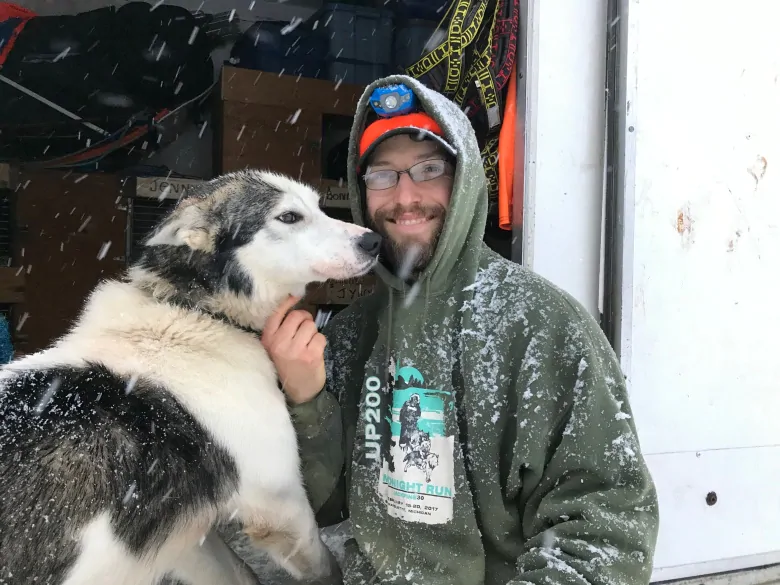
Glenwood, N.B., musher Remy Leduc poses with his dog, Red Bull. This is Leduc’s first Yukon Quest. (Jane Sponagle/CBC)
Those challenges are what attracts competitors from Yukon and Alaska, as well as France, Germany, Sweden, New Zealand and New Brunswick.
Yukon Quest rookie Remy Leduc drove from Glenwood, N.B., to Whitehorse to compete in the race.
“We managed to do it in about six days, and everything went fairly well,” he said.
Leduc said driving across the country with 17 dogs meant getting into a routine.
“Enough water so that they don’t dehydrate, but not too much that we have to let them out to pee.”
This year, Yukon Quest organizers have been keeping a close eye on the weather.
“The thing you gotta remember about the trail is the only thing constant is change. It changes every minute of every hour of every day,” said Sgt. John Mitchell of the Canadian Rangers.
Each year, the Rangers break and maintain the Canadian side of the trail.
Mitchell says the latest trail conditions are better than expected, but that does not stop the trail from having technical challenges, like overflow, or water seeping through ice, when crossing rivers.

Yukon Quest musher Michelle Phillips says organizers can’t change the weather, but they can make the race safer for mushers and their dogs. (Jane Sponagle/CBC)
Parts of the trail have little snow, so changes have been made to the race, including trucking dogs between the Braeburn and Carmacks checkpoints and allowing mushers to use as few as eight dogs from Whitehorse to Pelly Crossing, Yukon.
“You know, it’s a smart choice for the dogs and the mushers,” said Michelle Phillips, a musher from Tagish, Yukon.
This will be Phillips’s seventh Yukon Quest.
“You can’t do anything. You can just make the race safe for all of us,” she said.