While Winnipeg wrestles with how to handle historical markers that do not reflect Indigenous perspectives, a new poll finds the issue may not be top of mind for Manitoba’s Indigenous population.
The Probe Research poll found just 39 per cent of First Nations, Metis and Inuit Manitobans surveyed think removing statues and changing the names of places that commemorate Canadian leaders who helped set up residential schools should be considered a major aspect of reconciliation.
“Compared to things like land claims and even sort of territorial acknowledgments … issues of the statues and renaming roads is important, but not nearly as important as some of those really big structural sovereignty issues,” said Mary Agnes Welch, a senior researcher at Probe Research.
“There’s still a good four out of 10 of folks that say that removing statues and renaming streets is a big part of reconciliation, but they’re kind of a minority.”
The CBC Manitoba-commissioned poll, which surveyed 500 Indigenous people across Manitoba, found those in the north considered the issue to be slightly more important (45 per cent) than those in Winnipeg and the south and west, at 36 and 34 per cent respectively.
What to do with Winnipeg landmarks?
On Tuesday, Mayor Brian Bowman announced a plan that will see the city seek public input on the future of old statues, monuments, plaques and place names that only reflect colonial views of Winnipeg’s history.
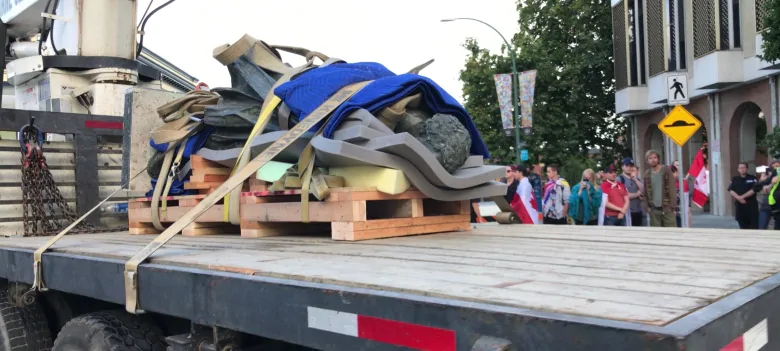
A statue of John A. Macdonald was removed by truck from in front of Victoria’s city hall as a gesture of reconciliation in August. A new poll finds renaming streets and removing statues marking colonial history is not a top priority of Indigenous people in Manitoba. (Megan Thomas/CBC)
Last August, Victoria, B.C., made a snap decision to remove a statue of John A. Macdonald, Canada’s first prime minister, from its city hall. In contrast, Bowman said he first wants to know what Winnipeggers think, so the city can have a policy in place before any decisions must be made.
The move in Victoria ignited debate in Winnipeg about whether or not to rename Bishop Grandin Boulevard. The roadway is named after Bishop Vital-Justin Grandin, a Roman Catholic priest and bishop who lobbied the federal government to fund the construction of residential schools.
While Grandin advocated on behalf of Métis rights, he also believed First Nations people needed to be “civilized” and viewed residential schools as the way to accomplish this.
His involvement was cited in the final report of the Truth and Reconciliation Commission of Canada, which concluded Grandin “led the campaign for residential schooling.”
Education over renaming
The Probe poll also asked Indigenous respondents their thoughts on what to do with Bishop Grandin Boulevard, and majority said they think educating the public about Grandin’s history is more important than renaming the road named in his honour.

The current plaque that marks the creation of Bishop Grandin Boulevard, which was named after the famous Roman Catholic priest and bishop in 1978. (Submitted)
Fifty seven per cent said the road’s name should remain with efforts instead made to educate the public about Bishop Grandin’s role in residential schools. Another 25 per cent said they’d like to see the road renamed, and 14 per cent would prefer to simply keep the name.
Respondents living in Winnipeg (33 per cent) were more likely to be in favour of changing the road’s name compared to 20 per cent of those in the north and 19 per cent of those in the south and west parts of the province.
While the city asks for input from Winnipeggers on the broader issue of renaming streets and landmarks and removing statues, Welch says the polls results show changing names and statues may not be what those most affected want.
“Fully changing the name is maybe a blunt instrument … folks seem to think there’s more value in the education part of things,” she said.
“That’s an interesting message to the mayor as he’s starting this process.”
The poll collected data from respondents using a computer-assisted telephone interviewing system and through an online survey between Oct. 28 and Nov. 26, 2018.
Due to the mixed methodology used, no margin-of-data can be ascribed. However, if random sampling had been applied, the margin-of-error for a sample of this size would typically ne +é- 4.33 per cent 19 times out of 20.