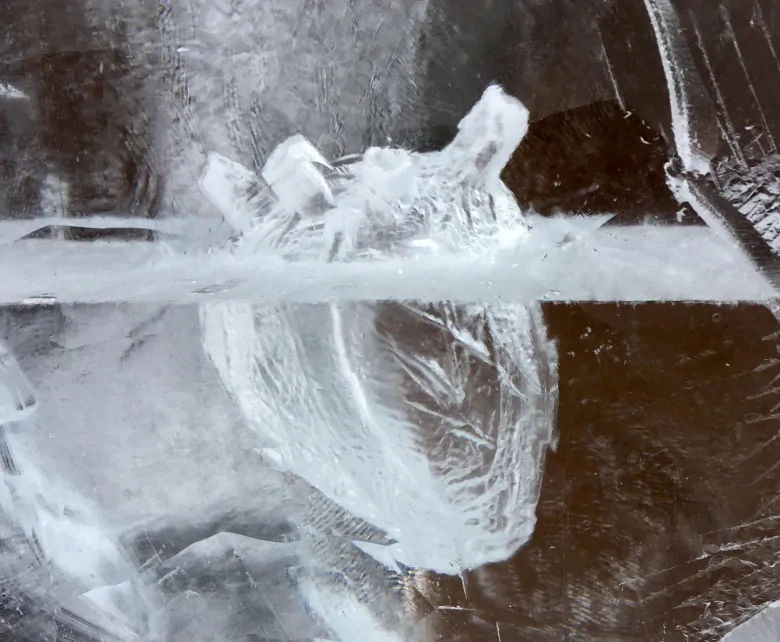
Karlis Ile points to a heart made of ice.
“That’s the giraffe’s heart. They need a big heart because it has to pump the blood very high,” laughs the Latvian ice carver.
The pair of giraffes spotted at the corner of Gateway Boulevard and Whyte Avenue as part of the Ice On Whyte festival, a staple in Edmonton since 2003.
A heart of ice embedded in giraffe is just one of the intricate details on display at the Ice On Whyte festival. (Adrienne Lamb/CBC)
The festival runs this weekend and next and features nighttime entertainment where patrons can belly up to a bar made of ice and select from chilled local spirits. Across the street is a huge inflatable igloo where kids can try their hand at ice carving.
But the biggest draw for the estimated 36,000 annual visitors is a chance to see work by some of the best ice artists from around the world, according to festival producer Wanda Bornn.
Ice On Whyte is one of only three international ice carving competitions in Canada with the others in Lake Louise, Alta., and Ottawa, Bornn said.
A few years back the three centres decided to combine forces, creating the Canada Cup of Ice Carving, she said.
“Canada Cup of Ice Carving just puts the ribbons on it and to have that in Edmonton, that’s big.”
Judges award marks for structure, skill, technique, detail design, creativity and artistic merit.

Festival producer Wanda Bornn is overseeing her 14th and final event before retiring. (Adrienne Lamb/CBC)
Ile and his carving partner Maija Puncule were feeling confident.
“We are one of the best teams in the world I think,” Ile said.
This weekend they were not only battling teams from China, Russia and the Netherlands, but also rising temperatures.
Warm weather means “fragile compositions can collapse,” no matter how good the ice is, Ile said.
“Of course there is better ice and worse ice but ice is ice. If there are less bubbles inside, less air, it’s better, more clear, more transparent, more strong, but every ice melts at zero temperature, so that’s the critical point,” he said.
To ensure the festival has the best ice, Bornn said they have it specially made in an ice plant in Mississauga, Ont., for the festival. This year alone the ice budget is close to $30,000.

Ice is shipped from Ontario in boxes. (Adrienne Lamb/CBC)
“They put distilled water in these machines. Now if you’ve ever noticed when you take an ice cube out of your freezer it’s kind of whitish in the middle, because all the impurities and the oxygen goes to the middle,” Bornn explained.
The icemakers keep stirring the water and they freeze it from the bottom up to the air bubbles and imperfections rise to the top and they cut those off with a bandsaw, she said.

The tools of the ice carving trade are ready to be pressed into service. (Adrienne Lamb/CBC)
That’s when the identically-sized blocks are put in plastics sleeves, placed in cardboard box and loaded on a truck destined to be beautiful creations in the hands like carvers Antonio Baisas.
“For us this is a passion, we love to do it,” Baisas said. “Although it’s hard to work with, dealing with the weather and sharp tools.”
Antonio and his brother Ross make up the Baisas Brothers, a team now living in Canada but originally from the Philippines.
The pair moved from their village, where they use to carve in wood, to working in ice in the hotel industry in Manila, before moving to Quebec.
Now, 20 years later, the brothers create jaw-dropping sculptures like Roarrrr!!!!, a skeleton of a T-Rex made entirely of ice on display at this year’s festival.
Warm as ice? Ice On Whyte to kick off with above freezing temperatures

Ice carving brothers Ross and Antonio Baisas take a break. (Adrienne Lamb/CBC)
“A lot of people are like, ‘They’re crazy or something like that.’ Yes we do crazy sometimes.”
Those daring designs often pay off. Last year the Baisas Brothers won the cup.
But this year, of the 10 teams competing, Alexey Andreev and Egor Stepanov of Team Sakha from Russia took the cup.
The pair has competed seven times in Edmonton.
“I like Edmonton,” Stepanov said.

Egor Stepanov of Team Sakha from Russia chisels out the finishing touches. (Rick Bremness/CBC)