Lawmakers in the U.K. have dealt a crushing defeat to Prime Minister Theresa May’s Brexit deal, setting the stage for a non-confidence vote tomorrow in the British Parliament.
Tuesday’s vote was 432 to 202 — the biggest government defeat in the House of Commons in almost a century — and was followed minutes later by a formal call for the vote of non-confidence by Opposition Labour Leader Jeremy Corbyn.
Parliament will hold a debate and vote on the non-confidence motion beginning Wednesday. The government is expected to survive with the support of the Northern Ireland Democratic Unionist Party.
Corbyn, who called the vote a “catastrophic defeat” for the government, said, “The House of Commons has delivered its verdict on this deal, and that verdict is absolutely decisive.”
May told Parliament moments after the result was announced: “It is clear that the House does not support this deal, but tonight’s vote tells us nothing about what it does support,”
EU seeks clarity after result
Following the vote, European Council President Donald Tusk challenged the U.K. to make its intentions clear after Tuesday’s Brexit defeat in Westminster. Tusk said the only positive solution now is for Britain to stay in the EU.
If a deal is impossible, and no one wants no deal, then who will finally have the courage to say what the only positive solution is?
—@eucopresident
Prior to the vote, May told MPs in the House of Commons that their decision would set the future course for future generations of Britons.
The deal, which the prime minster herself has called “not perfect,” was meant to establish terms for the March 29 exit and beyond, but was criticized from all sides. So much so that the prime minister recently had to fight off a non-confidence vote in her leadership.
May said earlier Tuesday if new election were to be held, “whatever the results, the choices facing us will not change,” adding, “all it would gain is two more months of uncertainty and division.”
May’s earlier win in the leadership challenge means she can’t face a similar vote for a year. But some MPs from both government and opposition parties are exploring ways to use parliamentary procedures to wrest control of the Brexit process away from the government, so that lawmakers, by majority vote could specify a new plan for Britain’s EU exit.
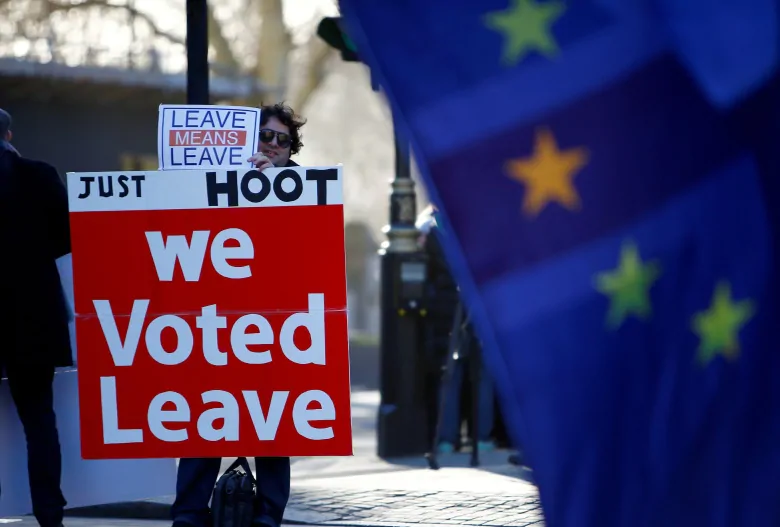
Demonstrators have been out on the streets in London trying to make their case ahead of today’s much-anticipated Brexit vote in Parliament. (Henry Nicholls/Reuters)
Conservative MP Dominic Grieve, who is spearheading efforts to unite Parliament to prevent a no-deal Brexit, said ahead of the vote that the prime minister is, “pursuing a policy which doesn’t meet with Parliament’s approval, and it’s gradually running into the sand.”
But with no clear majority in Parliament for any single alternate course, there is a growing chance that Britain may seek to postpone its departure date while politicians work on a new plan.
Most important vote ‘in a generation’
Ahead of Tuesday’s Brexit vote,Corbyn said the blame will “lie firmly with the government and firmly at the feet of the prime minister.”
Labour MP David Lammy, who has previously said Brexit is a “con” that will harm the country’s most vulnerable, told CBC News that he thinks it’s certain May will lose the vote, which he called “the most important in a generation.”

British Prime Minister Theresa May won a recent leadership challenge from her own party, but she faces more hurdles in the days and weeks to come. (Clodagh Kilcoyne/Reuters)
“At that point, it’s clear in our constitutional arrangement, the only thing you can do is go back to the country for a clear decision and direction,” he said. “That either means a general election or it means a people’s vote — a second referendum in which the issues, the more complex issues around Brexit, are put to the people.”
And of course, a potential no-deal Brexit looms.
Grieve, who has backed calls for another referendum, said that leaving without a plan would cause “immense” economic damage and hurt the country’s most vulnerable.
Still, it’s a possibility — one many people in the U.K. have been readying for.
As a crucial Brexit vote looms, many Brits are prepping for the worst in case trade with the EU gets messy but one mom has bigger worries. Her daughter requires tightly controlled imported medications, so stockpiling is not an option. <a href=”https://t.co/gCCARXoUt0″>https://t.co/gCCARXoUt0</a> <a href=”https://twitter.com/thomasdaigle?ref_src=twsrc%5Etfw”>@thomasdaigle</a> <a href=”https://twitter.com/hashtag/Brexit?src=hash&ref_src=twsrc%5Etfw”>#Brexit</a> <a href=”https://t.co/RcaTXxTcXz”>pic.twitter.com/RcaTXxTcXz</a>
—@CBCTheNational
A major issue in the pre-Brexit wrangling has been around the border between Northern Ireland and the Republic of Ireland.
In a bid to win support ahead of today’s vote, May sought reassurances from EU leaders about the deal’s most contentious measure — an insurance policy known as the “backstop” that would keep Britain in an EU customs union to maintain an open border between the U.K.’s Northern Ireland and EU member Ireland after Brexit.
Pro-Brexit lawmakers worry that Britain could be trapped indefinitely in the arrangement, bound to EU trade rules and unable to strike new deals around the world.
As Britain’s deepest political crisis for at least half a century built to a head, a spokesperson for May said she would respond quickly to the result of the vote.
He also said there had been no discussion at a meeting between the prime minister and her cabinet on Tuesday morning of delaying Brexit beyond the March 29 deadline.
Watch: Brexit woes have sparked renewed concerns along the Irish border.