Just over a day after NASA’s New Horizons spacecraft zipped by Ultima Thule, scientists are ready to reveal their preliminary findings of the distant object.
Ultima Thule, or more formally 2014 MU69, is a member of the Kuiper Belt, a ring-shaped region of icy objects orbiting the sun. The area begins just beyond the orbit of Neptune, more than 4.4 billion kilometres away, and is believed to extend to about eight billion kilometres from sun.
On Facebook, Stern posted: “Planetary science fans — I think you definitely want to tune in to our press conference about Ultima Thule today, 2 pm Eastern. Just one thing, before you do, fasten your seat belts!”
Think my team is happy about Ultima Thule? Find out at 2 pm on NASA TV– Press conference ahead! <a href=”https://twitter.com/hashtag/NASA?src=hash&ref_src=twsrc%5Etfw”>#NASA</a> <a href=”https://twitter.com/hashtag/Science?src=hash&ref_src=twsrc%5Etfw”>#Science</a> <a href=”https://twitter.com/hashtag/Space?src=hash&ref_src=twsrc%5Etfw”>#Space</a> <a href=”https://twitter.com/hashtag/UltimaThule?src=hash&ref_src=twsrc%5Etfw”>#UltimaThule</a> <a href=”https://twitter.com/hashtag/UltimaFlyby?src=hash&ref_src=twsrc%5Etfw”>#UltimaFlyby</a> <a href=”https://twitter.com/NASANewHorizons?ref_src=twsrc%5Etfw”>@NASANewHorizons</a> <a href=”https://twitter.com/NewHorizons2015?ref_src=twsrc%5Etfw”>@NewHorizons2015</a> <a href=”https://t.co/pixtDHbhnu”>pic.twitter.com/pixtDHbhnu</a>
—@AlanStern
Data from the New Horizons flyby of Ultima Thule will be coming in for about two years. Wednesday’s findings will be the first data analyzed by the team.
“This mission has always been about delayed gratification,” said New Horizons principal investigator Alan Stern of the Southwest Research Institute in a news conference on Tuesday. “It took us 12 years to sell it. It took us five years to build it. It took us nine years just to get to the first target.”
Next week, the spacecraft will be unable to transmit any data due to radio interference from the sun. Stern said the spacecraft will once again begin transmitting in mid-January.
The main priorities for the research is mapping Ultima Thule’s surface, as well as looking for any potential moons and rings.
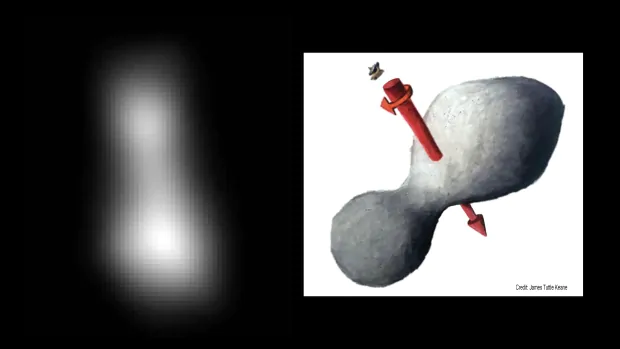
The first images returned from New Horizons have been pixelated and difficult to make out. So far, it appears that Ultima Thule is an irregularly shaped object that is rotating on an axis, or perhaps two objects in close orbit with one another.
New Horizons was launched in 2006 on a mission to fly by Pluto. In 2015, the spacecraft passed the planet providing the first images of a world once considered our ninth planet.