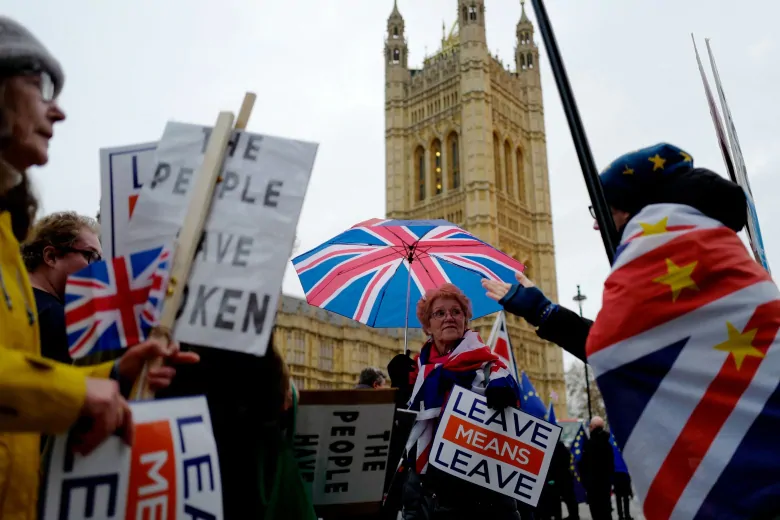
Britain’s Parliament will vote on whether to approve Prime Minister Theresa May’s Brexit deal before Jan. 21, her spokesperson told reporters on Tuesday.
May on Monday announced she would defer it and seek extra reassurances from the European Union to make sure it got through Parliament.
Junior Brexit minister Robin Walker said Parliament will debate and vote on the government’s next steps whether or May has a deal for them to approve by that date.
Walker was responding Tuesday to an urgent question put forward by an opposition lawmaker, who said there was confusion over whether the government could now bypass parliament and proceed to leaving the European Union without a deal if it wanted to.
“In the unlikely and highly undesirable circumstances that as of 21st January there is no deal before the House, the government would bring a statement to the House and arrange for a debate as specified by the law,” said Walker.
With less than four months until the United Kingdom is due to leave the European Union on March 29, Brexit was plunged into chaos on Monday when May finally acknowledged that British lawmakers would not accept her current deal.
Amid demands for a national election, ridicule and blunt warnings that her eleventh-hour bid for a changed deal was in vain, May pledged to seek EU support for changes to make it more palatable to lawmakers.
Pro- and anti-Brexit demonstrators protest outside Parliament as Theresa May announced a postponement of a crucial parliamentary vote. (Tolga Akmen/AFP/Getty Images)
She began making the rounds with European leaders on Tuesday, with meetings scheduled with German Chancellor Angela Merkel, Dutch Prime Minister Mark Rutte, European Commission head Jean-Claude Juncker and European Council president Donald Tusk.
May was to hold a meeting of her cabinet on Wednesday afternoon.
EU shows little sign of bending
The EU said it was ready to discuss how to smooth ratification in Britain, but that neither the withdrawal agreement nor the contentious Irish backstop would be renegotiated.
The backstop is, in effect, an insurance policy that would keep Britain in a customs union with the EU in the absence of a better way to avoid border checks between Northern Ireland and EU member Ireland.
Brexit is to be discussed at a previously scheduled EU summit on Dec. 13 and 14.
Without a deal, the options for the world’s fifth largest economy include a last-minute agreement, probably struck in 2019, another EU referendum or national election, or a potentially disorderly Brexit without a deal.
The ultimate outcome will shape Britain’s $2.8-trillion US economy, have far-reaching consequences for the unity of the United Kingdom, and it will determine whether London can keep its place as one of the top two global financial centres.
The British pound, which has lost 25 cents against the U.S. dollar since the 2016 referendum, was up 0.4 per cent at $1.2615 on Tuesday, a modest recovery after falling 1.6 per cent on Monday.
May said the deeper question was whether Parliament wanted to deliver on the people’s will from the 2016 referendum, or open up divisions with another national vote.
“If you take a step back, it is clear that the House faces a much more fundamental question. Does this House want to deliver Brexit?” May said.
Support for another referendum has been rising in recent months.

An anti-Brexit demonstrator wearing a Santa Claus costume rings a bell and holds a placard outside the Houses of Parliament. The chaotic process has sparked anxiety, debate and protest. (Henry Nicholls/Reuters)
John Major, who led Britain from 1990 to 1997 and campaigned to stay in the EU, is among three of the four former British prime ministers still alive to have called for a second referendum as a way to resolve the crisis.
On Tuesday, Major said Britain must revoke its notice to quit the European Union with immediate effect to allow for “serious and profound reflection” by both Parliament and the people.
“It’s clear we now need the most precious commodity of all: time. Time for serious and profound reflection by both Parliament and people. There will be a way through the present morass, there always is,” said Major, appearing at an event in Dublin for a European think-tank.
Irish backstop necessary: Juncker
A leadership challenge is triggered if 48 Conservatives write letters demanding one to the chairman of the party’s so-called 1922 committee, Graham Brady.
The Labour Party was urged by other smaller opposition parties to trigger a vote of no confidence in the government, but said it would not act right away.
Nobody wants the U.K. to leave. I cannot imagine where we could change something substantial in the withdrawal agreement.”– Michael Roth, European affairs minister for Germany
“We will put down a motion of no confidence when we judge it most likely to be successful,” a spokesperson said.
The most contentious issue has been the Irish backstop. May’s critics say it could leave Britain subject to EU rules indefinitely.
Juncker said neither side intended for the backstop ever to take effect, but it had to remain a part of the deal.
“We have a common determination to do everything to be not in a situation one day to use that backstop, but we have to prepare,” he said. “It’s necessary for the entire coherence of what we have agreed. It’s necessary for Britain and it’s necessary for Ireland. Ireland will never be left alone.”
Germany’s European Affairs Minister Michael Roth said the EU did not want Britain to leave, but added that substantial changes to the withdrawal agreement would not be possible.
“Nobody wants the U.K. to leave,” Roth said. “I cannot imagine where we could change something substantial in the withdrawal agreement.”