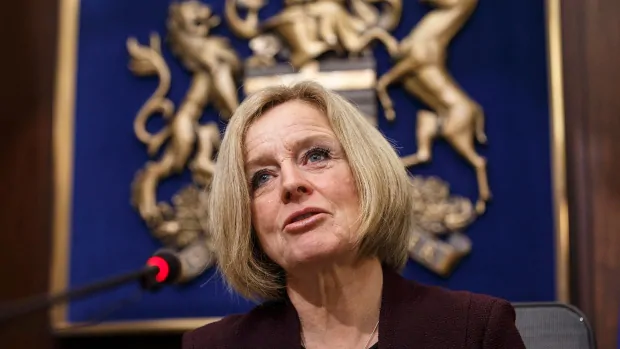
Premier Rachel Notley took shots at Ottawa as she addressed her cabinet Monday prior to a meeting where Alberta’s newly-announced oil production cuts will be approved.
“We need them to toss the half-hearted statements away,” Notley said as her ministers looked on.
“We don’t actually need Ottawa’s sympathy. We need Ottawa’s full attention. We need them to step up and help us bring in an end to this crisis.”
Notley’s remarks reflected her frustration over what she feels is inaction by federal government on getting Alberta crude to the west coast.
On Sunday, she announced a temporary 8.7-per-cent cut in the production of raw crude and bitumen starting Jan. 1, 2019.
The measure is aimed at closing the oil price differential which the government says is costing the Canadian economy more than $80 million a day.
Notley said cabinet will consider a regulation to give Energy Minister Marg McCuaig-Boyd the power to direct the Alberta Energy Regulator to enact the curtailments.
The amount will be revisited each month to ensure the province isn’t cutting production more than it has to, Notley said.
The gap in price between Western Canadian Select crude and the West Texas Intermediate benchmark widened to historic amounts this fall.
Alberta is blaming oversupply and a lack of pipeline capacity for what Notley claims are “fire sale” prices for Alberta crude.
There are currently 35 million barrels of processed oil sitting in storage awaiting transport out of the province.
The daily cuts of 325,000 barrels would remain in place until the stored oil is shipped to market, likely by the spring.
The reduction will drop to an average of 95,000 barrels a day until curtailment ends at the end of 2019, when Enbridge’s new Line 3 pipeline to the U.S. Midwest starts operating.
The Alberta government also expects to acquire locomotives and rail cars by that date to transport 120,000 barrels a day.
Notley wants the federal government to help with the costs but she said the province will go it alone, if necessary. Negotiations are already underway to buy the equipment.
There are now questions as to whether Saskatchewan will follow Alberta with its own production cuts.
McCuaig-Boyd says Alberta has been in discussions with its eastern neighbour.
“They’re not as big a player as us but they’re still a player so you know it’s important to have those discussions and as they say, there’ll be more to say in the next while,” she said.