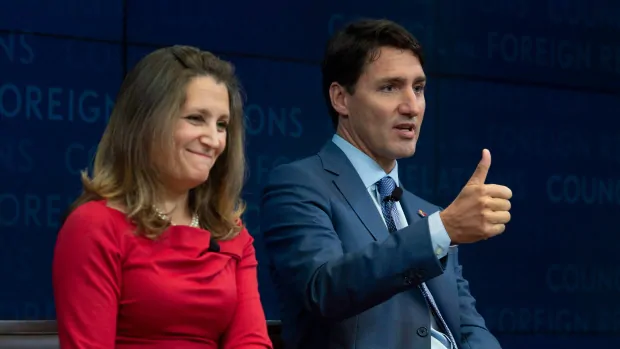
Prime Minister Justin Trudeau, U.S. President Donald Trump and Mexican President Enrique Pena Nieto will sign the new United States-Mexico-Canada-Agreement on continental trade in Argentina tomorrow morning.
While Foreign Affairs Minister Chrystia Freeland will be present at the event, the three leaders themselves will sign the new trade deal.
Even after the deal is signed, it remains a long way from taking effect. The elected governments of all three nations still have to ratify the deal.
In Canada and Mexico, that process is expected to be pretty straightforward. In the U.S. — where the recent midterm elections delivered the House of Representatives to the Democrats — it could be more challenging.
“I think it’s fantastic news,” former Conservative interim leader Rona Ambrose told CBC News Network’s Power & Politics. “We need to have that level of leadership come together to sign to send a very strong signal that if this is the agreement we’ve come to, and this is the agreement our leaders support.”
“We don’t need any more uncertainty around the trade file in North America,” added Ambrose, who served on Trudeau’s NAFTA advisory panel. “Of course we’ll probably continue to see some of it around tariffs on steel and aluminum, but let’s hope that’s resolved soon.”
U.S. tariffs on Canadian steel and aluminum will remain in place for the time being, Freeland’s office has confirmed.
Supporting dairy
In the run-up to this announcement, the NDP and two national dairy organizations have urged Trudeau not to sign the deal.
What worries the dairy sector is an USMCA annex on agricultural trade. The dairy organizations say it “fundamentally undermines Canadian sovereignty” by granting the Americans “oversight into the administration of our Canadian dairy system.”
Ruth Ellen Brosseau, the NDP’s House leader, demanded in the House of Commons today that the dairy oversight clause be removed before Canada signs the USMCA.
“This clause will have devastating and crippling consequences on our industry here in Canada,” she said.
“We made sure that the American attempts to destroy our supply management system did not succeed,” Agriculture and Agri-Food Minister Lawrence MacAulay replied. “We understand that they had some problems and we’re going to make sure that they’re fully and fairly supported.”
NDP trade critic Tracey Ramsey added that with U.S. steel and aluminum tariffs still in place, signing now would amount to “losing our best chance to eliminate them. The reasons for not signing this deal are stacking up.”