Angela Merkel told her conservative party and the country on Monday that she is prepared to step down as leader but remain Germany’s chancellor following a pair of state election debacles.
Merkel, 64, had indicated she planned to seek another two-year term as leader of her Christian Democratic Union at a December party congress, but appeared to be moving quickly to acknowledge pressure for renewal as her fourth-term government struggles to gain traction.
Merkel currently governs Germany in a “grand coalition” of what traditionally have been the country’s biggest parties — the CDU, Bavaria’s CSU, and the Social Democrats. Her fourth-term government took office only in March but has become notorious for squabbling.
An election Sunday in the central state of Hesse saw both the CDU and the Social Democrats lose significant ground, while there were gains for both the Greens and the far-right Alternative for Germany. Merkel’s party managed an unimpressive win, narrowly salvaging a majority for its regional governing coalition with the Greens.
The debacle followed a battering in a state election in Bavaria two weeks ago for the CSU and the Social Democrats.
A national election is not mandated until 2021, but the disappointing results for the coalition partners and a resignation as party leader by Merkel would likely hasten them.
At a news conference in Berlin, she said it was her intention to remain chancellor but this would be her final parliamentary term.
It had been widely assumed this would be Merkel’s final term as chancellor, but she had not confirmed that herself.
Party leader for 18 years
Andrea Nahles, leader of the Social Democrats, on Sunday demanded a “clear, binding timetable” for implementing government projects before the coalition faces an already-agreed midterm review next fall.
Merkel has led the CDU since 2000 and has been Germany’s chancellor since 2005. There is no single obvious successor, but several potential contenders.
News agency dpa and mass-circulation daily Bild were first to report Monday she wouldn’t run again as party leader, citing party sources.
It is a major concession for Merkel, who for years has insisted that the chancellor should also be party leader. But there is precedent for splitting the two jobs.
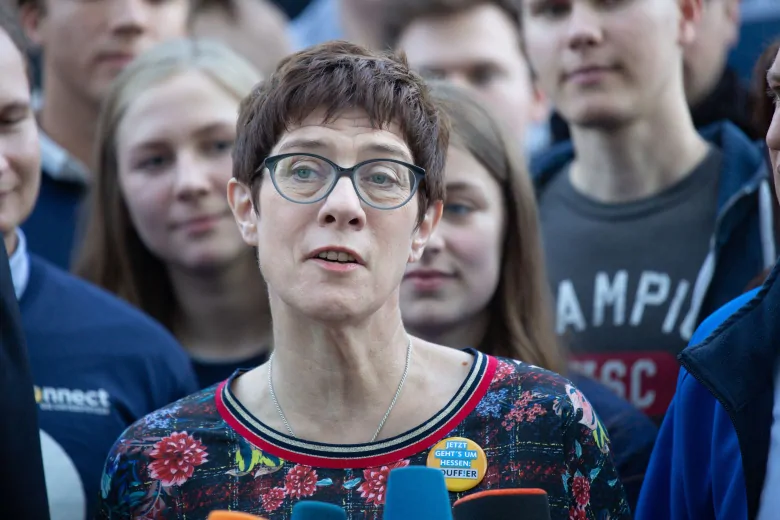
Annegret Kramp-Karrenbauer, secretary general of the CDU, is seen Oct. 21 in Berlin during the election campaign. She is expected to be one of the candidates for party leadership. (Omer Messinger/EPA-EFE)
Merkel’s predecessor, Gerhard Schroeder, stepped down as leader of his centre-left Social Democrats in 2004 as his government struggled, but remained chancellor until he narrowly lost an election 18 months later. Helmut Schmidt, West Germany’s chancellor from 1974 to 1982, never led the Social Democrats.
“The CDU faces a turning point,” Mike Mohring, a regional party leader from eastern Germany, told Welt television. “I have said over the past few days that Angela Merkel knows best what to do, and now she has decided. And that demands respect.”
He said it’s important to avoid “long personnel debates” and restore people’s confidence in the CDU as a governing party.
Merkel has dragged the CDU to the political centre in her years as leader, dropping military conscription, introducing benefits encouraging fathers to look after their young children, and abruptly accelerating the shutdown of Germany’s nuclear power plants following Japan’s Fukushima disaster in 2011.
She allowed in large numbers of asylum seekers in 2015, declaring “we will manage it,” before gradually pivoting to a more restrictive approach. That decision has led to lasting tensions in her conservative Union bloc, particularly with the CDU’s Bavaria-only sister party, the Christian Social Union.