Key ministers from incoming Mexican president Andres Manuel Lopez Obrador’s government are meeting with Canadian officials in Ottawa today.
Foreign Affairs Minister Chrystia Freeland and her counterpart Marcelo Ebrard, as well as International Trade Diversification Minister Jim Carr and the new economy secretary Graciela Marquez, will meet reporters at 1 p.m. ET. CBC News will carry their news conference live.
Seven of Lopez Obrador’s secretaries-designate will not only meet counterparts in Ottawa, but tour Montreal, Toronto and Guelph, Ont., for meetings with provincial governments and various private-sector representatives. In addition to Ebrard and Marquez, the future secretaries for interior affairs, environment, energy, finance and agriculture are on the tour.
Lopez Obrador won Mexico’s July 1 election with 53 per cent of the popular vote. He will be sworn in on Dec.1.
His party Morena, the National Reconciliation Movement, is a left-leaning social democratic movement with nationalist economic policies. It formed a coalition with a leftist workers’ party and the evangelical (socially conservative) social encounter party to win power.
While it’s backed away from extreme nationalist positions, Lopez Obrador’s platfom focused on populist appeals: empowering the underprivileged, alleviating poverty and violence and eliminating corruption among the political and business elites that Lopez Obrador called Mexico’s “mafia of power.”
The incoming administration is expected to pay particular attention to the needs of rural Mexicans, making potentially transformative changes in sectors like agriculture.
Tensions remain over steel
Canada’s relationship with the outgoing Mexican administration became fraught in the final weeks of the renegotiation of the North American free trade agreement, with Mexico agreeing to a bilateral deal with the Americans in August that put Canada under pressure to sign on before the end of September.
A week ago, Mexico’s current economy secretary Ildefonso Guajardo telephoned Freeland to express frustration over new surtaxes Canada is about to levy on $200 million worth of two kinds of Mexican steel exports.
Both countries are trying to persuade the U.S. to lift its steel and aluminum tariffs. No assurances have been provided for Canada or Mexico that the tariffs are coming off soon, and Mexico has suggested it needs assurances before agreeing to a signing ceremony for the new U.S.-Mexico-Canada Agreement.
Mexico believes that Canada’s decision to impose emergency safeguards on energy tubular (pipeline) products and wire rod undermines its argument that its steel exports are fairly priced, despite differences in labour standards and wages across the three countries.
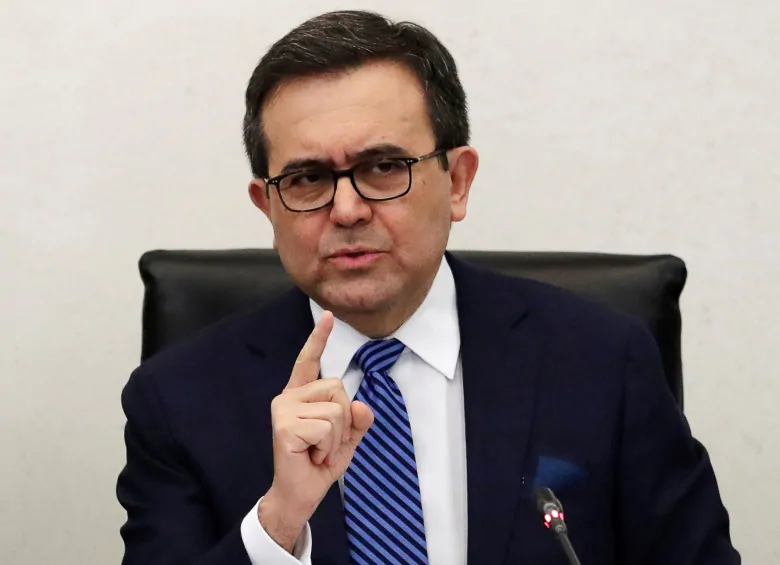
Mexico’s outgoing economy minister Ildefonso Guajardo expressed frustration over Canada’s decision to apply a surtax to two products representing 20 per cent of Mexico’s global steel exports, at a time when both countries are trying to persuade the U.S. to lift other steel tariffs. (Henry Romero/Reuters)
Trump administration officials had portrayed the tariffs as negotiating leverage in the NAFTA talks, leading to expectations that they would be removed when a deal was reached.
The new USMCA trade deal attempts to preserve the integration of North American automotive supply chains, including its integrated steel industry.
Freeland portrays the steel tariffs negotiation as on a “separate track” from the main trade deal.
The U.S. has demanded export quotas from Canada and Mexico in return for the removal of the tariffs, something Freeland has appeared to rule out, despite other reports suggesting the industry was being consulted on what kind of restrictions it could accept.
In an interview with CBC News last weekend, Freeland said two countries want to move their bilateral relationship “beyond the NAFTA talks” and get “off on the right foot.”
She told Chris Hall, host of CBC Radio’s The House:“As far as we know, Canada is the only country that this Mexican team is coming to meet with, and we’re very much looking forward to welcoming them.”
Freeland characterized the incoming government as progressive and said it had strong ties with civil society groups in Canada.