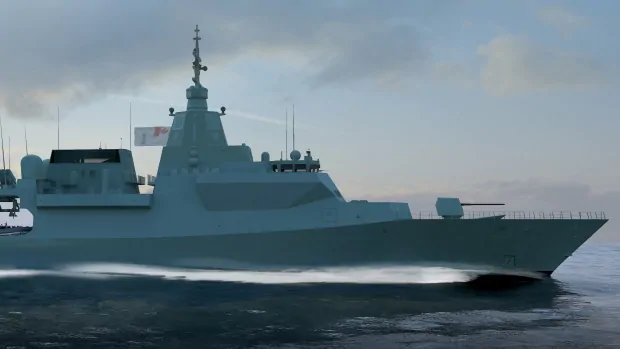
A group of companies led by multinational defence giant Lockheed Martin has been selected as the preferred designer for Canada’s next generation of warships, the Liberal government said Friday.
The announcement that the group’s BAE Type 26 design won the design competition represents a significant step forward for the long-anticipated $60-billion program to replace the navy’s aging fleet of frigates.
“The Canadian Surface Combatant project is the largest, most complex procurement ever undertaken by the Government of Canada. These ships will form the backbone of our Royal Canadian Navy and will be Canada’s major surface component of maritime combat power for decades to come,” Public Services and Procurement Canada said in a press release.
Procurement services and defence officials say this is not the final step; they will now enter into negotiations with the winning bidder to confirm it can deliver everything promised in the complex proposal.
The evaluation, which will take place over the winter, involves verifying the winning company’s financial wherewithal to complete the project, confirming that the proposal meets the military’s combat requirements and hammering down aspects of intellectual property licences.
The federal government now says it expects to award the final design contract sometime over the winter.
It could be 2023 before construction actually gets underway at the go-to yard for warships — Irving Shipbuilding of Halifax.
André Fillion, the assistant deputy minister of defence and marine procurement at Public Services and Procurement Canada, said if the federal government is not satisfied that the top bidder can deliver, it will open negotiations with the second-place team of companies.
Alion Science and Technology, along with its subsidiary Alion Canada, had submitted their proposal based on the Dutch De Zeven Provinciën Air Defence and Command (LCF) frigate.
Navantia, a Spanish-based company, headed a team that included Saab and CEA Technologies.
Its proposal was based on the F-105 frigate design, a ship in service with the Spanish navy.
“The former naval officer in me is very excited,” said Pat Finn, a retired rear admiral who heads up the Department of National Defence’s material branch. “I’ve been around this for a long time.”
Fillion would not say which aspect of the “due diligence assessment” will be the toughest to overcome.
Prior to asking for ship design bids, federal procurement officials spent a lot of time dealing with issues related to intellectual property on the complex systems that will be put into the new warships. Obtaining the necessary clearances is essential in order for the federal government to be able to maintain the vessels in the future.
Failure to do so could cost taxpayers untold tens of millions of dollars — perhaps hundreds of millions — over the five decades the ships are expected to be in service.
Some design changes are expected after the federal government selects an official winner and a contract is in place.
How many changes will be required is a critical question; Finn would only say he doesn’t anticipate cutting steel on the new warships for up to four years.
That fuzzy timeline means the program is already months behind schedule. The design competition was launched almost two years ago, when the Liberal government said selecting a foreign, off-the-shelf design would be cheaper and faster than building a warship from scratch.
Finn acknowledged there will be a production gap at the Irving yard in Halifax of about 18 months between construction of the navy’s Arctic offshore patrol ships and the frigate replacements.
He added, however, that the federal government is looking at a variety of options to keep the yard humming, including refit work on the existing frigates and possibly building an additional patrol ship, or ships.