City officials have shut down a north Edmonton shisha bar called the Nyala Lounge, saying the move came in the interest of public and patron safety.
The move was recommended by the city’s Public Safety Compliance Team (PSCT), the city says in a news release issued Monday.
“The PSCT recommended cancelling the licence in the interest of public and patron safety after repeated violations to safety and security conditions,” the release states, adding a news conference about the closure will be held Monday afternoon.
But the owner, a decorated war veteran who accuses police of harassment and discrimination, says he should have been given a chance to defend himself in court.
Mulugeta Tesfay, who has paid two fines but successfully fought a third of the tickets and two tobacco-related criminal charges, said he learned his business licence was cancelled in a letter dated Sept. 19.
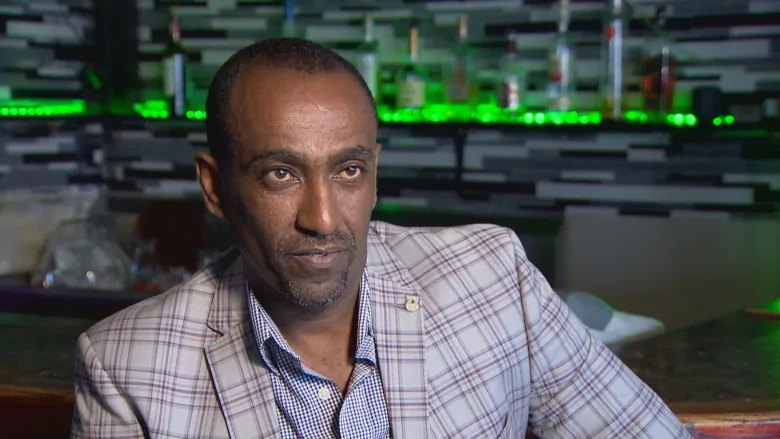
Mulugeta Tesfay says he is a victim of a campaign by police to shut down his business. (Peter Evans/CBC)
Among the reasons, police allege staff and owners hid a firearm someone attempted to use during an altercation at Nyala last January. Tesfay has pleaded not guilty to obstructing a peace officer in that incident.
Police also accuse Nyala of violating conditions imposed on its licence 82 times over 25 inspections in a seven-week period, including infractions surrounding “patron counts, patron scanning and incident logging” that resulted in 12 bylaw tickets.
‘A dangerous environment’
“This inaction presents a dangerous environment for the general public if Nyala is allowed to continue operating,” wrote Melanie Matwie, city program manager for business licensing.
Her letter notes that notice of cancellation sent on Aug. 17 provided Tesfay with a chance to respond by Aug. 31. At the time, Tesfay said he was in Ethiopia visiting his critically ill father, who later died.
“I didn’t even get a chance to respond,” said Tesfay. “So when I read it I was shocked.”
When he initially opened the business, Tesfay said he worked with police for the safety of his customers and community. But police refused to enter into mediation to address some of his growing concerns, he said.
Eventually he formally complained that some officers harassed his customers, who are mostly of African descent. After that, he said, inspections ramped up, and so did the tickets.
“They started coming every weekend, issuing tickets pretty much every Friday, Saturday,” Tesfay said, sitting next to a stack of freshly issued pink tickets at Nyala. “This is pretty much revenge, retaliation — we’re going to give you tickets until you close down.
“A single complaint has destroyed my life.”
Of the total 30 bylaw tickets issued to Tesfay over the past two years, nine were withdrawn or dismissed after he challenged them in court, documents show.
He paid two fines, including one for overcrowding, which the city notified media of in a press release. Tesfay is fighting the remaining 19 infractions at about a dozen trials scheduled over the next several months.
Two tobacco-related criminal charges that prompted police to arrest and detain Tesfay overnight in July 2017 were stayed at a preliminary hearing in July. Tesfay has pleaded not guilty to two additional charges, including one related to the January gun incident.
Tesfay is now trying to sell the building where Nyala is located at 108th Avenue and 98th Street, and says he is struggling to pay next month’s mortgage. He said he’s close to bankruptcy after spending tens of thousands of dollars in legal fees.
Police deny the tickets were motivated by retaliation. Edmonton Police Service communications sent CBC an email stating: “The enforcement conducted on any individual or business is in direct relation to the evidence documented to support action being taken.”
Tesfay and police first spoke to CBC about his case after an appearance before the city’s community standards and licence appeal committee on June 14.
Initially, Tesfay set out to challenge the conditions imposed on his business licence but acquiesced after police argued Nyala should be shut down for public safety reasons.
Among the conditions Tesfay took issue with, he was required to scan customer identification. But Tesfay said police were randomly searching the scanner and it amounted to an electronic form of carding, or street checks, that violated the privacy rights of his customers.
He also said he could no longer make a profit under conditions that shrunk customer capacity from 120 to 44 and required at least three security staff in place after 9 p.m.
‘Ethnically charged suspicion’
In a disclosure document submitted after the June hearing, lawyer Praveen Alwis raised concerns about his client’s arrest on July 8, 2017 — the day after Tesfay filed a formal complaint with the professional standards branch of Edmonton police.
In front of his customers, Tesfay was arrested and handcuffed, then held overnight for a bail hearing.
The disclosure document states that police held him on “primary ground” concerns, meaning they thought Tesfay was a “flight risk” and may not show up in court because of his “roots in Africa.”
But Alwis questions why Tesfay, a Canadian citizen and veteran who won the Sacrifice Medal after serving his country for 20 years, and who has a wife, children and a business in Edmonton plus has no criminal record, would be considered a flight risk.
“This attitude of ethnically charged suspicion has been implicitly demonstrated in the manner in which police have interacted with Mr. Tesfay, his business as well as other members of Edmonton’s African community,” wrote Alwis.
“The timing and nature of his arrest and detention on July 8 reflects a retaliatory and malicious intent on behalf of police,” he added.
In an email to CBC, police said “the EPS vehemently disagrees” with that assessment.
“There are many factors in determining whether an individual is at flight risk, some of which include family and community ties, as well as financial resources,” the email said.