Cedar Meuse-Waterman and Karlee Peck have a unique summer job.
The 14-year-olds from Bear River First Nation in Nova Scotia are learning how to work with birchbark and spruce root, studying alongside Mi’kmaw canoe builder Todd Labrador.
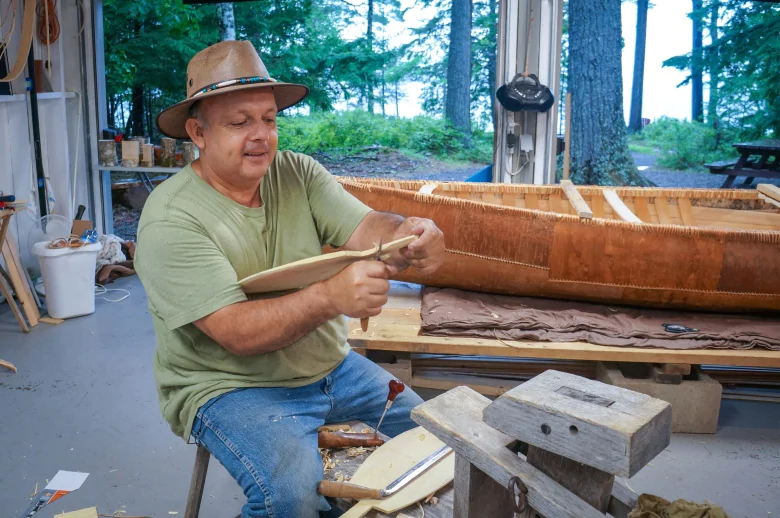
Labrador has been contracted by Parks Canada to build two canoes this summer in a converted picnic shelter in Kejimkujik National Park.
Labrador says he’s turned his focus toward passing along the skills he’s picked up over the past 40 years as he’s gotten older. (Elizabeth McMillan/CBC)
Crafting a canoe by hand is meticulous and time-consuming work, but Labrador doesn’t see it that way. He’s one of the few people who gets excited about spruce roots.
“This is my passion,” he said. “This is what I do on my days off. … When I go to sleep at night this is what I think about, I think about next summer and I think about trees that I saw.”
Labrador is one of the only people in the country with this passion and hopes to share the skills he has picked up with the apprentices and park visitors.

Todd Labrador, Cedar Meuse-Waterman, Karlee Peck and Rose Meuse harvest bark from a birch tree in Kejimkujik National Park. (Elizabeth McMillan/CBC)
“Todd is passing skills and the knowledge that our ancestors had and that’s really special for us,” said Peck.
“There’s always someone laughing, someone always learning, it’s an honour,” added Meuse-Waterman. “I find that making the canoe makes you closer to each other. And it’s not just a way of travel. It’s a way of knowing each other.”
The young apprentices aren’t the only ones getting an education this summer. Park visitors can drop by the workshop five days a week from 2-4 p.m. People can also sign up to work alongside Labrador on Sunday morning.

Cedar Meuse-Waterman uses a hand tool to coax off the outer layer of birchbark. Labrador says the piece of bark could be sewn together to form a canoe in the future. (Elizabeth McMillan/CBC)
Exploring the landscape by canoe has long been a tradition at Kejimkujik and the canoe project is a way to teach visitors about the area’s connection to Mi’kmaq culture, said Jonathan Sheppard, park superintendent.
“The birchbark canoe is such a powerful symbol both of historic and contemporary connection to this site, that working with Mi’kmaq birchbark canoes is really the perfect fit,” he said.
“It is really really rare to see that kind of traditional knowledge, traditional practice and traditional connection in place.”

The group will be starting work on a second canoe July 25. (Elizabeth McMillan/CBC)
Mi’kmaq guides and interpreters have been working in the park for decades and this year’s canoe project is part of efforts across the country to promote Indigenous tourism, Sheppard said.
He said staff have been working with Labrador as he harvests bark and it has helped them understand more about traditional forestry practices.

People can drop by Labrador’s workshop near Merrymakedge Beach in Kejimkujik National Park five days a week. (Elizabeth McMillan/CBC)
Working with Parks Canada is something Labrador has wanted to do for 30 years, he said, adding that he is “very pleased” to be part of the project.
“Many years ago, this was not something that [Parks Canada] considered. I did, I wanted to do it, at that time, it wasn’t something that was in their programming,” he said.
“To me this is home, and it’s just everywhere I walk I feel the ancestors with me and I feel joy because I know they’re happy to see this happening.”

Cedar Meuse-Waterman and Karlee Peck, both 14, are from Bear River First Nation. Labrador and the apprentices have plans to launch both canoes in mid-September. (Elizabeth McMillan/CBC)