An unmanned spacecraft is set to fly to the International Space Station in less time than it takes to fly from Toronto to Edmonton on a passenger plane.
The Progress 70 spacecraft loaded with food, fuel and other supplies, is scheduled to blast off aboard a Soyuz-2 rocket from Baikonur Cosmodrome in Kazakhstan at 5:51 p.m. ET. You can watch the launch live online starting 5:30 p.m.
The spacecraft is expected to dock at the space station at 9:39 p.m. ET.
“The less-than-four-hour trip will demonstrate an expedited capability that may be used on future Russian cargo and crew launches,” NASA said in a news release.
Who’s ready for an amazing <a href=”https://twitter.com/hashtag/Progress?src=hash&ref_src=twsrc%5Etfw”>#Progress</a> <a href=”https://twitter.com/hashtag/MS09?src=hash&ref_src=twsrc%5Etfw”>#MS09</a> cargo launch to <a href=”https://twitter.com/Space_Station?ref_src=twsrc%5Etfw”>@Space_Station</a> today at 5:51p EDT (2151 UTC)? Oh… by the way, it’s going to attempt the fastest-ever rendezvous/docking with Station – Launch to Docking in just 3hrs 48mins (2 orbits)! <a href=”https://twitter.com/roscosmos?ref_src=twsrc%5Etfw”>@roscosmos</a> <a href=”https://twitter.com/hashtag/Soyuz?src=hash&ref_src=twsrc%5Etfw”>#Soyuz</a> <a href=”https://t.co/BbL2Fasvr0″>pic.twitter.com/BbL2Fasvr0</a>
—@ChrisG_NSF
Russian spacecraft are already faster than most others heading to the space station. Since 2013, Soyuz spacecraft have been ferrying astronauts and cosmonauts to the space station in less than six hours, following successful tests with unmanned Progress spacecraft.
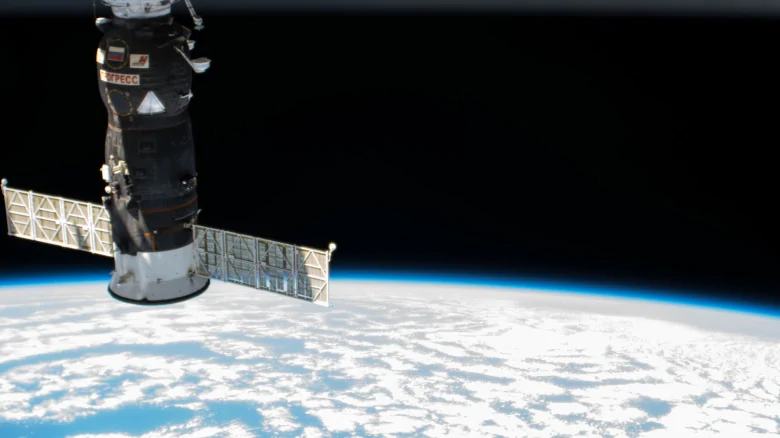
A previous Russian Progress resupply ship is pictured docked to the International Space Station’s Pirs docking compartment as it orbited over the Atlantic Ocean. (NASA)
Most other spacecraft take two or three days to make the journey. Recently, SpaceX’s Dragon capsule launched on June 29 and didn’t arrive at the space station until July 2.
This is the third attempt by the Russian space agency Roscosmos to make the trip at this speed, following just two orbits of Earth. During the first two attempts in October 2017 and this past February, launch delays forced the Russians to revert to an older trajectory that requires 34 orbits and two days.
A Russian Soyuz rocket & Progress supply ship are set for launch Monday on a less-than-four-hour trip to the International Space Station after last-minute launch scrubs prevented two similar fast-track approach attempts in recent months. <a href=”https://t.co/ufOIbvy0v6″>https://t.co/ufOIbvy0v6</a> <a href=”https://t.co/zeuCPedXv5″>pic.twitter.com/zeuCPedXv5</a>
—@SpaceflightNow