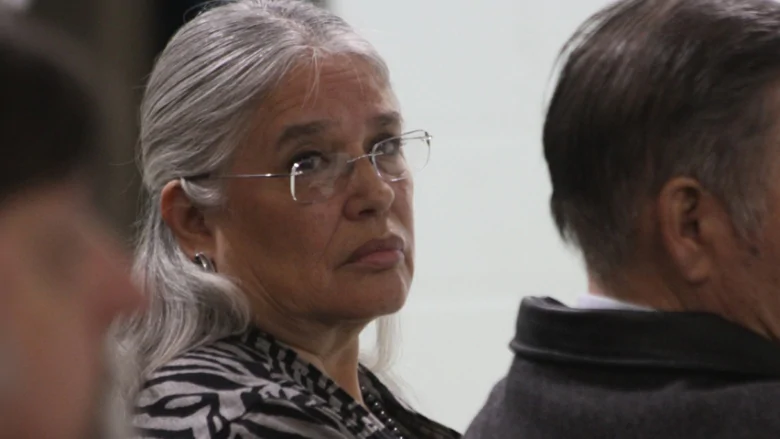
Chief Ava Hill is asking the province’s Attorney General to appeal the not guilty verdict for Peter Khill, with chiefs across Ontario joining the call for “immediate action.”
The elected chief of the Six Nations of the Grand River says if newly appointed Attorney General Caroline Mulroney challenges the verdict in the death of Jon Styres it could be the beginning of an effort to correct systemic discrimination in the justice system.
Styres, from Ohsweken, Ont. on the Six Nations reserve, was shot and killed by Peter Khill in the early morning hours of Feb. 4, 2016 while allegedly attempting to steal his truck.
The 28-year-old Hamilton-area man admitted he shot and killed Styres with two close-range shotgun blasts, but said he was following his military training and fired in self-defence because he believed the other man had a gun.
Six Nations elected chief Ava Hill is calling on Attorney General Caroline Mulroney to appeal Khill’s not guilty verdict. (Jeff Green/CBC)
Court heard Styres did not have a gun when he was killed, just a folding knife which was closed and in his pocket. A jury found Khill not-guilty of second-degree murder on June 27.
In a statement issued Tuesday, Ontario Regional Chief RoseAnne Archibald described Styres as “another victim of senseless violence.”
“This sort of extreme violence – shooting an unarmed man – is not acceptable in Canada,” she said. “No one should place the value of a possession over the sacred life of a human being.”
I urge all Canadians to walk with us on the road of reconciliation.– Ontario Regional Chief RoseAnne Archibald
She added more than 100 chiefs stood in solidarity with Hill and joined her call for the government to take action.
Chief R. Donald Maracle from the Mohawks of the Bay of Quinte specifically joined the call for the Crown Attorney to appeal the verdict “so that justice can be seen to be done.”
The Ministry of the Attorney General did not immediately respond to a request for comment.
Chief compares verdict to Boushie
Archibald also compared the outcome of the Khill trial to the not-guilty verdict of Gerald Stanley, a farmer from Saskatchewan who was acquitted by a jury with no visibly Indigenous jurors for killing Colten Boushie from the Red Pheasant Cree Nation.
The court in the Khill trial took the extra step of asking each potential juror if the fact the accused is white and victim Indigenous would affect how they viewed evidence. The five women and seven men who eventually found Khill not guilty all answered “No.”
Road to reconciliation
But Archibald said Indigenous people across Canada still face prejudice and racism that shakes their confidence in the justice system.
“We cannot afford to lose another generation to a racial divide that seems to put our Peoples at a disadvantage on the day they are born. Mr. Styres’ daughters have lost a father,” said Archibald.” We want them to grow up knowing that there is justice, equality, and love in this country. I urge all Canadians to walk with us on the road of reconciliation.”

Family and friends of Jon Styres hug outside court after hearing Khill was found not guilty on June 27, 2018. (Laura Clementson/CBC)
The calls for justice come after more than 200 people led by women from Six Nations rallied against the verdict at Queen’s Park during what they called a national Day of mourning for Styres, his family and Indigenous people across Canada.
“To say that this verdict is upsetting would be a gross understatement,” read a release from the event organizers. “We are outraged and we will not stand for these types of injustices anymore.”