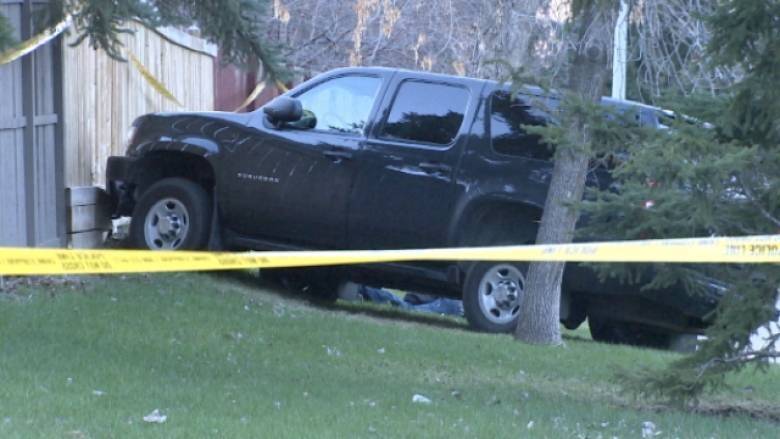
A judge who led a fatality inquiry into the shooting death of a homicide suspect by Edmonton police is recommending officers improve their communications and surveillance technology for future operations.
Judge Steven Bilodeau makes the recommendations in a report released Monday.
An inquiry was held in April into the May 2014 shooting death of 24-year-old David Sandaker, who police believed was responsible for the killing of another man, Michael Hill, in late April of that year.
Sandaker was wanted by police on a Canada-wide warrant when he was spotted on a footpath in a green space near 51st Avenue and 149A Street in Riverbend in the early evening of May 11, 2014.
‘Abort, abort, abort, abort — kid!’
The tactical unit’s plan was to apprehend Sandaker with gas that would “disorient and blind” him, allowing officers to take him down “without further violence.” But the arrest didn’t happen that way.
“The arrest plan did not unfold as envisioned,” Bilodeau said in his report. “If it had, perhaps Mr. Sandaker could have been arrested without the showdown which subsequently resulted in his death.”
A sergeant in one of the vehicles started closing in on Sandaker when he saw a child near the townhouses.
The officer stopped his vehicle and yelled, “Abort, abort, abort, abort — kid!”
But his colleagues, three of whom were sitting inside the same vehicle, didn’t hear the command.
At the fatality inquiry, the officers testified they did not hear the “abort” command. They were wearing gas masks which obstructed their hearing. And two of them were sitting behind a barrier between the sergeant and the rear passenger area.
The sergeant who was driving the covert vehicle told the inquiry the radio was hidden under the dash and was not accessible to him. he couldn’t use it to warn his fellow officers about the presence of the child.
‘Police, get on the ground’
Another tactical officer told Sandaker, “Police, get on the ground” but instead the suspect turned and ran southbound along the greenbelt, chased by members of the tactical unit.
Edmonton police pinned Sandaker against a fence. (CBC)
The officer in that vehicle testified he saw Sandaker pull out a gun and start firing his .45-calibre handgun.
The inquiry heard tactical officers returned fire with Sandaker, shooting up to three times before stopping to assess whether it was safe to shoot again.
One of the tactical officers was shot by Sandaker in the leg.
Sandaker was shot and killed. An autopsy revealed he was hit 10 times, four in the head. He was wearing body armour, and officers found a fully loaded magazine of .45-calibre bullets in his back pocket.
Better radios and ‘military-grade’ drones
Bilodeau makes two recommendations to prevent similar deaths from occurring, the first focusing on “better real-time communications.”
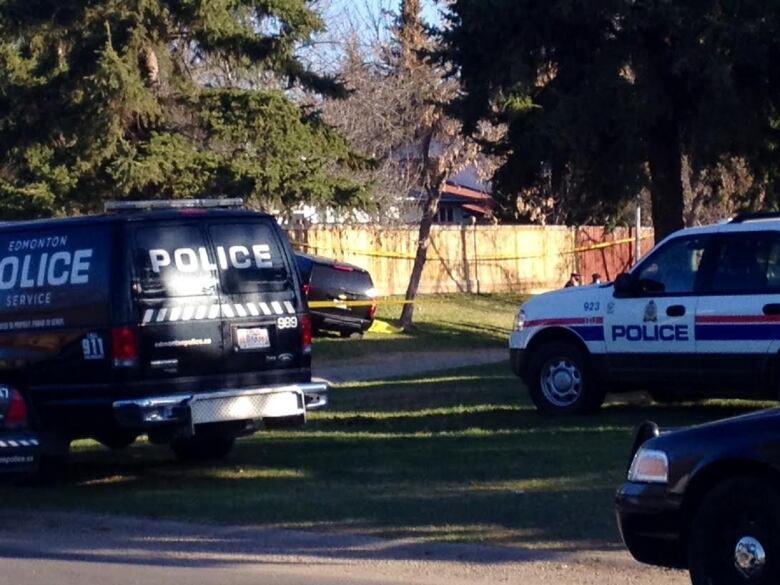
Police vehicles at the scene of the fatal shooting in May 2014. (Lydia Neufeld/CBC News )
If the radio communications were “always on” between the members of the team, they could hear such commands, said the judge.
“Instantaneous real-time communications between the unit leader and the members of the squad could prevent arrest plans from going awry.”
The second recommendation is for “additional surveillance officers” in the form of a “second set of eyes,” although the judge admitted that may not always be feasible.
Bilodeau said a surveillance officer was so fixed on Sandaker, his primary target, that he didn’t see the child between the police vehicle and the suspect.
“Additional or better surveillance might have spotted this unexpected interference to the plan,” the judge wrote.
He also noted technology in the form of “military-grade” drones may also be a solution one day, and urged Edmonton police to explore such solutions.
The inquiry was told that Transport Canada’s list of approved drones does not include the military-grade units “which would be required for what can sometimes amount to an urban combat operation.”