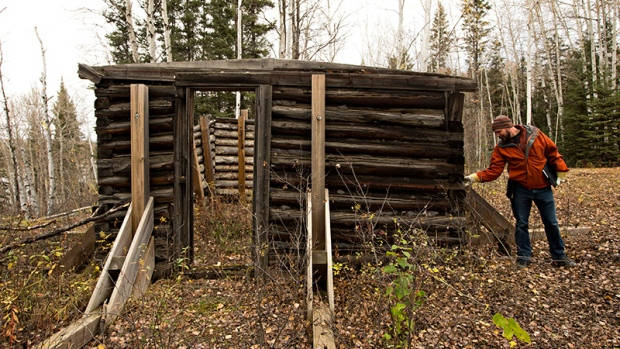
Bitumount, Alberta’s first oilsands processing facility, has seen better days.
But this summer, the province will clean up some elements of the historical site, located about 90 kilometres north of Fort McMurray, before it succumbs to the boreal forest that surrounds it.
“Bitumount is really the granddaddy of all oilsands plants in Alberta,” Matthew Wangler, executive director of the Historic Resources Management Branch, said. “It really traces the very early evolution of oilsands development in the province.”
The province will hire a contractor to remove hazardous materials and buildings that have collapsed. That’s a small step toward preserving this historic resource for a possible future as a museum and an interpretive centre, Wangler said.
Bitumount: A quick history
- Located 90 kilometres north of Fort McMurray, along the Athabasca River
- Between 1925 and 1958, the site was an experimental oilsands plant and camp
- Built upon efforts in the 1920s and 1930s to release the oil trapped in the “bituminous” sands through the hot water method developed by the Dr. Karl Clark of the Research Council of Alberta at the University of Alberta
- Plant was first developed by oilsands pioneer Robert Fitzsimmons
- Taken over by investor Lloyd Champion in 1942 with a deal from the Government Alberta to build a completely new facility
- The government closed the facility after it was able to demonstrate it was possible to separate oil from the oilsands on a large scale commercial basis.
- Designated an historic resource in 1974.
Mercury, asbestos abatement
According to the provincial government’s procurement website, part of the project will need a clean up of toxic asbestos and mercury. Several buildings on the site will also need to be demolished before the fall.
The garage, bunk house, dinning hall, lab and office have collapsed and will be demolished in response to safety concerns.
Two other buildings, Fitzsimmons Cabin and Staff Cabin, will remain intact and be remediated for asbestos.
Five other buildings (the machine shop/warehouse, pump house, the steel shed, power house and separation, and extraction plant) contain trace elements of mercury and cannot be saved, according to the tender document.
“Those buildings have been in a very advanced state of deterioration for some time,” Wangler said. “There has been some challenge with them because the materials that they were constructed from do not lend themselves to long–term preservation.”
As the government is still going through the tender process, there is no final price tag yet for the renovations.
The future of the site
The province has no plans, Wangler said, to immediately create an interpretive centre or museum, but the renovations are a proactive step in that direction.
An interpretive centre, he said, would take considerable time to develop programs, displays, landscaping and parking for visitors.
Wangler said it would take millions to develop and it would likely require support from private donors.
[embedded content]
Follow David Thurton, CBC’s Fort McMurray correspondent, on Facebook and Twitter, or email him at david.thurton@cbc.ca