An era will end in Communist-run Cuba on Thursday when President Raul Castro retires, likely handing over the reins to right-hand man Miguel Diaz-Canel, born the year after Castro and his brother Fidel led their 1959 leftist revolution.
However, after nearly 60 years of Castro rule, the change is not expected to herald sweeping reforms to the island’s state-run economy and one-party system, one of the last in the world.
First Vice-President Diaz-Canel, 57, is seen as a stalwart of the Communist Party, designated by the constitution as Cuba’s guiding political force, who has worked his way up the party’s ranks over three decades.
Raul Castro, 86, will retain considerable power as he will remain head of the Communist Party until a congress in 2021.
-
Analysis
Cuba’s next president won’t be a Castro. Here’s what that means for Canada.
For many Cubans struggling with economic hardships, the transition in leader is seen as merely symbolic.
“We always wish the symbolic would translate into real and concrete actions for our lives,” said Jose Jasan Nieves, 30, editor of an alternative news outlet to the state-run media monopoly. “But this isn’t the case.”
Lawmakers will gather at 9 a.m. ET at a convention centre in a leafy Havana suburb to announce the results of their vote on the unopposed candidacy of Diaz-Canel that was put forward by a party-backed commission on Wednesday. He will be immediately sworn in.
The results of votes for unopposed candidates for the vice-presidents and members of Cuba’s council of state, its top executive body, will also be announced.
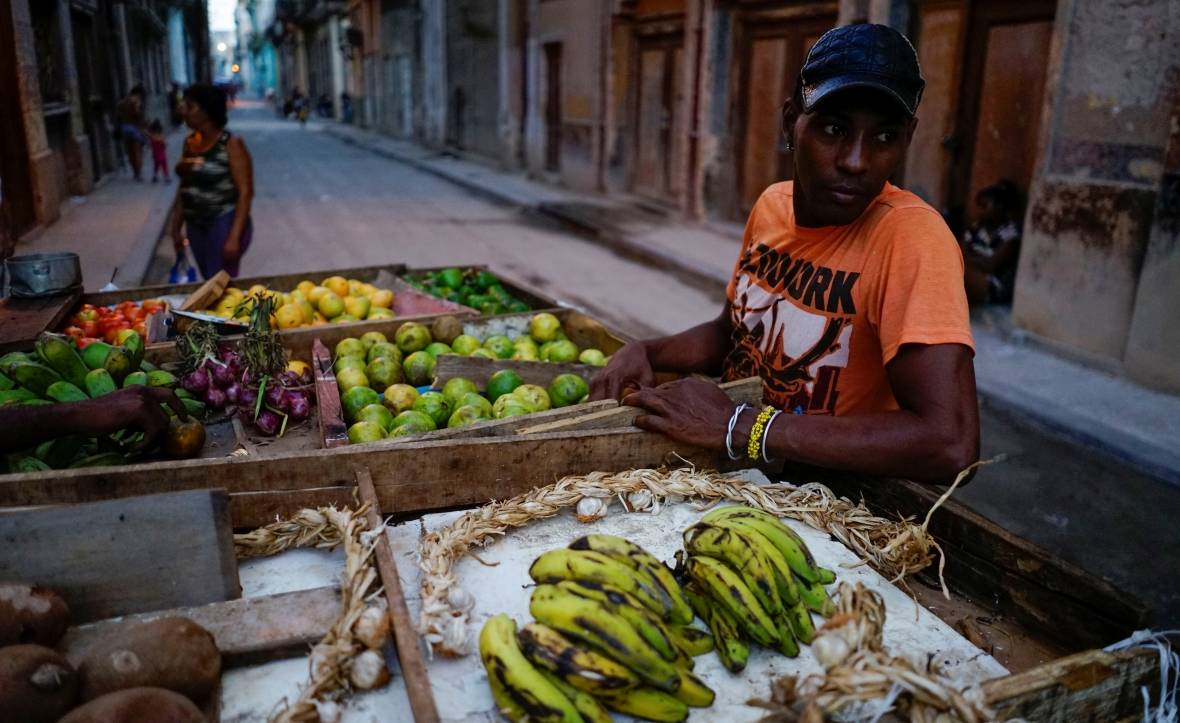
A self-employed vendor sells produce from a cart in Havana on April 14. Analysts say it will be difficult for the incoming president to deepen economic reforms. (Alexandre Meneghini/Reuters)
Cubans hope the next government can resurrect one of the world’s last Soviet-style centrally planned economies that has failed to improve under limited market reforms by Castro.
Those domestic economic woes have been exacerbated over the last year by a decline in aid from ally Venezuela and a partial rollback of a detente with the U.S., which has maintained an economic embargo on the island in the years since the Cold War to try to pressure Havana into change.
Analysts say it will be tricky for Diaz-Canel to get the party and government to deepen the reform process, given his predecessor struggled to do so despite his clout as one of the revolutionary leaders.
Dealing with Trump
Cuba’s relationship with the United States has nosedived since Donald Trump was elected president, another major challenge Diaz-Canel will inherit.
Washington has reduced staffing at its embassy in Havana to its lowest level since the 1970s due to a spate of unexplained illnesses among its diplomats — a political move to justify unraveling the detente, critics say.
The U.S.-Cuba detente, under U.S. President Barack Obama in 2014, was one of the highlights of Castro’s presidency and part of his broader opening of the island in order to preserve Cuban socialism beyond his “historic generation.”
Castro allowed Cubans to travel more freely and to own cellphones and property, while expanding internet access, albeit continuing to limit public dissent.
There is no profitable economy in the world with two currencies.– Jose Luis Gomez, waiter in Havana
On the economic front, he encouraged the creation of small private businesses, from hairdressers to restaurants, while encouraging more foreign investment.
But he did not get around to implementing most of his planned reforms, including key ones such as the unification of Cuba’s dual currency system. Those will fall now to Diaz-Canel.
For more than two decades, two currencies have legally circulated in Cuba at multiple exchange rates, distorting the economy. The peso is used to pay most wages and local goods, while the CUC is used in the tourism industry, foreign trade and upscale eateries, and stores carrying imported goods.
“People are waiting for a solution to the monetary duality,” said Jose Luis Gomez, a waiter at a Havana restaurant. “There is no profitable economy in the world with two currencies.”