Russia’s foreign minister says that a suspected chemical attack in the Syrian town of Douma last weekend was staged with the help of a foreign intelligence agency, without specifying or providing evidence, and sternly warned the West against proposed military action.
Sergey Lavrov said Friday that Russian experts have inspected the site of the alleged attack in Douma, just east of Damascus, and found no trace of chemical weapons. He says Moscow has “irrefutable information that it was another fabrication.”
Lavrov spoke to reporters in Moscow on Friday.
He said that “intelligence agencies of a state that is now striving to spearhead a Russo-phobic campaign were involved in that fabrication.” He didn’t elaborate or name the state.
The attack has drawn international outrage and prompted the United States and its allies to consider a military strike on Syria, something Moscow has strongly warned against.
France’s foreign minister has cancelled trips to Albania and Slovenia because of rising global tensions around the war-torn Middle Eastern country.
Macron claims proof
French President Emmanuel Macron said Thursday he had proof that Syrian President Bashar al-Assad’s government was behind chlorine attacks in recent days. Syria’s government denies responsibility.
On Friday, Macron stressed concerns about the deterioration of the situation in Syria in a phone call with his Russia counterpart Vladimir Putin and called for more dialogue with Moscow, his office said.
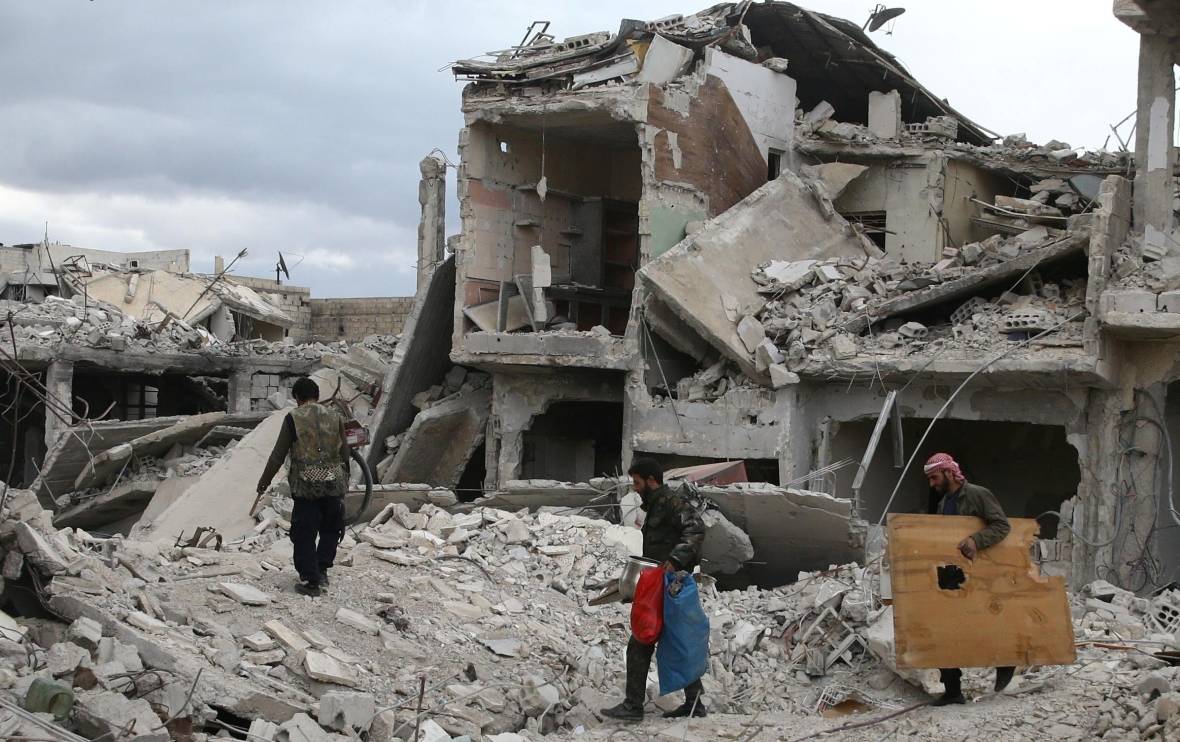
People walk on rubble of damaged buildings in the besieged town of Douma, eastern Ghouta, on March 30. (Bassam Khabieh/Reuters)
U.S. Defence Secretary Jim Mattis warned Thursday that launching a military strike on Syria could spin out of control, suggesting caution in advance of a decision on how to respond to the alleged chemical weapons attack in Douma, which British officials say killed up to 75 people.
“Our strategy remains the same as a year ago,” he said. “It is to drive this to a UN-brokered peace but, at the same time, keep our foot on the neck of ISIS until we suffocate it,” referring to the Islamic State in Iraq and Syria militant group.
Mattis’s remarks at a House armed services committee hearing followed a series of Trump tweets this week that initially indicated he was committed to bombing Syria but later suggested he was awaiting further advice and assessment.
Trump wrote in a Thursday morning tweet that an attack could happen “very soon or not so soon at all.”
Investigators en route
A team of inspectors from the international chemical weapons watchdog is travelling to Syria to begin an investigation into the suspected chemical weapons attack.

A Syrian Army solider gestures as a Russian flag is seen on a military vehicle, at the entrance of the Wafideen camp in Damascus on April 12. (Omar Sanadiki/Reuters)
The fact-finding mission from the Organization for the Prohibition of Chemical Weapons was expected to head to Douma, where Russia said rebels had now capitulated to government control. The Syrian government said it would facilitate the mission’s investigation, which was to begin Saturday.
Syria and its ally, Russia, deny any such attack. Speaking at the United Nations on Thursday, Russia’s UN ambassador, Vassily Nebenzia, said the top priority had to be to avert a wider war, and didn’t rule out the possibility of a U.S.-Russia conflict.
On Thursday, Russia’s military said Douma has been brought under full control of the Syrian government under a Russia-mediated deal that secured the evacuation of the rebels and thousands of civilians after it was recaptured by Syrian forces.
The government, however, said evacuations from Douma were continuing, and no Syrian government forces had entered the town.
Douma and the sprawling eastern Ghouta region near the capital, Damascus, had been under rebel control since 2012 and was a thorn in the side of Assad’s government, threatening his seat of power with missiles and potential advances for years. The government’s capture of Douma, the last town held by the rebels in eastern Ghouta, marked a major victory for Assad.
Speaking to reporters after a closed emergency meeting of the UN Security Council, Nebenzia said Russia was concerned with “the dangerous escalation” of the situation, and “aggressive policies” and preparations that some governments were making — a clear reference to the U.S. and the Trump administration and allies.
“We hope that there will be no point of no return — that the U.S. and their allies will refrain from military action against a sovereign state,” Nebenzia said.
He said “the danger of escalation is higher than simply Syria.”