The U.S. Congress is poised to pass the most significant changes to tax rules in a generation a day after the Senate passed a bill Tuesday evening that free market enthusiasts have been clamoring for for years.
The Republican-controlled U.S. House of Representatives is expected to give its second OK to the bill and send it to the desk of U.S. President Donald Trump to sign into law, sealing his first major legislative victory in office.
In a matter of weeks, Republicans managed to pass the largest overhaul to the U.S. tax code in 30 years, slashing taxes for corporations and the wealthy while offering mixed, temporary tax relief to working American individuals and families.
Not a single Democrat voted for the bill in the Senate, but the Republican-controlled body approved it in the wee hours Wednesday morning in a 51-48 vote. It must now go back to the House for a vote that’s almost sure to pass, before going to the White House to be signed into law.
It’s the most substantive reform of the U.S. tax system since at least 1986, and a distillation of the ethos that has dominated the Republican Party since the Reagan administration: namely, that cutting taxes and regulations and shrinking government will spur businesses to invest, which will in turn boost the economy by creating jobs and money for all that will trickle down, in time, to ordinary Americans.
“It would be good in the short term,” said Sung Won Sohn, economics professor at California State University, Channel Islands. “Corporate cash flow would improve, helping investments. Businesses would be spending money and then hiring people.”
The sprawling, debt-financed legislation would cut the U.S. corporate income tax rate to 21 per cent from 35 per cent, give other business owners a new 20 per cent deduction on business income and reshape how the government taxes multinational corporations along the lines the country’s largest businesses have recommended for years.
But millions of Americans would stop itemizing deductions under the bill, which would put tax breaks that incentivize home ownership and charitable donations out of their reach, but also making tax returns somewhat simpler and shorter.
The total cost of the legislation is estimated to be at least $1.5 trillion US over the next decade, Toronto-Dominion Bank said in a note to clients Wednesday morning.
“It will also add to a national debt level already set to rise,” the bank said. “Over the medium term, this poses several risks to government finances and the economy. The TCJA ultimately reflects an intergenerational shift of the tax burden to future taxpayers.”
The White House and the Treasury Department say it will add as much as a full percentage point to economic growth, but non-partisan estimates are far lower. The Congressional Budget Office says the impact is likely to be closer to 0.12 percentage points per year, on average.
TD Bank puts the figure at between 0.1 and 0.3 points per year.
The corporate tax cuts would be permanent, but cuts to personal income taxes are set to expire in 2025, something that will “set up a fiscal cliff battleground for a future administration,” TD said.
Debt-financed legislation
The bill would keep the current number of tax brackets, but adjust many, though not all, of the rates and income levels for each one. The top tax rate for high earners would be reduced. The estate tax on inheritances would be changed so far fewer people would pay.
In two provisions added on to secure needed Republican votes, it also would repeal part of the Obamacare health system and allow oil drilling in Alaska’s Arctic National Wildlife Refuge.
Democrats have railed against the legislation as a giveaway to the wealthy and the business community that would widen the income gap between rich and poor, while adding $1.5 trillion US over the next decade to the $20 trillion U.S. national debt, which Trump promised in 2016 he would eliminate as president.
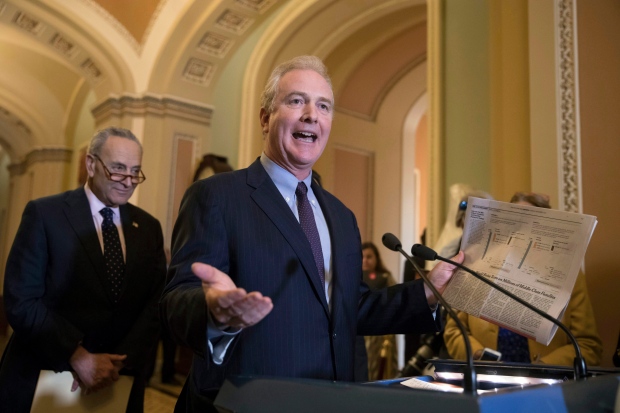
Sen. Chris Van Hollen, joined at left by Senate minority leader Chuck Schumer on Nov. 7 in Washington, refers to a newspaper article as he challenges claims by Republicans about the party’s tax reform plan. (J. Scott Applewhite/Associated Press)
Democratic Sen. Chris Van Hollen said the bill “will harm millions of middle-class families … It contains huge, permanent giveaways for big banks and corporations, and asks our children, millions of working Americans and senior citizens, and future generations to pay the price.”
Backers of the bill say the tax breaks would spur corporations to invest and hire more workers. But U.S. companies already hold nearly $2.4 trillion US in cash on their books which they aren’t investing, said Joseph Song, senior economist at Bank of America Merrill Lynch.
“It’s not like they’re dying for extra cash.”
Although Republicans all voted for the bill, a few expressed concerns about its impact on the government debt, by cutting so deeply from tax revenues.
Today, the Senate delivered on its promise of allowing Americans to keep more of their hard-earned money, a commitment I worked to hold it to by fighting to make sure the bill became a bigger and better tax cut and included repeal of the Obamacare individual mandate.
But the party leadership insists the tax cuts will pay for themselves.
“We’ve had two quarters in a row of three per cent growth. The stock market is up. Optimism is high. Coupled with this tax reform, America is ready to start performing as it should have for a number of years,” said Senate Republican leader Mitch McConnell after the chamber’s vote.
Despite Trump administration promises that the tax overhaul would focus on the middle class and not cut taxes for the rich, the non-partisan Tax Policy Centre, a think-tank in Washington, estimated middle-income households would see an average tax cut of $900 US next year under the bill, while the wealthiest 1 per cent of Americans would see an average cut of $51,000.
Republican congressional leaders and White House officials drafted the bill behind closed doors, unveiling it on Sept. 27.
No public hearings were held and numerous narrow amendments favoured by lobbyists were added late in the process, tilting the package more toward businesses and the wealthy.
“When future generations look back at the short and messy history of the Republican tax bill, its most enduring lesson will be what it has taught us about how not to legislate,” said Senate Democratic leader Chuck Schumer on the Senate floor.
“After only a few months of frantic backroom negotiations by only one party, we are left with a product as sloppy and as partisan as the process used to draft it…. What a disgrace.”
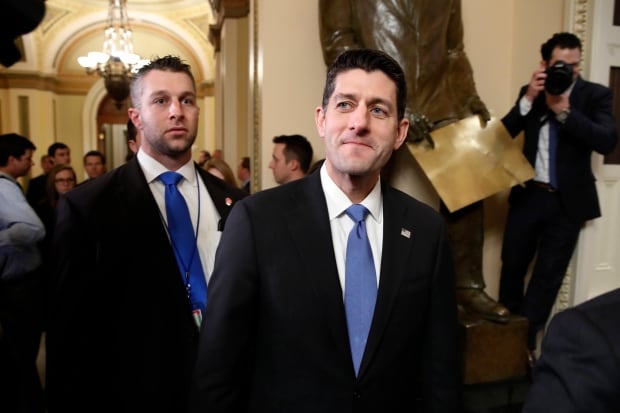
House Speaker Paul Ryan of Wisconsin leaves the House chamber after voting on the Republican tax bill Tuesday. Republicans muscled the most sweeping rewrite of U.S. tax laws in more than three decades through the House. (Jacquelyn Martin/Associated Press)
U.S. House Speaker Paul Ryan defended the bill in television interviews on Wednesday morning, saying support would grow for the tax plan after it passes and Americans felt relief.
“I think minds are going to change,” Ryan told ABC’s Good Morning America program.
In an overnight post on Twitter, Trump said he would hold a news conference at 1 p.m. ET if the House approves
it.