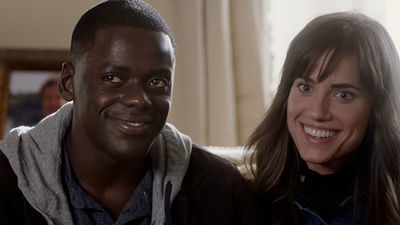
As soon as I heard that Jordan Peele’s debut feature had the plot of an edgy indie romantic comedy but was in fact “a horror movie,” I knew it was going to be terrific. There was just no way it couldn’t be. I rarely feel this confident about a film sight-unseen, but as a longtime fan of Peele, it seemed clear that he knew exactly what his movie was about a deep level. “A black man meets his white girlfriend’s parents for the first time; it’s a horror movie” is the kind of pitch that might earn a delighted “I’m down, brother!” chuckle from the father of said white girlfriend, a brain surgeon played by Bradley Whitford who tells the hero Chris (Daniel Kaluuya) that he would vote for Obama a third time if he could. But for all its laughs, both subtle and broad—and for all its evident familiarity with crowd-pleasing yet grimly clever ’80s horror comedies like “They Live!”, “Fright Night,” “Reanimator,” “The People Under the Stairs,” “The Hidden,” “Child’s Play” and other movies that people in their 30s and 40s saw multiple times at dollar theaters and drive-ins and on cable—”Get Out” is no joke. It made all as much money as it did because everyone who saw it, including the ones who only went because everyone else they knew had already seen it, instinctively sensed that it was observing this moment in American history and capturing it, not just for posterity’s sake or for perverse entertainment value but as monument and warning.
It’s a Great American Movie in the vein of the Great American Novels that used to be published in the middle part of the 20th century when reading novels was a common and desirable thing to do, not a niche activity that marked Americans as “elites,” though of course most of the people writing Great American Novels were white men, and somehow the movie makes us aware of that, too, incidentally, by rooting us almost entirely in the point-of-view of a young black man whose singular and utterly absurd and of-course-non-representative experience (cult leaders! body theft! slave auctions!) somehow illuminates the condition of blackness in 2017. “Get Out” is as much a corrosive social satire and a despairing, laugh-so-you-don’t-cry lament as it is a one-stop-shopping fright flick, stuffed to bursting with paranoid visions, Freud-and-Jung saturated nightmare landscapes, abductions and tortures and revenge killings, and freakish medical procedures that fuse the Tuskegee Experiment, Jeffrey Dahmer’s basement, the Ludovico Technique from “A Clockwork Orange,” and the mournfully cosmic finale of “Being John Malkovich.” If Luis Bunuel had somehow ended up working for Cannon Films during the Reagan years, he might’ve made something in this vein, although not as raucously entertaining, and not with these inside-America cultural references.
So many of the horror spoofs on Peele’s great sketch comedy series “Key & Peele”—a collaboration with Keegan Michael Key and director Peter Atencio—were not just certifiably nerdy send-ups of particular films, but great approximations of the very essence of the thing being spoofed. Baby Forest Whitaker, one of my favorite Peele characters, is funny at first because he’s so random, but after a while he’s funny because he’s uncanny enough to raise the hairs on your arm; the mad glint in Peele’s eyes as he plays him confirms that he knows that one important source of terror is the inability to tell if you’re dealing with someone who’s truly unhinged or evil or a prankster who’s just messing with you. It’s that kidding/not-kidding-at-all thing that often marks the truly unnerving, great popular art. “Get Out” has it, too, in every shot of every scene. There are also splashes of Roman Polanski in there (the question, “Am I imagining all of this?” recurs in most Polanski thrillers) and David Cronenberg and William Shakespeare. Chris is a high achieving man of color, an island unto himself here, Othello with a camera—a black man who has theoretically been welcomed into a white world with open arms yet can never relax because his favored status is precarious and founded on stereotypes and acquisitiveness, and can be soured or contaminated or taken away from at any moment, along with his life.
And yet the totality of “Get Out” is so original that it defies labels. It seems to have been thought about daily for years or longer, so exact are its meanings, references, compositions, cuts and music cues. Peele’s command of historical and literary symbolism is so complete that he can free-associate even as his script is taking care of business, delivering necessary plot details and making us laugh. So many details here have an audacious charge that goes beyond character building to connect with something larger and more sinister, such as the shot of Chris’ girlfriend Rose (Alison Williams, cast like a irredeemably sinister version of her character from HBO’s “Girls”) sitting on her bed eating dry Fruit Loops and sipping milk through a straw a separate glass; it’s another admiring Kubrick shout-out in a movie with lots of them, but there’s an element of “I see you out there, white supremacists” as well: there’s an entire subcategory of YouTube videos in which white folks ostentatiously drink milk to prove they’re genetically superior to black folks, who are more likely to be lactose intolerant. In the finale of a movie that’s as much about the image of black manhood in high and low culture as it is a freestanding thrill-ride of a horror- comedy, Peele presents us with black man whose life is saved by picking “cotton” (from the chair), a runaway slave who (Django style) sets a plantation on fire and kills every white tormentor living in it, and an Othello who has an excellent reason to strangle Desdemona. (As Sophie Oberfield, a teacher, points out, in this “Othello,” Desdemona is actually Iago.)
Is “Get Out” a comedy, as the film’s distributor decided to brand it for Golden Globe submissions? Yes, it’s a comedy. But not in the “Annie Hall” or “Young Frankenstein” sense. “Get Out” is a comedy in the “Dr. Strangelove” or “Network” or “Slaughterhouse Five” sense, or in the sense of David Cronenberg’s “Naked Lunch” or “Cosmopolis,” where the laughs catch in the throat. Of course it’s a horror movie too, and an assured one. The conversations between Chris and Betty Gabriel’s Georgina, the shots of the groundskeeper Walter (Marcus Henderson) racing towards the camera out of the gloom, his arms piston-pumping, and the ominously lowering boom shots of the old-fashioned TV console playing historical/expository videos for the abducted and trussed-up Daniel in the basement: these all bespeak a deep knowledge of horror movie grammar through the ages. But the knowledge is tied to wisdom. This movie is the work of an observer, not just an entertainer. “It’s the eyes, man!” says Stephen Root’s old hipster white guy, a character that Chris thinks (or hopes) is the one non-black face in that suburban enclave who kinda, sorta gets him. Chris is given shreds of kindness or hope throughout the film but they are nearly always snatched from him, just as so many young men in “Get Out” have been snatched from their normal environments (abducted like slaves) and exploited, turned into empty vessels that other people’s fantasies will be poured into. The motif that ties the entire movie together is the sight of Chris’ eyes filling with tears. This is a movie that weeps for the world that made a film like “Get Out” necessary.
I’ve heard a number of people say that they like “Get Out” until the final act, when they feel that it becomes too much of a crowd pleaser, and that it would have been stronger had it stuck with its original ending: the cop car that shows up isn’t driven by his TSA agent buddy (Lil Rey Howery) but by white police officers who arrest Christ, eventually landing him in a prison cell where he can never prove that his killing of all those white folks was justified. I prefer the movie’s existing ending, not in spite of the fact that it’s a fantasy, but specifically because it’s a fantasy. It’s more daring to end a movie like this the way Peele ends it, because it tells audiences that a nightmarish satire on exploitation and powerlessness can be crowd-pleasing if the victimized hero turns the tables and lashes out rather than collapsing into a ball in the corner of a cell somewhere and trying to take comfort in the knowledge that he, at least, knows what actually happened.
It’s a form of optimism, this end, weird as that probably sounds. Chris was, to paraphrase Malcolm X, Hoodwinked! Bamboozled! Led astray! Run amok! But then he came out of the Sunken Place—the one where Rose’s mother Missy (Catherine Keener, a “Being John Malkovich” alum) kept plunging him by stirring tea rhythmically in a teacup—and put into cartoonishly bloody action another X quote: “It doesn’t mean that I advocate violence, but at the same time I am not against using violence in self-defense. I don’t even call it violence when it’s self- defense. I call it intelligence.