More women from Innu communities on Quebec’s Lower North Shore are coming forward with stories of being sexually abused by a Catholic priest who worked in their territory for decades.
The allegations come after two women who had lived in Pakua Shipu, one of the last communities on the Saint Lawrence coast before the Labrador border, told the national inquiry into missing and murdered Indigenous women and girls (MMIWG) Tuesday they were victims of a Belgian missionary named Alexis Joveneau.
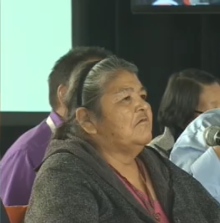
Simone Bellefleur testified Wednesday, on the third day of the inquiry’s Quebec hearings now underway in Mani-Utenam, near Sept-Îles, 900 kilometres northeast of Montreal.
Bellefleur said she met Joveneau in Unaman Shipu, the Innu name for the village better known in Quebec as La Romaine.
Joveneau, who worked in several remote Innu communities along the St. Lawrence River, died in Unaman Shipu in 1992.
Simone Bellefleur testified she met a Belgian priest named Alexis Joveneau in Unamen Shipu and he sexually abused her from the age of 10 until she married at 19. (CBC)
Bellefleur said the abuse started when she was about 10, until she got married at 19.
“Normally, when we go to the confessional, we kneel down, but he’d ask us to sit on his lap,” Bellefleur told the inquiry. “It’s the same story as yesterday.
“He was behind me, he started touching my breasts, then he’d touch my thighs, and went down towards my hips.”
The allegations against the priest were first raised Tuesday by Mary Mark, who was living in Pakua Shipu when she says she was first abused by Joveneau.
She said Joveneau asked her to sit on his lap and started touching her chest when she went to confession.
“I am sure I wasn’t the only one to live that kind of things; there were others,” Mark said.
Bellefleur echoed Mark’s sentiments Wednesday, telling the inquiry she knew of several other women in Unamen Shipu who had been victims of Joveneau’s abuse as girls.
She said Joveneau’s actions left deep scars in the community.
“The priest showed us how to fight amongst ourselves. He broke the values we had.”
Families from Unamen Shipu, Natashquan and Uashat are expected to speak on 3rd day of @MMIWG inquiry #MMIWG pic.twitter.com/zO71O234TD
‘Like a god’
Thérèse Lalo also testified about alleged abuse by Joveneau, saying she never spoke about what she went through until the preliminary hearings of the inquiry visited Pakua Shipu in September.
“I could not talk about it; he was like a god.”
She said he was feared in the community because he had moral authority, but was also admired and charismatic.
“I remember his laugh,” she said, adding she was always afraid she would run into him.
Intense 2nd day of hearings @MMIWG finishes with dance and song, offered as gift by last family from Pakua Shipi, Que. #MMIW #MMIWG pic.twitter.com/2AgTBYsy7t
She said she also witnessed the priest assault her mother, and that when she told her father about the assault, he beat her.
Lalo said that was the start of more conjugal violence in the family.
She thanked the commissioners for hearing her story, questioning “why there wasn’t this kind of panel before to talk about this.”
Oblates offer ‘full collaboration’
Joveneau was a member of the Missionary Oblates of Mary Immaculate (OMI), a congregation founded in France in the early 1800s which sent its first missionaries to Canada in the 19th century.
“The Oblate Fathers are deeply concerned following the testimonies heard during this inquiry and hope light can be shed on these events,” the congregation said in a statement, after the first allegations against Joveneau were raised at the inquiry on Tuesday.
“The Oblate Fathers fiercely hope that the members of the community can testify openly to find peace. We condemn any form of physical or psychological violence.”
The inquiry’s hearings began in Whitehorse in May, and proceedings have taken place in British Columbia, Manitoba, Nova Scotia, Alberta and Saskatchewan so far. Hearings are scheduled for Thunder Bay, Ont., and Ranklin Inlet, Nunavut, next month, and for Yellowknife in the new year.