Catalan regional leader Carles Puigdemont said on Wednesday he was in favour of mediation to find a way out of the Catalan crisis, but the Spanish government has not agreed.
“This moment calls for mediation. We have received various offers in the last hours and we will receive more. All of them know I am ready to start a mediation process,” he said in a televised address. “I will repeat it as many times as necessary: dialogue and agreement are part of the political culture of our people, however, the state has not given any positive answer to those offers,” he said.
Puigdemont called the government of Prime Minister Mariano Rajoy “irresponsible” for not accepting mediation in the deadlock.
Rajoy’s office replied in a statement that, “If Mr. Puigdemont wants to talk or negotiate, or wants to send mediators, he knows perfectly what he first needs to do: go back to the law.”
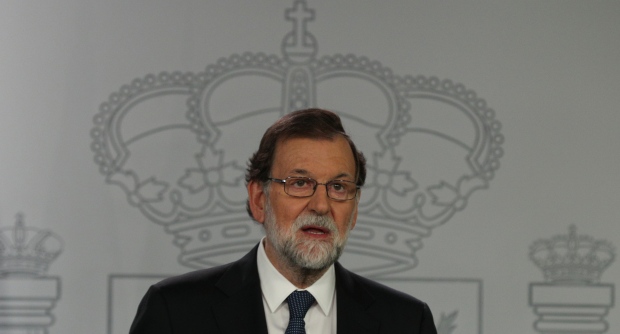
Spain’s Prime Minister Mariano Rajoy delivers a statement at the Moncloa Palace in Madrid on Oct. 1. Puigdemont called Rajoy’s government ‘irresponsible’ for not accepting mediation in the deadlock. (Sergio Perez/Reuters)
Catalonia’s regional government on Wednesday mulled when to declare the region’s independence from Spain, with some lawmakers saying it would happen next Monday, following the referendum on Oct. 1 that the Spanish government and courts have declared illegal.
“I am sure that in the next few days we will show the best of our country when the institutions of Catalonia will have to apply the results of the referendum,” Puigdemont said.
He also criticized King Felipe VI for following what he said were the government’s “catastrophic” policies toward Catalonia.
“You have disappointed many Catalans,” Puigdemont told the king. Criticism of the king by a governing politician is unusual in Spain. Puigdemont also said the king has failed to perform “the role of moderator.”
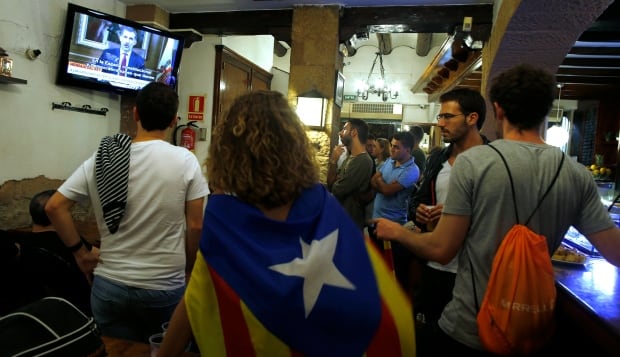
People, one of them with a Catalan independence flag around her shoulders, watch Spain’s King Felipe’s TV address about the situation in Catalonia in Barcelona on Tuesday night. (Manu FernandezAssociated Press)
The Catalan president said both the government in Madrid and the king “ignored deliberately the Catalans who have been victims of the police violence that has stopped the hearts of half the world.”
Politicians in other parts of Spain and a handful of civil groups have offered to try to bridge the divide between the two sides, but Rajoy said no dialogue can take place outside of the country’s constitution, which doesn’t include provisions for a region to secede.
“Mr. Puigdemont has been outside of the law for way too long,” Rajoy’s deputy, Soraya Saenz de Santamaria, said, responding to the remarks Puigdemont made in the televised address.

Spanish Deputy Prime Minister Soraya Saenz de Santamaria in Spain’s parliament with Prime Minister Mariano Rajoy on May 31, said Wednesday ‘Mr. Puigdemont has been outside of the law for way too long.’ (Juan Medina/Reuters)
European leaders have sided with Spain and, amid fears that Catalonia’s secession bid could find echoes elsewhere on the Continent, the European Union has so far refused to step in.
European Commission Vice-President Frans Timmermans stressed on Wednesday the need for Spain and Catalonia to talk with each other, but said there is a “consensus that the regional government of Catalonia has chosen to ignore the law when organizing the referendum.”
Puigdemont will address the regional parliament Monday to review the disputed vote — a session that his parliamentary supporters in the radical CUP group say they will consider the independence declaration.
Spain could impose martial law
Rajoy’s conservative government has pledged to respond with “all necessary measures” to counter Catalan defiance, without revealing how it intends to do so.
It’s anybody’s guess what might happen if the prosperous northeastern region does actually try to secede. Spain could intervene to take over the regional government; it could even declare a state of emergency and impose martial law.

A Spanish riot police officer shoots a rubber bullet at people trying to reach a voting site at a school assigned to be a polling station by the Catalan government in Barcelona on Sunday. (Emilio Morenatti/Associated Press)
The route to becoming independent won’t be easy for Catalonia. The region doesn’t have any power over defence, foreign affairs, taxes, ports or airports, all of which are in the hands of the Madrid government. The European Union has also said that an independent Catalonia cannot stay in the bloc, but must apply to join — a lengthy, uncertain process.
Perhaps hinting at compromise, in his TV address Puigdemont said Catalonia “wants to continue contributing to the development of the Spanish state.”
Xavier Garcia Albiol, Rajoy’s party deputy in Catalonia, called Wednesday for Catalans who want to stay inside Spain to join a rally Sunday in Barcelona, the region’s main city.
Spain’s National Court, meanwhile, said it will quiz two senior officers of Catalonia’s regional police force and the leaders of two pro-independence civic groups who have been placed under investigation for sedition.
Led by losses for the two main Catalan banks, Spain’s main stock market index lost almost three percentage points in Wednesday’s trading amid uncertainty over how the secession bid will proceed.