Florida Highway Patrol troopers are monitoring the high volume of traffic heading north on the Turnpike as people evacuate South Florida ahead of Hurricane Irma, which is expected to make landfall in the state early Sunday morning.
In a news release Thursday, the highway patrol said extra troopers, road rangers and wreckers will be on the roadways to help drivers whose vehicles have become disabled.
The agency says disabled vehicles left on the shoulders of the highways would be towed starting Thursday morning to make it easier for emergency workers trying to reach crash victims.
Turnpike officials are also using cameras along the road to monitor conditions.
The storm was increasingly likely to rip into heavily populated South Florida early Sunday, prompting the governor to declare an emergency and officials to impose mandatory evacuation orders for parts of the Miami metro area and the Florida Keys about 24 kilometres to the south of the Florida city.
About 100,000 in Miami-Dade County, many in low-lying areas, were subject to an evacuation order to begin Thursday.
Forecasters said it could punish the entire Atlantic coast of Florida and rage on into Georgia and South Carolina.
“This could easily be the most costly storm in U.S. history, which is saying a lot considering what just happened two weeks ago,” said Brian McNoldy, a hurricane researcher at the University of Miami, alluding to the damage caused by Hurricane Harvey.
No one is expecting Irma to flood Florida on a similar scale, however. Harvey sat over Houston for days, dumping up to 127 cm of rain. Irma is moving swiftly and should bring less than a quarter of that to Florida cities.
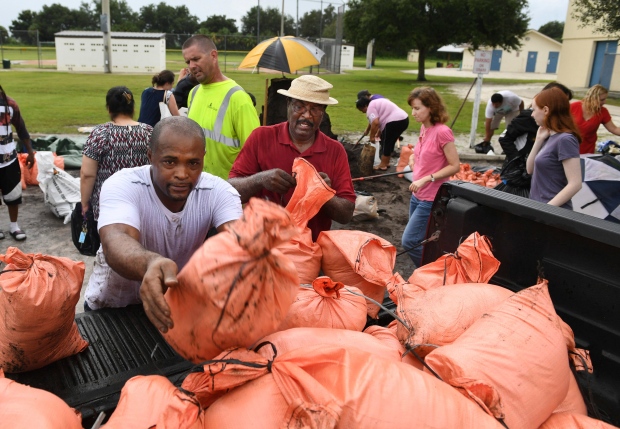
James Byrd, left, and Richard Clark, right, load their sandbags in a truck Wednesday at Newtown Estates Recreation Center in Sarasota, Fla., as they prepare for Hurricane Irma. (Mike Lang/Sarasota Herald-Tribune via AP)
South Florida also has a better flood control system — the ground is more porous and there aren’t any hills to send water rushing down from above, said Hugh Willoughby, a former research director at the National Oceanic and Atmospheric Administration (NOAA) and now a professor at Florida International University in Miami.
Still, many Floridians could find themselves with no money for flood repairs, just like people in Houston, where flood coverage dropped by nine per cent since 2012.
Flood insurance rates lacking
Gov. Rick Scott said he planned to activate 7,000 National Guard soldiers by Friday. He warned that Irma is “bigger, faster and stronger” than Hurricane Andrew, which wiped out entire neighbourhoods in south Florida in 1992.
Until Hurricane Katrina over 12 years later, Andrew was estimated as the costliest storm in U.S. history, according to the National Weather Service.
The latest forecasts suggest Irma’s most destructive winds could carve up much of Florida’s priciest real estate, damaging properties from the Florida Keys through Jacksonville as it swirls north.
An Associated Press analysis shows a steep drop in flood insurance across the state, including the areas most endangered by what could be a devastating storm surge.
In just five years, the state’s total number of federal flood insurance policies has fallen by 15 percent, according to Federal Emergency Management Agency data.
Bracing for hurricane Irma in Florida5:31
Florida’s property owners still buy far more federal flood insurance than any other state — 1.7 million policies, covering about $42 billion US in assets — but most residents in hazard zones are badly exposed.
With about 2,173 kilometres of coastline, the most in the continental United States, Florida has roughly 2.5 million homes in hazard zones, more than three times that of any other state, FEMA estimates. Yet across Florida’s 38 coastal counties, just 42 per cent of these homes are covered.
Georgia, Carolinas also monitoring
Florida’s overall flood insurance rate for hazard-zone homes is just 41 per cent. Fannie Mae ostensibly requires mortgage lenders to ensure property owners buy this insurance to qualify for federally backed loans, and yet in 59 per cent of the cases, that insurance isn’t being paid for.
In the counties under at least partial evacuation orders Wednesday (Collier, Broward, Monroe and Miami-Dade), where 1.3 million houses are estimated to be in flood hazard zones, the percentage is an even lower 34.3 per cent.
If Irma’s eye follows a track just west of Florida’s eastern coast, the initial storm surge could heavily damage the Florida Keys, the cities at the southern tip of Florida’s mainland, Florida City and Homestead, parts of Miami and Miami Beach, and other Atlantic coast cities, said Brian Haus, a professor of ocean sciences at the University of Miami’s Rosenstiel School of Marine and Atmospheric Science.
If Irma’s eye moves instead up Florida’s west coast, that would put Tampa, St. Petersburg and other Gulf cities in danger to significant storm surge, Haus said.

Residents line up for propane in Boca Raton, Fla., on Thursday. (REUTERS)
The declines in flood insurance coverage started after Congress approved a price hike in 2012, making policies more expensive.
Maps of some high-risk areas were redrawn, removing a requirement that these homeowners get the insurance. About seven of 10 homeowners have federally backed mortgages, and if they live in a high-risk area, they still are required to have flood insurance. But many let their policies slip without the lender noticing; loans also get sold and repackaged, paperwork gets lost and new lenders don’t follow up.
FEMA, which is ultimately responsible for enforcing flood insurance requirements, did not respond to an email seeking comment from its Washington office on Wednesday.
Shifting forecasts have also prompted emergency declarations in the Carolinas and coastal Georgia, including areas that haven’t suffered a direct hit from a major hurricane in more than a century.
Georgia Gov. Nathan Deal declared a state of emergency Wednesday for the state’s 160-kilometre swath of Atlantic coast, which was last struck by a hurricane of force Category 3 or higher in 1898.
His South Carolina counterpart, Gov. Henry McMaster, declared an emergency for that neighbouring state as officials assessed the chances of receiving a major hurricane strike there for the first time in nearly 28 years.
McMaster cautioned it wasn’t yet an order of evacuation, but that could occur as early as Friday.
“When that hurricane is coming, when it gets close, it’s too late.”