The first restaurant in Edmonton to adopt a non-tipping policy is now letting customers tip their servers.
Café Linnea, at 10932 119th St., opened in July 2016 with a novel concept for Edmonton — tips for servers were included in menu prices.
Servers were paid a higher wage than they would receive at other restaurants but didn’t get anything extra in the way of tips.
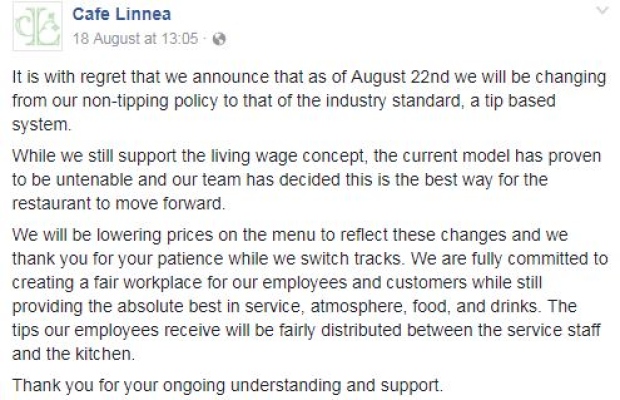
On Aug. 18, 2017, Café Linnea announced on its Facebook page and menus that it was changing to a tip-based system.
“While we still support the living wage concept, the current model has proven to be untenable and our team has decided this is the best way for the restaurant to move forward,” the statement reads.
An announcement appeared on the restaurant’s Facebook page on August 18,2017. (Facebook)
Co-owner Garner Beggs declined comment, but in an interview with CBC Radio just before the restaurant opened, Beggs said he got the idea from living in Japan, where there is no tipping in restaurants.
“Coming back, I found tipping as an institution, to me, doesn’t make a lot of sense,” he said.
He said the owners decided to instead pay their staff good wages and include that in the cost of the food.

Garner Beggs, second from left,with staff at Edmonton restaurant Cafe Linnea last year. (Supplied/Facebook)
At the time, Beggs called it an experiment that he was entering with an open mind.
More money working for tips
Theo Fox, who worked at Café Linnea for more than a year, said the policy was one of the reasons he wanted to work there.
“You get to know how much money you’re going to make at the end of the month at the beginning of the month because you’re making a consistent wage,” he said.
Fox said it’s hard to make plans when working for tips because there can be a big fluctuation in how much a server makes, depending on how busy the restaurant is.
But after several months working at Café Linnea, he found he was making less money than he could at a restaurant that allows tipping.
“I think that the wage ended up working out to be like … an average of what one might expect to make on a slow night but it didn’t adequately make up for the busy nights.”
Fox said the non-tipping policy meant management couldn’t end up sending servers home early on slow nights.
“I think it’s a really important mechanism to how people keep their labour costs low,” he said. “People were not going to go home early because they were being paid hourly.”
Fox has worked as a server for seven years, some of those in fine dining, high-end restaurants where tipping made up most of his income.
“My employer paid for less than half of my total earnings,” he said. “Most of the burden of my earnings was on the customer and thus didn’t have to be reflected in prices.”
Café Linnea never got their prices up high enough to make up for the increased wages to wait staff, he said.
Customer habits hard to change
It’s very difficult for one restaurant on its own to change the way the industry operates, said Kyle Murray, professor of marketing at the Alberta School of Business at the University of Alberta.
“If it was going to happen, you’d need an industry association to make it change so that it happened in hundreds of restaurants across the province or across the country all at once and made a really big push to try and change people,” he said.
“One restaurant here and there, the odds of that working are really small.”
People in Canada are used to tipping in restaurants and taking that away may have made some customers uncomfortable, Murray said.
“There’s kind of a social norm that makes us feel like, if we get good service, we should tip,” he said.
He said if the business wasn’t charging enough on its menu to cover costs, that would also be problematic.
“It’s really just a pricing issue,” he said. “In theory, you can charge enough money that you don’t need to tip and you could pay your staff very well, which is essentially the Australia model where servers are making $25 an hour but prices are much higher.”
Communicating the difference in pricing to customers is also key, he said.
“When you look at a price for … an omelette and it seems like it’s $5 more than everywhere else, that’s going to have an impact on demand,” he said. “So higher prices will reduce demand.”
Murray said theoretically that shouldn’t matter because what the customer ends up paying with tip would work out to the same amount.
“It’s really more the customer’s perception,” he said. “When they look at the price, they don’t end up thinking about what they paid somewhere else plus a tip.”
Disappointed by change
Roberta Stasyk, who has eaten at Café Linnea several times, said she was disappointed by the change.
“I was hoping this model would be successful because as a customer, I really like it,” she said. “I like knowing what my meal is going to cost.
“I like not having this angst about, ‘Oh what should I give? Should I give 15 per cent? Should I give 18 per cent? Do I look cheap if I only give 15 per cent?'”
Stasyk said she always got excellent service at Café Linnea, even though the servers weren’t being tipped, and she plans to continue to eat there.