Taylor Swift’s new single called Look What You Made Me Do is rumoured to be about her tiff with Kanye West, but there could be another target: ticket bots.
Along with her new song, another video was posted to her YouTube channel. It claims it’s “time to beat the bots.” The supposed solution: Taylor Swift Tix through Ticketmaster’s Verified Fan program.
[embedded content]
She’s not the first artist to use it. Bruce Springsteen, Ed Sheeran and Harry Styles have all tested the verification system that requires people to register for a sale in advance, with information including their names, phone numbers and emails.
But Swift appears to be taking it up a notch by getting her fans to prove their loyalty with their wallets.
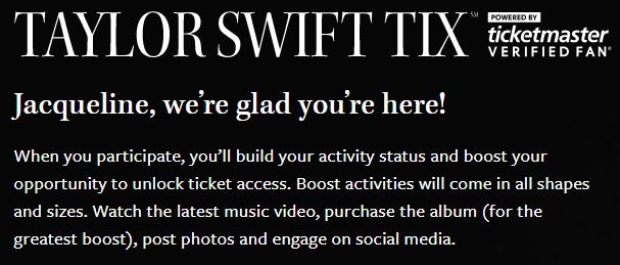
Along with signing up, her website encourages fans to buy albums, merchandise and watch videos in order to “boost your opportunity to unlock ticket access.”
Taylor Swift’s website appears to promise ticket-buying priority for fans who buy albums and merchandise. (TaylorSwift.com)
To music publicist Eric Alper, Swift’s new strategy is a good one.
“Taylor Swift is one of the smartest people that has ever entered into the music industry or entertainment industry bar none,” Alper said.
He views it as a way for both fans and artists, like Swift, to both get what they want.
“We may not make as much money anymore on the recorded music side of things, so let’s make sure that the stereotypical view of where they make their money — on the road — let’s exploit that in the best possible way,” Alper said.
But there’s just one problem — there’s no guarantee fans will get what they want.
Engaging in the program doesn’t actually promise access to purchase tickets or the ability to purchase tickets.
Economics professor at the University of Victoria Pascal Courty, who does research on ticket reselling, says Swift could expect some unhappy fans who think spending money on merchandise will get them tickets.
“It might frustrate them with a fake sense of hope,” Courty said. “If you ask them to spend money, it might backlash.”
The fine print on Swift’s website counters how the rest of the site markets the program. In bold print in the program terms section it reads: “A purchase or payment of any kind will not increase your chances.”

Program Terms on TaylorSwift.com actually says that purchases don’t boost a fan’s chance of getting a ticket access code. (TaylorSwift.com)
When asked to explain the disconnect between the terms and the marketing pitch, in an email to CBC News, Ticketmaster said: “We worked closely with Taylor Swift to craft a unique approach to our Verified Fan program that rewards her fans with access to the best tickets first.”
Ticketmaster North America’s executive vice-president and head of music David Marcus said, “By removing bots and scalpers from the equation, and adding a series of fun activities to help registrants boost their spot in line through our official Verified Fan Activity Meter, we’re able to ensure that tickets make it into the hands of Taylor’s most avid fans, at fan-friendly prices.”
Alper says artists don’t actually owe people anything for being a fan, and he expects that Swift’s legal team has likely gone to great lengths to make that clear.
Potential for ‘bad blood’ with fans
“I’m sure there’s going to be people who are going to complain on social media, it’s mostly a cesspool of negativity sometimes. But it’s the best alternative out there, because I don’t see more than a handful of people trying to make sure that the fans are getting in the right way,” Alper said.
Even if some lucky fans manage to snag a ticket after participating in the program, there’s little evidence that it will do anything to stop scalpers from getting tickets and then reselling them at exorbitant profits.
“Because the tickets are transferable, it means there is a profit opportunity,” Courty explained.
He says making tickets non-transferable isn’t the full answer either: he says they also need to be refundable, in case fans who bought tickets can’t make it to the concert.
In Swift’s case, Courty thinks ticket scalpers could try old-fashioned strategies. Just as they used to pay people to physically wait in line for tickets, they may pay people to make fake profiles.
“If there’s a lot of money to be made, the brokers they’re going to come back to the old way,” Courty says.