A “Thank you to Canada” dance performed by the Pavlychenko Folklorique Ensemble at Saskatoon’s annual Folkfest is being called “a mockery” despite the group’s good intentions.
Two women who saw the performance Saturday evening also recorded it, and posted the video to Facebook, with commentary on the offensiveness of the piece.
The dance involves costumes and traditional dance from several ethnic groups, including two dancers in First Nations costume, performing a seemingly Indigenous dance.
“Although it kind of looked like a dance, it wasn’t showing my culture’s dances’ honour in the way I would hope to,” said Janelle Pewapsconius, herself a powwow dancer.
“Beyond those things happening to us, and being offended, our faces, our emotions, are on display for non-Indigenous people around us.”
‘They started off with good intentions’
Before the dance began, Janelle and her sister Betty Pewapsconius were looking forward to the Ukrainian pavilion’s entertainment.
“I’m very fond of their ballet dance,” said Janelle Pewapsconius.
There was an introduction of sorts before the performance, but neither woman was able to hear it.
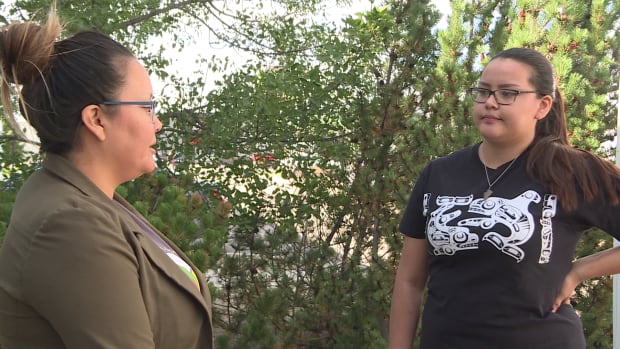
Janelle Pewapsconias, right, and her sister Betty Pewapsconias saw the controversial dance at Saskatoon Folkfest’s Ukrainian pavillion Saturday night. (Bridget Yard/CBC)
“As the dance proceeded, they did their regular ballet part, and a male and female dancer came out,” said Janelle Pewapsconius
“I found it a bit odd because their cultural regalia, or outfits … I had a little bit of a chuckle despite all the triggering factors, because it wasn’t very well put-together.”
Despite an obvious effort by the pavilion co-ordinators to be inclusive, Janelle Pewapsconius says it felt “tokenistic.”
“Even beyond this cultural performance, a lot of Indigenous inclusion is very tokenistic,” she said.
“Each song has a significant meaning, each feather has a significant meaning and has to be earned, and it’s a way of healing for lots of people.” – Bety Pewapsconius
The women are certain organizers had the best of intentions, but are disappointed with the outcome.
“Even as a person who doesn’t dance, I know each song has a significant meaning, each feather has a significant meaning and has to be earned, and it’s a way of healing for lots of people,” said Betty Pewapsconius.
‘Created with gratitude, love and respect’
The Pavlychenko Folklorique Ensemble posted a statement to Facebook, saying the dance was created by Serhij Koroliuk around the time he received Canadian citizenship in 2003.
“It was created with gratitude, love, and respect to all of the cultures that make Canada so wonderfully diverse,” according to the statement, and has been performed around the world and across Canada.

Pavlychenko Folklorique Ensemble posted a response to the controversy on Facebook, Sunday evening. (Pavlychenko Folklorique Ensemble/Facebook)
The dance also includes depictions of Scottish, Irish, Spanish, and Ukrainian cultures.
Pavlychenko Folklorique’s statement included names of people from each community depicted, who had been consulted during the creation of the dance, according to the group.
CBC contacted the person consulted for the Indigenous portion of the dance, and has yet to receive comment.
Organizers of Saskatoon Folkfest declined to comment on the dance, or the public reaction.
Pavlyvhenko Folklorique Ensemble declined to speak to CBC News, and would not say whether the dancers representing Indigenous culture in the performance were Indigenous.
‘Asking for a little respect’
After speaking out on Facebook, Betty Pewapsconius said she has been shocked by the nature of some comments from other users.
She shared the video of the performance with the caption “Who thought this was a good idea?!”
“I appreciate the people asking why, and I will be more than happy to share my perspective on it,” she said.
Some have told her she is using hate speech by criticizing the performance.
“It is interesting how asking for respect in 2017 is considered hate, or victim. I’m not a victim. We’re not victims. We’re just asking for a little respect or equality to represent ourselves.”