A training program being made available to Mounties in Alberta aims to build better relationships with the Indigenous communities they police by learning more about Aboriginal history and rights.
The Kairos Blanket Exercise sees officers spend two days role playing to give them a better perspective on Aboriginal history.
It includes experiences that range from smallpox epidemics to residential schools.
“They can have more empathy for what they’re doing in everyday policing,” said Insp. Honey Dwyer, head of the RCMP Aboriginal Policing Unit in Alberta.
She helped introduce the Kairos program into the RCMP’s training and says it can benefit First Nations officers as well.
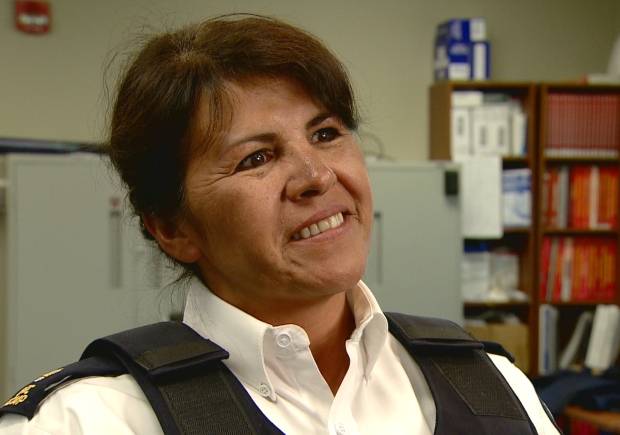
Insp. Honey Dwyer, head of the RCMP Aboriginal Policing Unit in Alberta, says the Kairos program is beneficial for officers. (Laurent Pirot/CBC)
“We are, as Indigenous people, a part of the RCMP and we can make that change with the youth nowadays,” she said.
The Kairos program was created two decades ago in response to the Report of the Royal Commission on Aboriginal Peoples.
It covers more than five centuries of Aboriginal history over two days.
Cpl. Pascal Richard, who has worked in First Nations communities for several years, took part in a recent session in Cochrane.

Cpl. Pascal Richard says the Kairos program will help officers better understand First Nations communities. (Laurent Pirot/CBC)
“It’s going to help me to be more attentive to what the native people have gone through and all the issues,” he said.
The program is one of four courses aimed at improving Aboriginal awareness in the province, the others being a two-day cultural camp, a four-day perceptions course and a four-hour online course.
“I think the difference here is definitely the interaction and being part of the process as opposed to being spoken to,” said Dwyer, “Just to hear the different comments and experiences from each of the members and employees that have taken the training, I find it inspirational.”

Part of the program sees officers stand on blankets, representing land in Canada. (Laurent Pirot/CBC)