A Syrian Kurdish-led force backed by the United States has begun an offensive to retake Raqqa, the de facto capital of ISIS in Syria.
The group launching Sunday’s battle is called the Syria Democratic Forces, made up of Kurdish, Arab and Christian fighters.
Some 30,000 SDF fighters were expected to take part in the operation, against an estimated 5,000 men fighting for the group Islamic State in Iraq and Syria.

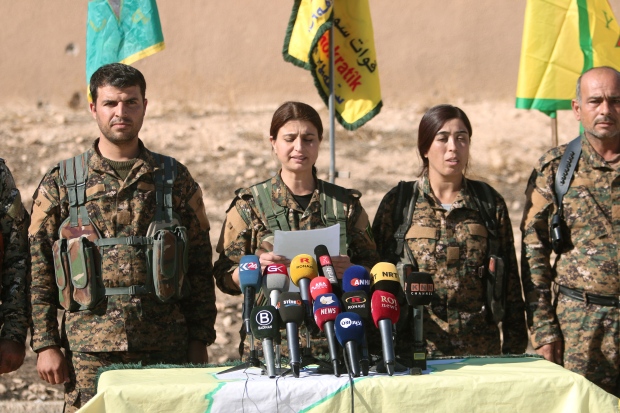
SDF commanders hold a news conference in Ain Issa to announce the operation to retake Raqqa from ISIS. (Rodi Said/Reuters)
The offensive to free Raqqa from ISIS control comes as Kurdish and Iraqi forces continue their operation to drive ISIS out of Iraq’s second largest city, Mosul.
The SDF is dominated by the main Syrian Kurdish fighting force known as the People’s Protection Units, or YPG. The United States considers the group as the most effective force against ISIS.
However, Turkey views the YPG as a terror organization and claims it’s linked to Turkey’s outlawed Kurdish group. Turkish officials including President Recep Tayip Erdogan have said they will not accept a role for the Kurds in the liberation of Raqqa.
Turkey’s defence minister last week suggested that instead of the Kurds, Turkish-backed forces can present an “alternative.”
But Kurdish officials have rejected any role for Turkey, or the opposition forces it backs inside Syria, in the Raqqa campaign, and U.S. officials have also acknowledged that the YPG will be a major part of any Raqqa offensive.
Hope that Turkey will not interfere
“Our hope is that the Turkish state will not interfere in the internal affairs of Syria,” said an unidentified SDF official at Sunday’s press conference. “Raqqa will be free by its own sons.”
There was no immediate comment from Turkey or the U.S. on the Kurdish announcement.

A member of the Syrian Democratic Forces flashes the victory sign in Ain Issa. (Delil Souleiman/AFP/Getty Images)
U.S. officials have acknowledged that ousting ISIS from Raqqa poses tougher political challenges than the offensive on Mosul, and have suggested the initial stage would involve isolating the city before any forces try to move in.
The commander of anti-ISIS coalition forces, Lt. Gen. Stephen Townsend, said last week that American intelligence has detected signs that Islamic State attacks against Western target are being plotted from Raqqa, adding urgency to coalition plans to encircle and eventually assault the city.
“We know this plot-and-planning is emanating from Raqqa. We think we’ve got to get to Raqqa pretty soon.”

This satellite image taken Oct. 31, 2016, shows the Islamic State group’s defensive line in southern Mosul, Iraq. New satellite images show that Islamic State militants in Mosul have set up daunting defences designed to bog down advancing forces. (Stratfor.com/Associated Press)
But coalition leaders have been struggling with the timing for the Raqqa campaign, not only because of the demands of the large Iraqi-led Mosul operation but also because the political and military landscape in Syria is more complicated. Townsend said more Syrian opposition fighters need to be recruited, trained and equipped for the Raqqa battle, but he and other officials have said in recent days that the Mosul and Raqqa operations will overlap.
Unlike in Iraq, where the coalition has a coherent government to work with, the U.S. and its coalition partners in Syria are relying on a hodge-podge of local Arab and Kurdish opposition groups, some of whom are fierce rivals. The tensions are exacerbated by the presence of Russian and Syrian forces on one side and Turkish forces on another.
Townsend said, however, that the YPG will necessarily be part of the offensive.
“The facts are these: The only force that is capable on any near-term timeline is the Syrian Democratic Forces, of which the YPG are a significant portion,” Townsend said. “So, we’re negotiating, we’re planning, we’re having talks with Turkey and we’re gonna take this in steps.”