Alberta won’t cut health or education but spending in other areas will be contained, Premier Rachel Notley said Wednesday in a major address that comes at a time when the province is staring down a $10-billion deficit and her NDP government is sagging in polls.
“We can handle the current dramatic drop in government revenue — for a time,” Notley said in her state of the province address, delivered to an audience at Calgary’s Jack Singer Concert Hall.
“But as our economy improves in coming years, the provincial budget is going to have to come back into balance,” the premier added.
“That means we can protect health care and education … but that also means we are very unlikely to have headroom for major new spending proposals until recovery arrives.”
The crash in oil and natural gas prices has ripped a gaping hole in the government’s budget. Ten years ago, the province derived more than 40 per cent of its revenue from royalties and other income from non-renewable resources. Last year, it was less than six per cent.

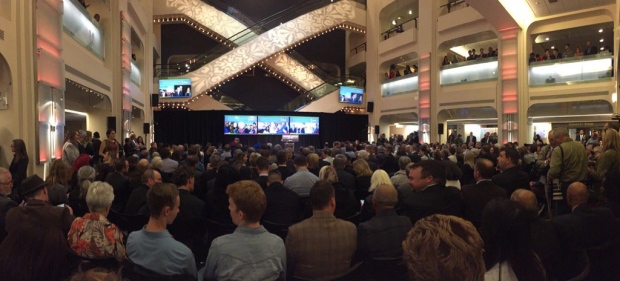
About 600 people gathered in the lobby area outside Calgary’s Jack Singer Concert Hall for Premier Rachel Notley’s state of the province address. (Bryan Labby/CBC)
Still, Notley reiterated her government’s pledge to not slash its way out of deficit.
“Firing nurses and teachers won’t make the price of oil go back up,” she said.
“It makes no sense to try to deal with a crisis in the price of oil by creating a second crisis in basic public services like health and education. That was tried in the past, and it failed.”
Expect ‘stability’ in funding, but not increases
The premier said stability is the “watchword” for the coming budgets in Alberta.
“That means that people providing public services funded by the provincial government need to find innovative ways to do more with the funding they have now,” she said.
“That means that municipal leaders need to understand that exciting new proposals will probably need to be paid for by reallocations — starting a new project might mean ending an old project.”
That last sentence will catch the attention of civic leaders in Calgary, who have been calling on the province to contribute its share to the Green Line, a planned multi-billion LRT expansion to which both the federal and municipal governments have pledged $1.5 billion.
Opposition response
Wildrose energy critic Leela Ahee said that, regardless of the impact of oil prices on the province’s economy, the government has taken steps to make things worse.

Wildrose energy critic Leela Ahee speaks to reporters about Premier Rachel Notley’s state of the province address on Oct. 19, 2016. (CBC)
“When we’re talking about stability, you have to consider the factors of policy,” she said.
“We’re looking at policies that are hurting Albertans right now … minimum wage and carbon taxes and all these other things that we’ve been talking about that are so impactful on Albertans right now.”
Alberta’s minimum wage rose to $12.20 an hour on Oct. 1, the highest among the provinces, and the government plans to increase it to $15 an hour by 2018.
Alberta also plans to introduce a $20-per-tonne carbon tax in 2017 that includes offsetting rebates to middle- and low-income households.
The tax is to grow to $30 per tonne in 2018, with a corresponding increase in the rebates.
Commitment to combating climate change
Notley, for her part, said the carbon tax is not only a way to combat climate change but also continued to suggest the policy would help Alberta develop the so-called “social licence” to get pipelines built.
The premier blamed previous governments’ inaction on reducing carbon emissions for the opposition Alberta has faced in attempts to pipe oil to tidewater.
“On few files was our province more poorly served than by elected officials from this province who claimed — with a straight face — there was no need to act decisively or effectively on climate change,” she said.
“This failure to attend to the fundamental strategic interests of Alberta is a key reason why we remain landlocked today, despite 10 years of promises that the issue was going to be addressed effectively. So let there be no doubt. If we want a better economic future, we need to lead on climate change.”
Anxious Albertans
Albertans, in general, are feeling anxious these days — a recent CBC/Angus Reid poll confirmed as much — and the premier needed to take that into account in her speech, according to Janet Brown, an independent pollster based in Calgary.
Despite an ambitious and wide-ranging agenda that includes combating climate change and introducing new transgender policies in Alberta’s schools, Brown said Notley has to show the government hasn’t lost sight of what’s first and foremost on many people’s minds.
“I think what the public wants to hear from the premier is that she’s very focused on the economy, she’s focused on jobs,” Brown said before Notley spoke.
“She has some other priorities like the environment, but I think Albertans want to know … that she’s carefully thinking through all of her policies to ensure that they won’t undermine any possible recovery.”