It’s a phenomenon that Neil Young sang about and Native Americans took as a sign their corn was ready.
On Friday, we’ll get a peek at the season’s first harvest moon. In fact, it’s being called a “super” harvest moon by some but not without controversy.
There’s a debate taking place in astronomy circles as to whether this first full moon of September 2016 qualifies for supermoon status or not.
The harvest moon is usually described as the full moon occurring closest to the autumnal equinox, which actually falls on Sept. 22 of this year. (That said, some astronomers disagree about this definition and time frame.)
But most can agree that a supermoon is defined as a full moon that occurs at—or very near—the moon’s closest point to the Earth on its elliptical orbit.

That’s calculated by comparing the distance of the moon at its apogee (or furthest orbital point) to the perigee (the closest orbital point).
But here’s the contentious issue: The definition doesn’t specify if that’s an annual or monthly measurement.
That means distances compared for a monthly orbit of the moon, with its own apogee and perigee around the Earth, will in some cases differ from the distances of the annual orbit.
Using the monthly measurements, Friday’s moon does qualify as a supermoon.
Going with the annual apogee and perigee comparisons, it falls just outside that definition.

That’s why astrologer Richard Nolle, credited putting together the definition of supermoon, lists only the remaining full moons of October, November, and December this year as supermoons.
Others, like Fred Espenak, a retired astrophysicist, include September.
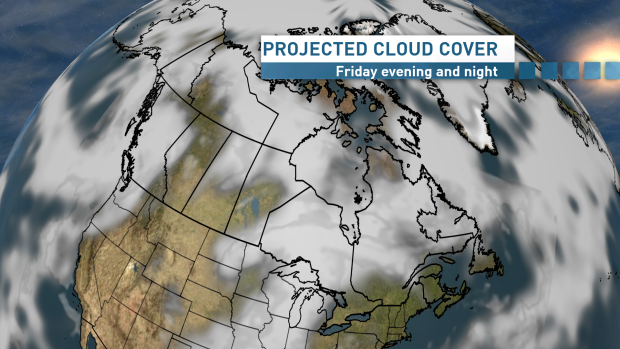
Whether supermoon or not, there will be large areas of the country with good viewing conditions of Friday’s impressive moon.
Maritimes will have good view
Nearly unobstructed views will be found in the Maritime provinces, but not so much in Newfoundland and Labrador which is expecting cloudy conditions.
Much of the evening and night should be clear for southern Quebec and southern Ontario, with mostly cloudy skies for northern Ontario and some cloudiness extending over James Bay and into northwestern Quebec.
Southern parts of the Prairie provinces are in for good viewing conditions, while northern areas will be cloudier. There will also be cloudy conditions for most of British Columbia.
In the Yukon and the Northwest Territories, look for breaks in otherwise cloud-obstructed skies. Nunavut will be contending with broken cloudiness.
However, it’s good to remember not much changes faster than cloud coverage in a forecast. So be sure to check your local forecast Friday for latest updates on viewing conditions.
(And yes, there are micro-moons, but that’s a subject for another time.)