Democratic presidential candidate Hillary Clinton was grilled about her record of dealing with classified information during a national security forum with veterans on Wednesday.
The NBC “commander-in-chief” forum marks the first time both Clinton and Republican rival Donald Trump have appeared at the same event.
Questioned back-to-back but not face-to-face, the presidential candidates are addressing an audience of veterans and active-duty troops — and a national TV audience — from the decommissioned USS Intrepid, which is now a floating museum in New York.
Clinton was up first, fielding tough questions from NBC’s Matt Lauer and audience members about her foreign policies and handling of classified emails while she served as secretary of state.
She acknowledged her use of a personal server to handle government emails was “a mistake” and something she “should not have done.”
Still, Clinton maintained she never mishandled classified information,
“I communicated about classified material in wholly separate systems,” she said. “I did exactly what I should have done and I take it very seriously — always have, always will.”
Wednesday’s forum will serve as something of a preview for voters of the candidates’ highly anticipated trio of debates later this fall.
Ahead of the forum, Trump rolled out a new plan to boost military spending by tens of billions of dollars, including major increases in the number of active troops, fighter planes, navy ships and submarines. The Republican also said that, if elected, he would give military leaders 30 days to formulate a multi-pronged plan to defeat ISIS.
“This will require military warfare, but also cyberwarfare, financial warfare and ideological warfare,” Trump said during an address in Philadelphia.
Thank you to all of our amazing military families, service members, and veterans. #ImWithYou pic.twitter.com/RmQJt0Wxcq
Clinton has spent much of the summer trying to paint Trump as ill-prepared to be commander-in-chief and too unpredictable to make decisions that put American service members in harm’s way.
Her case has been bolstered by numerous Republican national security experts who have spoken out against their party’s nominee, including former defence secretary William Cohen, who announced his support for Clinton on Wednesday.
A man who talks about our veterans and military families like this doesn’t deserve to be Commander-in-Chief. pic.twitter.com/4s6SvAAyNA
Said Clinton: “They know they can count on me to be the kind of commander-in-chief who will protect our country and our troops, and they know they cannot count on Donald Trump.”
“They view him as a danger and a risk.”
But Trump is trying to stir up similar questions about Clinton, who spent four years as President Barack Obama’s secretary of state. He’s zeroed in on her controversial email practices at the State Department, calling her private email server “reckless.”
Clinton could also be vulnerable to Americans’ worries about terrorism — particularly the ISIS designs on the West — and criticism that Obama hasn’t done enough to combat extremism emanating from the Middle East. While she’s articulated an anti-ISIS plan that is more aggressive than Obama’s, she’s largely in line with the president on foreign policy.
Trump’s address in Philadelphia also included plans to eliminate deep spending cuts known as the “sequester” that were enacted when Congress failed to reach a budget compromise in 2011.
Republicans and Democrats voted for the automatic, across-the board cuts that affected both military and domestic programs, though the White House has long pressed Congress to lift the spending limits.

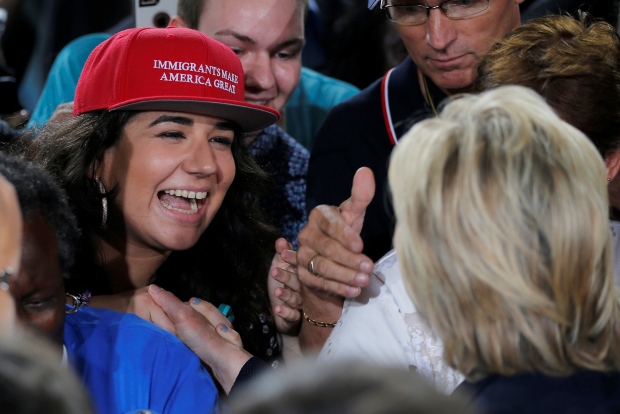
Audience member Ana Gomez, wearing a cap reading ‘Immigrants Make America Great’ in the style of hats worn by U.S. Republican presidential nominee Donald Trump, greets U.S. Democratic presidential candidate Hillary Clinton during a campaign voter registration rally at the University of South Florida in Tampa. (Brian Snyder/Reuters)

Protesters stand outside a campaign stop for Clinton in Hampton, Ill. (Brian Snyder/Reuters)
Trump expressed support for the sequester in interviews in 2013 — even describing them as too small — but seemed to suggest at the time that military spending should be exempt.
A senior adviser said ahead of the speech that Trump would make sure the additional spending was fully paid for but did not explain how.
The United States currently spends more than $600 billion a year on the military, more than the next seven countries combined.
Even before promising a huge boost in military spending, Trump’s plans to cut taxes, expand infrastructure spending and leave untouched entitlement programs such as Social Security already threaten to add trillions of dollars to the federal deficit.