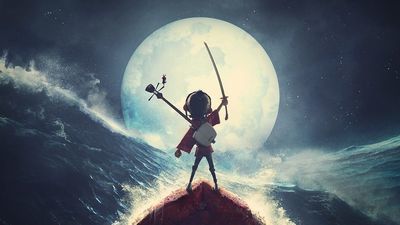
The less you know about the plot of “Kubo and the Two
Strings” the better. It’s a delicate, nuanced adventure film from the team at
LAIKA, the geniuses behind “Coraline,” “Paranorman” and “The Boxtrolls.” Art
Parkinson voices Kubo, a young boy in ancient Japan who cares for his sick
mother. In Kubo’s world, spirits of ancient warriors and lost relatives share
space with the living, and a little boy has powers that even he doesn’t
understand. Travis Knight, the head of LAIKA, took over directorial reins on this
one, and sat down with us last week to talk about one of the most
critically-acclaimed animated films of the year. As I was coming into the room,
we were chatting about the response from last night’s Q&A …
Audiences are
responding well.
Yeah, it’s a great. A number of people came up to me and
were talking about how moved they were by it. And that’s why we do it. That’s
what storytellers are. They try to connect people.
Yeah, but it’s not
why everybody does it. It’s why you guys do it. Let’s start there; I was
going to get there later—the creative focus of LAIKA, as a company, because it
seems to me to be a little bit different. A lot of people get into this
business to make money, and you just said you got into this to share stories
and to share things. Can you expound on that a little?
Well, that’s from an artist’s perspective. I was an artist
before I was anything else. I think back to the formative experiences I had
when I was a kid. When I would go with my parents to the movie theater. I’d sit in a darkened room full of strangers and you’d be transported to another world. You’d
see things that you never thought of before. I loved that. It made me think
about things in a different way, and I think that’s what art in its finest form
does. It opens us up to new ideas and new perspectives. When you see someone
else’s story through their eyes; when you experience their story is if it’s
your own—that can’t help but engender and elicit some kind of empathy, and I think
that’s what art does in its finest form. It binds us together. Movies kindle
our imagination and inspire us to dream. That’s what they meant for me when I
was a kid. Those are the kinds of movies that I want for us to make at LAIKA.
When we began ten years ago, there were a number of us who had
been doing this for years, and with the ascendancy of the computer in the ‘90s,
the clock was ticking. The plug was about to be pulled on this medium that we
loved. So there was a real key inflection point when we had to decide what to
do. Do we continue to pursue this path? If we do that, we have to find a way to
reinvigorate it. And that was when we decided to embrace the author of our demise,
the infernal machine threatening to destroy our livelihood. And really find a
way to embrace the way the Luddite would the loom. Take this tool and bring it
into our process. That was the beginning of the technical way we make films. We
saw that from “Coraline” to this point.
But, philosophically, why we make movies—there is something
of a creative restlessness at our company. There’s a want to do the things;
challenge ourselves; never take it easy; explore new worlds; new stories in new
genres; to explore new aspects of what it means to be human. That’s what drives
us and keeps us going. That’s been true for me from the beginning. It’s show business, so it’s art & commerce and
you have to try to find that balance—not making weird little arthouse things
that are not going to appeal to anybody—but I think because of structure, point
of view, and how efficient we are at making these films, our threshold for success
is lower, which means we can take more chances. I’m really excited when I look
at the things we’ve done and how different they are from each other, and then
when I look ahead at the stuff we have coming down the road. We just love
telling stories in new ways.

How do you engender
that kind of professional atmosphere? Is it a lot about hiring the right
people?
It’s absolutely
about hiring the right people. We are this weird hippie commune out on
Portland, Oregon. By virtue of where we are, removed from major film hubs, it’s
allowed us to create our own culture and our own philosophy. We’re not influenced
by those around us. That’s part of it—people who are drawn to a place like that
are a certain kind of person. It kind of weeds people out who don’t have that
mentality. And I think people who are drawn to this field are a particular kind
of person. Our crew comes from all over the world. That helps to make it not a
monolithic culture, but a real rich culture. I think that’s one of the things
that makes our stories unique. Sometimes people will come aboard and it’s not
for them. They want something different out of their life and career. You’ve
got to be willing to throw your life into these movies. But for a certain kind
of person, it’s exciting. It’s a great way to spend your life—trying to make
stories that are meaningful.
Do you have
overriding principles of art that you pass along? I’m thinking about the fact that
all four of the films—“Coraline,” “Paranorman,” “The Boxtrolls,” and now this—have
a certain timelessness to them. You could watch it in 50 years and not find it
dated. They don’t use pop songs or smartphones. Is that something you have as
a corporate policy? “We’re going to make films that kind of exist outside of
the era they’re made in.”
Yeah. Our first two films were set in the contemporary
world but I agree that they’re timeless stories. They’re not relying on a
specific time to work.
Exactly. You’re not
talking about Twitter or making a Ke$ha reference.
No [laughs]. But even if we did, as a one-off, the
overriding sentiment is that we want to make films that are timeless; we want
to make films that are enduring. We don’t want to make pop culture confections.
These candy-coated …
They’re everywhere.
They are!
I think often how
films of this era are going to look in ten years.
Terrible! The movies I loved growing up are still awesome,
and many of the movies from the last ten, fifteen years look like they’ve
expired. But if you look at something like “The Nightmare Before Christmas.” It
still looks amazing. It still looks timeless. And the themes that are explored
within the film are timeless. That’s your point. If you want to make films that
are bold and distinctive and have a shelf life that last, you gear toward a
certain kind of story. If you want to make something that’s a product, a cash grab,
that’s a different kind of thing. A franchise. A brand. A remake. Those are
certain kinds of stories. If you want to tell an original story, you have a lot
more options. That can be fairly terrifying, but it’s also exhilarating.
We are an
independent animation house. We’re not a part of some international media
conglomerate. There are great things that come with that—freedom, the ability
to tell these kinds of stories. At the same time, we’ve got to be very sensible
about how we develop these things. We’ve got to keep our budgets low. Overall,
our independence is one of our greatest strengths.

Let’s talk a little
bit about fear. There are elements of all of your films, but this one in
particular … when the sisters showed up, I thought, “Whoa, I don’t know if my kids
are ready for that.” Pretty freaky. How do you balance out “Is this too scary?” How much fear do you think is good for children?
I generally think that in media today we’re coddling our
kids way too much and that’s to our detriment. The kinds of films I loved
growing up had that elusive balance of darkness and light. That kind of dynamic
storytelling makes for a rich, cinematic experience. I think that spending a
little bit of time in the shadows makes the light brighter and more beautiful. We
certainly don’t want to traumatize children. I know that we have soaked more
than a few bunk bed mattresses in our time [laughs]. That’s never the goal.
And it really does depend on the kid. When we made “Coraline,” my daughter
would come to the studio and she knew that these were puppets and what dad does
for a living, but she was five when the movie came out—she made it through
about 30, 40 minutes and was like, “OK, Dad, that’s enough.” She wasn’t ready
for the rest. And so I think it really does depend on your kid. But I think
that within the safety of a movie theater or a home where you’re watching a
movie that those are great opportunities for us to share things with our kids
that are safe. We know they’re not going to be hurt. And so through the
stylized prism of animation, there are interesting ideas and deeper themes.
Yeah, after this one,
there are going to be some conversations about the afterlife.
And I love that. As a father, my favorite cinematic
filmgoing experiences are when we watch a film and, on the ride back home, we’re
engaged. We’re talking about what we just watched. Those are the kind of films
we try to make. Those are the kind of films I remember as a kid. When I was
growing up, I was a fairly lonely kid—I made friends slowly when I made them at
all. I was often in my own, little world. My mom took me to see “E.T.” when I
was about eight years old, and it was the first movie that moved me to tears, and I
remember part of my brain recognizing that what I was seeing was fake—it was
all make-believe, and none of this stuff was real—and, on the other hand, it
was more than real. It tapped into something I didn’t even know that I felt. It
was this portrait of childhood loneliness. Love and pain go hand in hand. It
opens us up but it also makes us vulnerable and it can also heal us.
And it can convey
things to a child in a way that a parent can’t really explain to them.
Right. That I couldn’t articulate. I think that’s one of the things that great art does. That great music does. And I think that we try to
do that in all of our films—this one in particular. It taps into stuff that’s
difficult to explain, difficult to verbalize. If you can tap into it in a
beautiful and poetic way, kids can understand it.

Let’s talk character
design a bit. I think it’s fantastic here. There are so many different ways you
could have gone with the monkey character, for example. How do you find the
right look? How does that process work?
With each film that we’ve done, we’ve wanted them to be
aesthetically different. We didn’t want a “house style.” In the last film that
we did, it was this Dickensian, steampunk adventure, and it was really
intricate and overwrought and really heavily designed and really noisy. It fit
the film. But this film was different. The story. The place. It demanded its
own aesthetic. What is the visual signature? For this film, we’re very inspired
by classic forms of Japanese art. Origami is a very big one, obviously, for
storytelling reasons, but also just aesthetically for what it means. The last
film, there were no straight lines, and everything was distorted. This film, it’s
clean, it’s geometric. It’s because of what inspired it: Noh Theater, ink wash
paintings, late-Edo period dollmaking. The biggest influence was Ukiyo-e, which
literally means “Pictures of the Floating World.” The most well-known form of
Ukiyo-e is the classic wood-block print. The most well-known one is Hokusai’s “The Great
Wave.” In fact, we give a nod to that at the beginning of the movie with that
enormous wave.
Because of the process of wood-blockmaking, it required the
artists in that medium to simplify. There’s something that’s so beautiful about
it. There’s a spare poetry to it. Even if it has vibrant colors and beautiful
shapes within it, there’s something that’s kind of spare and simple and clean.
This film really was a visual palette cleanser compared to our last film
because there are wide open spaces, vistas. It’s really punchy and bright in
its color.
Within that, you want to make sure the characters are all
living in the same world. The monkey—you want to make sure her hair is not
taxidermy. It’s a stylized fur. You start defining the signature and winnowing
down and defining the characters and the world and all that. It takes years.
The character design
is fantastic, and the voice work. Charlize Theron is incredible.
So good.
There’s a lot of
great stuff in the movie but if her performance doesn’t work … if she doesn’t
ground it emotionally, the whole thing dies in the center. So talk a little bit
about her.
It’s a big sweeping samurai epic but if you get down to the
core of it—there’s like five characters!
Yes. Which is crazy
in modern animation! “The Secret Life of Pets” has 800 speaking parts.
Yes. There are five main characters. So every single one of
them was absolutely critical to nail. Charlize in particular.
She brings emotional
gravity.
She does. She’d never worked in animation before. We’re an
independent animation house, so basically any time someone agrees to be in one
of our movies, I can’t believe it.
With three Oscar
nominations in a row. Don’t undersell yourselves.
But still … look, we’re a bunch of weirdos in the patchouli
oil armpit of the Northwest. So when people respond to our movies and want to
be a part of it, it’s kind of moving and surprising. We reached out to
Charlize. The way we go about it—ultimately, what matters is the quality of the
voice and the ability of the actor to bring all of the emotion through the
voice, which is really hard. A lot of actors can’t do it. They can use their
face and their body language. Look at “45 Years” with Charlotte Rampling. The
last ten minutes, she doesn’t utter a word. It’s all in her face and body. It
showcases what you can do with your body. With an animated film, it’s all what
you can do with your voice. There are great actors who can’t do animation. With
Charlize, what we do is we end up pulling audio clips from films so we can see
how they act dramatically, and we pull clips from interviews so we can hear how
their voices naturally sound. And then we put that up next to a character
design, and we have a wishlist of actors that we want and we put them together
to see who sounds right together. Can they convey the entire range of emotion?
You assemble it like you would an orchestra or a band. You start arranging
these things like instruments.
So you put clips of “Mad
Max: Fury Road” and “Dallas Buyers Club” [for co-star Matthew McConaughey] next to each other to see how they
would sound together?
You would. But those films hadn’t come out yet. But that’s
right. With Charlize, she had never done animation before, but she was a
first-time mother, and what she responded to was themes of family in this
story. It’s a testament to this group of people that they threw themselves in
and gave it their all.