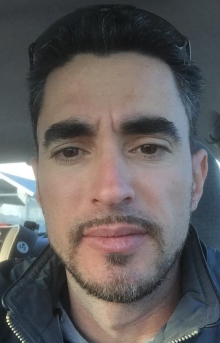
Armando Cosmea-Aspillaga never showed up to his friend Jensy Menendez’s birthday party on Friday.
“I was upset, I was calling him and texting him and he wouldn’t answer my calls or my text messages,” said Mendez, a long-time friend of Cosmea-Aspillaga. “I said things that, you know… silly things, because I thought he was ignoring me.”
On Friday, at 7:45 p.m., police were making their way to a home in southwest Edmonton for a domestic dispute call.
When they arrived, they found Cosmea-Aspillaga dead inside the house.
One day later, Roberto Robles, his 73-year-old father-in-law — who the victim’s friends said needed a cane to walk — was charged with second-degree murder in connection with the killing.
Menendez said she’s more sad than angry about the loss of her friend.
“We lost a really good man,” she said. “A friend, a loving father who cared so much about his little girl. He was supporting his family back home, his mom and sister.”
‘A problem solver’
Menendez grew up with the victim’s sister in Cuba.The Cosmea-Aspillagas were like a second family.
She described Cosmea-Aspillaga as someone you could bring personal problems to for advice.

Cosmea-Aspillaga was described as someone you could bring personal problems to for advice. (Facebook)
“He was always quiet and very well spoken, soft spoken,” said Menendez. “He was kind of like a problem solver ever since he was young.”
He was a doting father, she said.
“When his little girl came into the world that was his life,” she said.
Ernesto Rodriguez, who grew up on the same Cuban street as Cosmea-Aspillaga and affectionately refers to his friend as “Mandy,” agreed.
“He would work and when he finished he would go straight to the house and start playing in the playroom with his daughter,” said Rodriguez.
Rodriguez said he is having a hard time comprehending that his friend won’t get to see his daughter grow up.
“I know it’s true, I know he’s not coming back, but I don’t want to believe it.”
Coming to Edmonton
Menendez said that Cosmea-Aspillaga met his wife Flavia when both of them were guests at her wedding in Cuba in 2009.
Flavia is currently the executive director of the northern Alberta and Territories Branch for the Kidney Foundation of Canada and was the former executive director of Crime Stoppers.

Jensy Menendez described the Cosmea-Aspillagas as a second family. (CBC)
Menendez said they were married in 2010 and Cosmea-Aspillaga came to Edmonton in 2011. When Menendez heard her old friend was coming to Edmonton she was ecstatic.
“I was very happy,” said Menendez. “It was very hard for me to make friends in Edmonton because I left my life behind in Toronto, so I was so happy to have him here.”
In 2013 Flavia and Armando welcomed a daughter into the world. However, according to the two friends, the marriage crumbled soon after.
‘Why don’t you move to an apartment?
Menendez said the couple was in the middle of a long and heated separation that went back as far as a year.
According to Menendez and Rodriguez, even though the two were separating, Cosmea-Aspillaga stayed in the same house because he was worried about losing custody of his daughter.

Ernsto Rodriguez grew up on the same Cuban street as Cosmea-Aspillaga and affectionately refers to his friend as “Mandy.” (CBC)
“I asked him: ‘Why don’t you move to an apartment?’ and he said: ‘I will move when the judge and the court tells me what days I get my daughter,’ ” said Rodriguez. “He was scared that when he moved he could not go back to see his daughter.
“He wanted to be a part of his daughter’s life, that’s what fathers do.”
This awkward living arrangement led to tension in the household, said Menendez.
‘We want him to be with his loved ones’
Menendez said that when she heard about his death, she and a friend went to the home and waited outside until 2 a.m..
Rodriguez flew in from Florida to give help Cosmea-Aspillaga’s family through the process.
Their main goal now is helping Cosmea-Aspillaga’s mother bring his body back home to Cuba. Menendez said they are worried because the divorce isn’t finalized, so the victim’s wife may block the repatriation of the body.
“We want him to be with his loved ones, with his family that loved him, not with someone who didn’t.”