Beatrice Hunter, Alberta's roughneck historian, dies at 97
Beatrice Hunter, an author and historian hailed for chronicling the early roughneck history of Alberta’s oil fields, has died.
Hunter died on March 19 on her 97th birthday.
“She was just a very talented lady. She was a writer, a painter, an artist, she was a captain in the army,” Don Hunter, Beatrice Hunter’s stepson, said in an interview Friday with CBC Radio’s Edmonton AM.
“She was just a very accomplished lady and that’s how I remember her.”
‘It told a different side’
Beatrice Hunter earned acclaim later in life for Last Chance Well. The book, her second, was published in 1997 and preserves the firsthand accounts and anecdotes of the rig workers in the early days of Leduc’s oilfields.
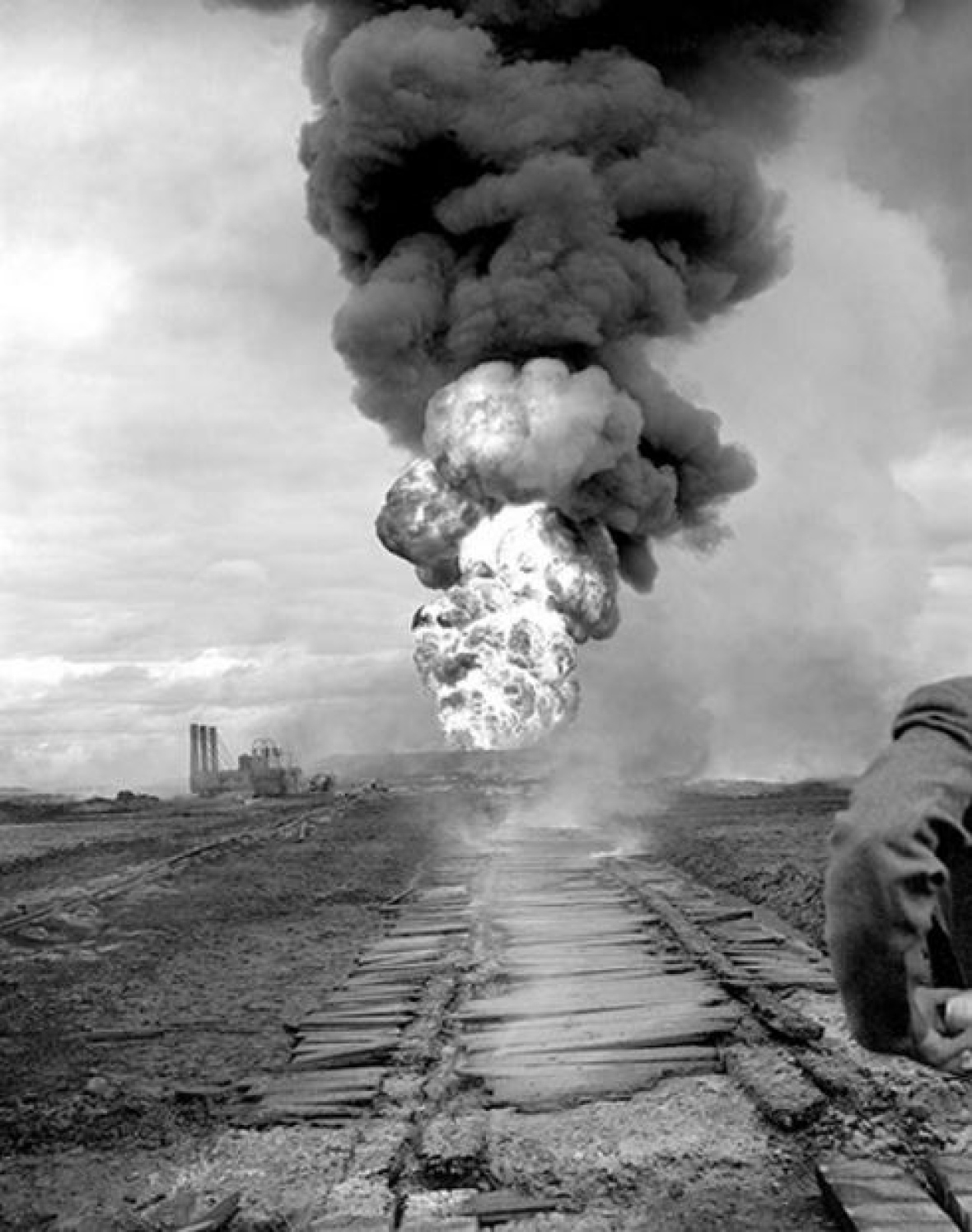
On Feb. 13, 1947, the Leduc oilfield struck a gusher for the first time, sending a fireball of flames 15 metres into the air. (Leduc Energy Discovery Centre)“It was more of a human interest story rather than a history of finding oil at Leduc No. 1,” Hunter said. “A lot of those people, especially the wives, had a pretty tough life leading up to Leduc No. 1.
“It told a different side of people’s lives … how the working people have to innovate in order to just keep going.”
Beatrice “Bea” Hunter’s passion for the oil industry was personal.
She was the second wife of Vern “Dry Hole” Hunter — a roughneck and wildcat driller — who on Feb. 13, 1946, long before he met Beatrice, bought the lease for the first well at Leduc No. 1.
‘The enormity of it didn’t hit us’
Vern Hunter was a rig supervisor when the famous well struck the first rich deposit of oil.
On a chilly February morning in 1947, on a dusty farm near Devon, the ground rumbled as grease-covered roughnecks opened creaking valves, and a mix of crude oil and gas spewed 15 metres into the air.
“It was pretty exciting, but the enormity of it didn’t hit us until a year or so later, when we moved into a house in Devon and moved out our skid shack,” Don Hunter recalled.
“And we thought the skid shack was heaven.”
Hunter remembers those early days well. He was 11 when the gush of mud finally gave way to a spout of clear, light crude — a discovery that forever changed the course of Alberta history.
“Well, I lived it. We followed the rig around, my mother and I, for many, many years,” he said. “We’d been travelling around Saskatchewan and central Alberta for years, not finding anything.
Sometimes, a single event can change the course of history. In Alberta, that happened in 1947. The energy heart of Alberta gushed to life just south of our city. In 2012, correspondent, Peter Mansbridge visited Leduc No. 1 to meet a man who was there. 1:58
While the oil patch would eventually become a sort of obsession, Bea Hunter’s first passion was nursing.
Born the daughter of a farmer in Wapella, Sask., Hunter was educated at the Regina General Hospital School of Nursing before enlisting in the Royal Canadian Army Medical Corp and serving overseas during the Second World War.
After returning home, she enrolled at the University of Alberta and received a nursing degree.
Her long nursing career consisted of ward work, teaching and administration in Alberta and B.C. She retired as director of the nursing program at the Misericordia Hospital.
In 1972, Bea married Vern and they enjoyed many happy years of gardening, travel and golfing.
“My mother had passed away and my father met (Beatrice),” Hunter recalled. “They got along very well.
“They both liked to golf and that’s how they kind got together, but she was the better golfer.
“They spent a lot time together.”
After Vern’s death in 1985, Beatrice devoted much of her time to researching her family tree.

The Leduc No. 1 crew hard at work on the wellhead located on a farm near Devon. (Leduc Energy Discovery Centre)
It was a book she had been dreaming of writing for years after hearing so many tales from the oilfields.
She was a powerful storytelling and had a knack for endearing herself to the men and women of Leduc No. 1.
‘She had a passion for people’
“With my dad telling all his stories, she decided to write the book,” Don Hunter said. “She had a passion for people.
“She interviewed all those people and she really enjoyed that, talking to them and recording the interviews.
“These were just ordinary people that had to work for a living. They all loved her.”
Hunter was an original member of the Leduc No. 1 Historical Society and she remained editor of the society newsletter The Catwalk for more than a decade.
We find out more about the legacy of Beatrice Hunter who interviewed rig workers to tell the history of Alberta’s first major oil discovery. 7:20