Everything you need to know about the SpaceX Falcon Heavy launch
Thousands are expected to line roadways and beaches around Cape Canaveral, Fla., ahead of Tuesday’s inaugural launch of the SpaceX Falcon Heavy rocket.
You can follow the launch here, starting at 1:30 p.m. ET.
If successful, the Falcon Heavy would be the most powerful rocket in use, and many hope it will make it easier to get humans past low-Earth orbit, back to the moon and even to Mars.
Though the maiden launch is unmanned, there is a special payload: a car destined for Mars.
What is the Falcon Heavy?
SpaceX’s workhorse rocket is the Falcon 9, named for its number of engines. It’s used to launch satellites and for supply missions to the International Space Station.
What makes the Falcon 9 special is its reusability: Once launched, the rocket’s first stage returns to Earth, landing at Cape Canaveral.
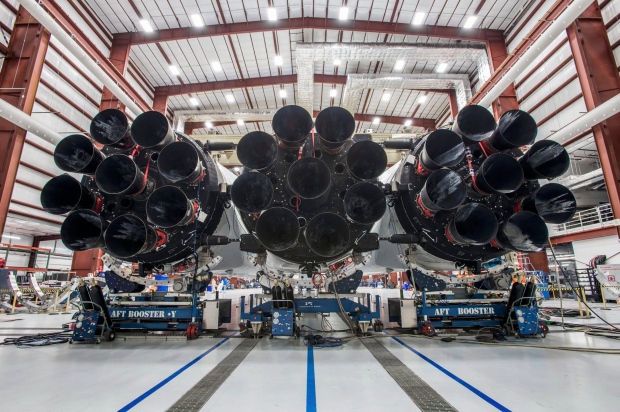
The Heavy is made up of three Falcon 9s — two of them launching today have been used before — for a total of 27 engines.
It should be capable of lifting some 63,800 kilograms into low-Earth orbit (LEO). The Delta IV Heavy, currently the most powerful rocket in production, can carry roughly 22,560 kilograms.
This photo made available by SpaceX on Dec. 20 shows the new Falcon Heavy rocket in a hangar at Cape Canaveral, Fla. (SpaceX via Associated Press)
What’s the big deal?
The launch is potentially historic: not only would it be the most powerful rocket in production, but it would also be the such rocket built by a private company. As well, it would be the first time that three boosters would land back on Earth simultaneously.
SpaceX founder and CEO Elon Musk has long said his goal is to make access to space affordable and his reusable rockets are what’s cutting the costs. The Falcon Heavy has a price tag of $90 million per launch compared to more than $1 billion for the second most powerful rocket, the United Launch Alliance’s Delta IV Heavy.
“This is a big first for just getting things into low-Earth orbit, but it’s also a big deal for commercial space because a company is about to put potentially 140,000 pounds into low-Earth orbit, years ahead of NASA’s expensive Space Launch System,” said space historian Randy Attwood, referring to NASA’s next-generation rocket, which is scheduled to launch in 2020.
“They’re doing it earlier, they’re doing it cheaper and the capability of the first stage is incredible.”
“It represents big changes in space in the future in that it’s going to get cheaper to space which means we’ll be doing more of space, which I think is good for humanity,” Canadian astronaut Jeremy Hansen told CBC News.
“This rocket represents progress for SpaceX and they’re already making a great contribution to space exploration and utilization of space,” he said.
[embedded content]
What’s inside?
Musk, who is also CEO of the electric car company Tesla, is having fun with this launch.
In the case of Heavy’s maiden voyage, Musk has used a cherry red Tesla Roadster as the payload — complete with a dummy named Starman.
As Musk posted on Instagram on Monday afternoon, “If it doesn’t explode into tiny pieces, it will carry Starman in Roadster over 400 million km from Earth at 11 km/sec on a billion year journey through deep space.”
There will also be three cameras aboard the car as it heads to Mars.
And of course, Starman is wearing the newly designed spacesuit astronauts will be donning aboard the crew capsules currently in production by SpaceX.
What could go wrong?
In a media briefing Monday afternoon, Musk said he feels everything has been done that needs to be to ensure a successful launch, but noted a number of things that could go wrong.
- Boosters could vibrate and potentially impact one another.
- Supersonic shock waves could cause stress on boosters.
- Ice could fall from upper stage.
- Separation of boosters could fail.
But he said he hopes the Heavy at least clears the launch pad. An explosion could destroy the launch pad and take upwards of six to eight months to rebuild.
Normally, Musk said, he feels nervous ahead of a launch. But not this time.
“I feel quite giddy and happy, actually,” he said. “I’m really hopeful for this flight going as planned.”
“It’s guaranteed to be exciting one way or another,” Musk said. “It’s either going to be an exciting success or an exciting failure.