Rachel Notley and Brad Wall: A borderline relationship
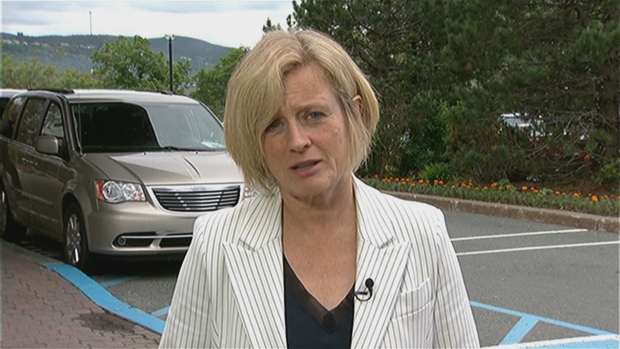
When Brad Wall arrived at the Council of the Federation meeting in St. John’s, N.L. in July 2015, he wasted no time telling reporters what he thought about the proposed national energy strategy.
The strategy, a pet project of Alberta Premier Rachel Notley, was designed to support common energy interests between the provinces and address climate change.
But it irritated Wall, who said it treated the oil and gas industry as an “afterthought.”
The Council of the Federation meeting was Notley’s launch on the national stage, and marked the first time she and Wall came face-to-face as leaders of their respective provinces.
Notley’s upset election win two months earlier had left Wall as the lone conservative premier in the West, squeezed by NDP governments in Manitoba and Alberta.
Now, after 10 years as Saskatchewan premier, Wall is stepping aside. His Saskatchewan Party will choose a new leader this weekend. The winner will be sworn in as premier a few days later.
Since Notley was elected, the two have had an acrimonious relationship marked by a litany of trade irritants.
With Wall’s departure looming, Notley and Wall have offered each other parting shots.
Wall’s successor should “reconsider the approach they’ve taken up ’til now, because one province is making its way out of a recession and one is not,” Notley said this month during a visit to a Calgary microbrewery.
“One province is adding tens of thousands of new jobs; one province is losing jobs,” she said.
Wall told reporters his advice to his successor will be to not listen to an NDP premier who imposed a carbon tax on her oil-dependent economy and is presiding over an annual $10 billion deficit.
Tense talk from outset
At times during the premier’s meeting in St.John’s discussions were tense and divisive, with Wall dismissing the approach to a national energy strategy as an “embarrassment.”
Wall’s frustration, he said at the time, was with a general reticence by politicians and the public at large to acknowledge the benefits reaped from the oil and gas sectors.
“But my point coming into this meeting, is what I would like — and not just from a document but from all of us as Canadians — is to reflect on the fact that we have this great resource,” Wall said in St. John’s.
“It employs people, it funds social programs, it pays for equalization and it’s OK for us to say oil and gas is a good thing.”
Since Alberta Premier Rachel Notley and Saskatchewan Premier Brad Wall met face to face for the first time as provincial leaders in 2015, the relationship between the two hasn’t gone well. (CBC)
Notley clearly had Wall in mind when she cast the performance as “showboating.”
“I sort of think those mature, longstanding, responsive, collaborative relationships are the way to ensure you have good but sometimes difficult discussions, but ones where you can keep the dialogue going and hopefully reach good outcomes,” Notley said during an interview with CBC News.
Friction along the border
And from that point on, it appeared, the relationship between the Alberta and Saskatchewan premiers was set.
There was collaboration between Alberta and Saskatchewan when the Canadian Free Trade Agreement was negotiated, but that has been overshadowed by a series of trade disputes.
Wall was caught poaching Calgary energy companies in early 2017 with an offer of incentives to lure them to Saskatchewan.
Notley suggested it was a direct violation of the New West Partnership agreement between British Columbia, Alberta, Saskatchewan and Manitoba, which prohibits subsidies that “entice or assist the relocation of an enterprise from another party.”
Saskatchewan launched and won a trade challenge against Alberta’s incentives for the craft brewing industry. Alberta countered with an appeal; a ruling is expected in February.
Then it seemed, out of nowhere came the December licence-plate dispute, where Saskatchewan imposed a ban on vehicles bearing Alberta licence plates from any government worksites in that province.
The reasons for the ban by Saskatchewan were vague and changing, and the lack of dialogue between the provincial government ministers involved was testament to just how bad relations had become.
Alberta Trade Minister Deron Bilous said his Saskatchewan counterpart wouldn’t take his calls, and between Christmas and the new year there were “crickets.”
The issue wasn’t resolved, but it was dropped by Saskatchewan a day before a trade panel was about to arbitrate the case. It could have resulted in Saskatchewan fined up to $5 million.
Wall popular in Alberta
Through the years, Wall held fundraising dinners in Calgary and at times was characterized as being the most popular politician in Canada.
His name came up on several occasions in the Alberta legislature, most notably on May 27, 2016 .
As Ontario Premier Kathleen Wynne looked on from the Speaker’s gallery during question period, then-Wildrose MLA and finance critic Derek Fildebrandt launched into a tirade against Wynne and her Liberal government.
Fildebrandt chided Wynne’s government on everything from greenhouse gas emissions to racking up “the largest subnational sovereign debt on the planet.”
As Notley tried to answer a question, Fildebrandt shouted, “Invite Premier Wall here! Invite Premier Wall,” to the visible disgust of MLAs on the government side.
Calls for Wall’s invitation grew silent after his government introduced an unpopular budget in March 2017, hiking the provincial sales tax, and reducing services.

Saskatchewan’s long-time premier Brad Wall steps down this weekend. He has enjoyed popularity on both sides of the Alberta-Saskatchewan border. (CBC)
Then it became Notley’s turn to toss Wall’s name around.
She criticized the Saskatchewan budget, saying “That’s not how we believe we should approach things in Alberta,” Notley said of the “very significant tax increase.”
That in turn prompted Wall to shoot back on Twitter — and so it continued.
Not so different, professor says
University of Alberta political science professor Jim Lightbody says even though the premiers may disagree in public, provincial governments are “big beasts” that work together on a range of cross-border issues.
“The premiers do call the shots,” said Lightbody, adding that’s ultimately why the relationship is important.
Lightbody said both Notley and Wall have more in common than they might admit.
He said they are both populists leaders who fight mutual enemies such as banks, railways, climate issues and the central government.
“Maybe they don’t like each other because they are basically grounded by so much of the same,” Lightbody said.