Jasper trying to slow down 'mass attack' from mountain pine beetle
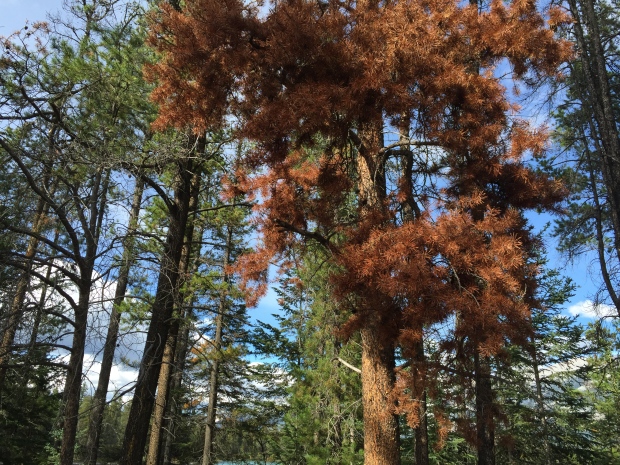
Faced with increasing losses of millions of trees being killed by the dramatic spread of the mountain pine beetle, Jasper National Park has come up with a new plan to halt the beetle’s infestation.
A new management plan was released July 22 after a tripling of the beetle’s population in the park over the past two years.
“I’m astounded at how quickly and rapidly the beetle has affected the pine forest through these valleys,” said Keith McClain, the program lead for the mountain pine beetle ecology program at the Foothills research institute in Hinton.
‘I’m astounded at how quickly and rapidly the beetle has affected the pine forest through these valleys.’ – Keith McClain
Just a couple of years ago park officials were only counting individual trees that had been attacked by the beetle. The insect causes its devastation by burrowing under the tree bark and stops the flow of nutrients.
Parks Canada believes large swaths of the forest have been affected with an estimated 21,568 hectares of lodgepole pines killed by its invasion.
“Jasper is facing a change in the landscape from nice green pine stands to red pine stands,” said McClain. The pines turn red after they have succumbed to the beetles onslaught.
Parks Canada confirms affected areas include trees in the Miette River Valley corridor along Highway 16 west of the townsite.
The tree shows all the signs of being attacked by the mountain pine beetle. Females burrow into the living parts of the tree to lay eggs stopping the flow of nutrients from the root system. (Gareth Hampshire CBC News)
‘Mass Attack’
Trees along Maligne Lake Road and areas south of Jasper along the Icefields Parkway have also been under attack from the beetle.
McClain, whose institute is researching and attempting to understand the ecology of the beetle in Alberta, describes the pest’s spread in Jasper as a “mass attack,” and an “epidemic.”
He says temperature plays a role, as warm winters means fewer beetles are killed off in the cold.
To slow the spread of the beetle, Parks Canada has unveiled a plan that will use a number of approaches in working alongside the province of Alberta and the town of Jasper.
It includes doing prescribed burns as well as cutting down swaths of trees in an attempt to take away the beetles food source.

The red patches in the valley indicate the presence of the mountain pine beetle that Parks Canada says has covered approximately 21,568 hectares in Jasper National Park. (Gareth Hampshire CBC News)
The beetle is considered to be a naturally occurring species, but the park sees intervention as a measured approach which is necessary in the circumstances.
“I’d sum it up as a reasonable response to a very difficult situation,” said Salman Rasheed, the Resource Conservation Manager for Jasper National Park.
‘Mountain pine beetle is a tremendous challenge. It is rampant throughout British Columbia and Alberta now.’ – Salman Rasheed
“Mountain pine beetle is a tremendous challenge. It is rampant throughout British Columbia and Alberta now,” said Rasheed.
He said the response Parks Canada is taking is needed for several key reasons, this includes keeping the park safe for both tourists as well as people who live in Jasper.
Rasheed explains a beetle infestation of this magnitude results in a lot more standing dead trees. These trees are more susceptible to other insect species as well as storms possibly knocking them over.
‘We’re doing what we can’
In addition to the danger posed to tourists, Rasheed said there’s an increased risk of fire. Three areas have been earmarked for prescribed burns of infected trees in Jasper, but an unusually wet summer hase meant they haven’t started yet.
He’s hoping the burns go ahead before theh snow starts coming down, but they can’t go ahead unless conditions are optimal to make sure it’s safe. The scale of the tree cutting measures are still to be determined.
The three-pronged approach is one Rasheed believes will finally slow down the beetle’s advance.
“I’m fairly confident, I mean I think we’re doing what we can, I think the jury is still out (and) we will need some follow up monitoring to assess how effective our actions are.”